Caption: Pictographs from a site at Fort Hunter Liggett, processed with D-stretch imagery. DRI Archaeologists will soon travel to Fort Hunter Liggett, in California, to document rock art in high resolution. Credit: Fort Hunter Liggett.
Las Vegas, Nev. (Nov. 10, 2020) – Long ago, before widespread European-American settlement, ancestors of the Salinan Tribe left rock art featuring colorful handprints and abstract symbols at various sites located along narrow valleys and rugged hills in southern Monterey County, Calif. This month, a group of Desert Research Institute (DRI) archaeologists will document several of these sites using high resolution photography, in partnership with the U.S. Army’s Fort Hunter Liggett Cultural Resources Management Program.
The project, which is co-led by DRI’s Greg Haynes, Ph.D. and Dave Page, M.A., with technical support from staff at Fort Hunter Liggett, will provide updated photographic documentation and a rock art management plan for pictographs (images painted on rock) and petroglyphs (images carved into rock) at eight different sites located on the grounds of Fort Hunter Liggett. One site, called La Cueva Pintada, or the Painted Cave, is estimated to have hundreds of pictographs and is listed on the National Register of Historic Places.
“Many of the pictographs are handprints, but kind of unusual – they look like they were made by people swiping their fingers across the rock face,” Haynes said. “There are also various abstract symbols. They’re multicolored – red, white, black, yellow, and possibly blue or green – so part of our work will be to determine what pigments were used and to advise the Army on how to best preserve them.”
The DRI project team includes Megan Stueve, M.A., who will provide expertise in rock art recording and in the photographic documentation of pictographs using D-stretch imagery, a computer program that helps bring out colors that can’t be seen with the naked eye.
“D-stretch, short for decorrelation stretching, is a type of image processing that essentially stretches or exaggerates the colors to make them easier to see,” Stueve explained. “Images that you can already see become very visible and that those are faint hopefully become more visible.”
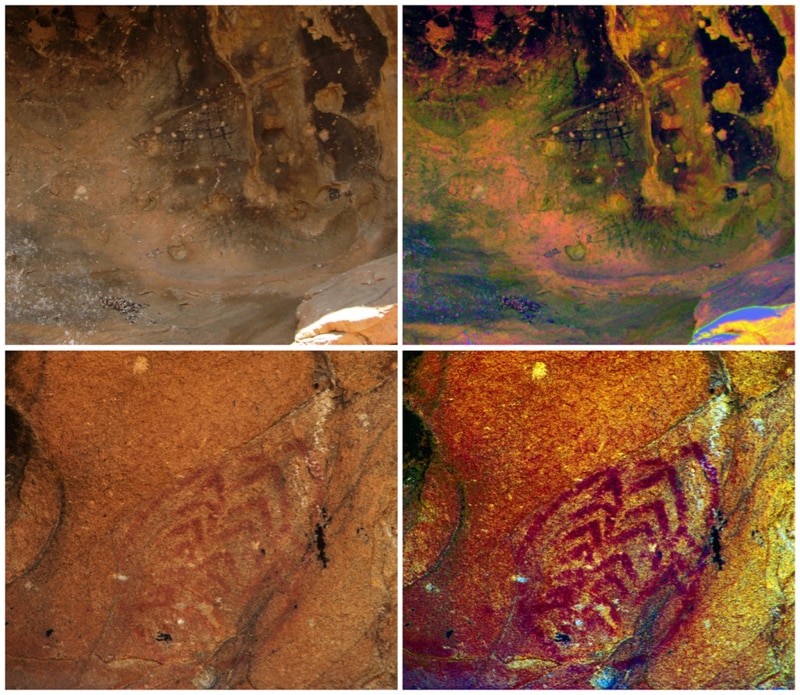
DRI Archaeologists will use D-Stretch imagery to document rock art at Fort Hunter Liggett in high resolution. The photographs on the left, showing pictographs from a site at Fort Hunter Liggett, have not been altered; The photographs on the right, processed with D-stretch imagery, show the pictographs in greater detail. Credit: Fort Hunter Liggett.
In addition to petroglyphs and pictographs, the Salinan people of this region left behind an abundance of bedrock mortars, circular depressions in rock outcrops that were likely used for grinding food items such as acorns, but may also have been used to grind the pigment to make the pictographs. The extensive use of the area might indicate it was used as a habitation locale or meeting area, or possibly for ceremonial purposes, Stueve said.
Although all of the sites that the DRI team will visit have been documented previously, some site records have not been updated in more than 30 years. As part of this project, they will provide Fort Hunter Liggett with up-to-date site records and photographs, and also make recommendations for future study and preservation of these pictographs and petroglyphs.
“The Army wants a management plan for the preservation of these historical resources,” Haynes said. “In addition to these pictographs, there are a few other important historic sites nearby. There’s a mission called Mission San Antonio de Padua that was founded in 1771 by Father Junipero Serra, and a hacienda that was built for William Randolph Hearst. It’s an important area with an interesting history.”
###
The Desert Research Institute (DRI) is a recognized world leader in basic and applied interdisciplinary research. Committed to scientific excellence and integrity, DRI faculty, students, and staff have developed scientific knowledge and innovative technologies in research projects around the globe. Since 1959, DRI’s research has advanced scientific knowledge, supported Nevada’s diversifying economy, provided science-based educational opportunities, and informed policy makers, business leaders, and community members. With campuses in Reno and Las Vegas, DRI serves as the non-profit research arm of the Nevada System of Higher Education. For more information, please visit www.dri.edu.