Join DRI’s Conservation Ecology Lab in Protecting Desert Flora & Fauna

The DRI Conservation Ecology Lab, led by Tiffany Pereira and Tsvetelina Stefanova, helps guide the conservation and restoration of the Southwest’s diverse flora and fauna through basic and applied ecology and collaboration with federal agencies, community non-profits, and more. Central to the Conservation Ecology Lab’s mission to protect desert ecosystems is addressing and educating the public on the detrimental effects of invasive species, particularly on rare and threatened species.
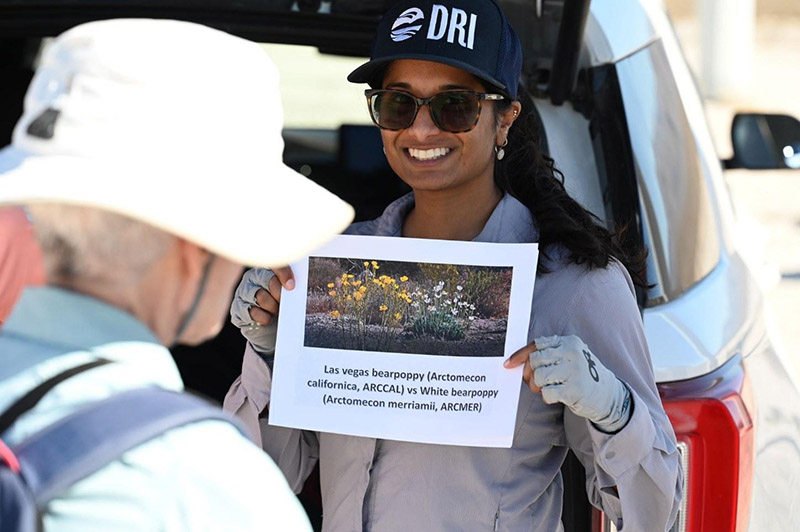
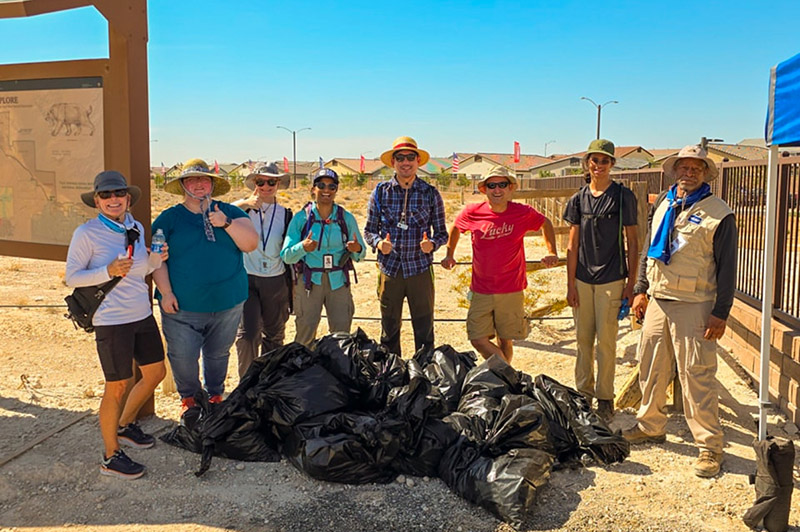
Last year, the Conservation Ecology Lab hosted two public meetups for “Invasive Weed Pulls” at Tule Springs Fossil Beds National Monument in Southern Nevada. This event was planned in conjunction with the nonprofit organization Protectors of Tule Springs and the National Park Service. Volunteers were taught about native ecosystems, the negative effects of invasive weeds, their impact on rare plant species and desert habitat, and the best practices for effective removal. Hundreds of Russian thistle and saltlover plants were removed during these events, preventing thousands of seeds from entering the soil. These invasive species threaten rare plants like the Las Vegas bear poppy and the Las Vegas buckwheat. These events bring awareness to the community and recruit new volunteers for conservation efforts. The Conservation Ecology Lab’s work with Tule Springs Fossil Beds National Monument will continue this year with more volunteer events planned.

Help protect the Southwest’s native flora and fauna from invasive species! Philanthropic support helps the Conservation Ecology Lab procure necessary lab and field supplies, integrate art & science through botanical illustration, and engage and educate the public.

Donate now to support DRI’s Conservation Ecology Lab.

You May Also Like…

Legacy of Education and Community Support Lives On Through Gallifent Endowment at DRI

Legacy of Education and Community Support Lives On Through Gallifent Endowment at DRI

The DRI Foundation is honored to announce that DRI recently received a generous donation from the estate of Elizabeth “Betty” Gallifent for the Betty & John Gallifent endowment. The Gallifent Endowment provides essential unrestricted support to advance DRI strategic priorities, such as the Innovation Research Program (IRP). The IRP provides essential seed funding for early-stage research projects at DRI, allowing DRI scientists to test promising ideas and build the initial data needed to secure larger state and federal grants. We are grateful to Betty and John, as well as Betty’s family, for the Gallifent’s continued generosity to DRI. The Gallifent Endowment will provide essential support to DRI for generations to come.

With Help from Nevada Foundations and Community Partners, DRI is Bringing High-Quality, Hands-On STEM Learning to Nevada’s Schools

With Help from Nevada Foundations and Community Partners, DRI is Bringing High-Quality, Hands-On STEM Learning to Nevada’s Schools

This April, we are celebrating STEAM – science, technology, engineering, art, and mathematics – at DRI. Both the STEM Education Program and Nevada Robotics are dedicated to ensuring that Nevada educators are empowered to bring high-quality, hands-on STEM learning to their classrooms and that every Nevada student has the confidence and skills to thrive in our technology driven world. Community support plays a critical role in helping both programs fulfill their missions.

Remembering the Legacy of Sue Wagner, Long-Time DRI Supporter and Pioneering Woman in Nevada Politics

Remembering the Legacy of Sue Wagner, Long-Time DRI Supporter and Pioneering Woman in Nevada Politics

Sue Wagner built the foundation for state support for DRI. She joined the staff of DRI in 1981 and served as Special Assistant for Government and Legislative Affairs for nine years, and ending when she was elected Lieutenant Governor. One of her major achievements at DRI was shepherding of special legislation through the U.S. Congress to establish the DRI Dandini Research Park. Sue remained active in local and state politics and continued to play a role in supporting promising scientists from DRI and beyond.