In a new pilot study, DRI scientists visited four cannabis growing facilities in Nevada and California to learn about the chemicals that are emitted during the cultivation and processing of cannabis plants, and to evaluate the potential for larger-scale impacts to urban air quality.
At each facility, the team found high levels of strongly-scented airborne chemicals called biogenic volatile organic compounds (BVOCs), which are naturally produced by the cannabis plants during growth and reproduction. At facilities where cannabis oil extraction took place, researchers also found very high levels of butane, a volatile organic compound (VOC) that is used during the oil extraction process.
“The concentrations of BVOCs and butane that we measured inside of these facilities were high enough to be concerning,” explained lead author Vera Samburova, Ph.D., Associate Research Professor of atmospheric science at DRI. “In addition to being potentially hazardous to the workers inside the cannabis growing and processing facilities, these chemicals can contribute to the formation of ground-level ozone if they are released into the outside air.”
Although ozone in the upper atmosphere provides protection from UV rays, ozone at ground-level is a toxic substance that is harmful for humans to breathe. Ozone can be formed when volatile organic compounds (including those from plants, automobile, and industrial sources) combine with nitrogen oxide emissions (often from vehicles or fuel combustion) in the presence of sunlight. All of these ozone ingredients are in ample supply in Nevada’s urban areas, Samburova explained – and that impacts our air quality.
“Here in our region, unfortunately, we already exceed the national air quality standard for ground-level ozone quite a few times per year,” Samburova said. “That’s why it is so important to answer the question of whether emissions from cannabis facilities are having an added impact.”
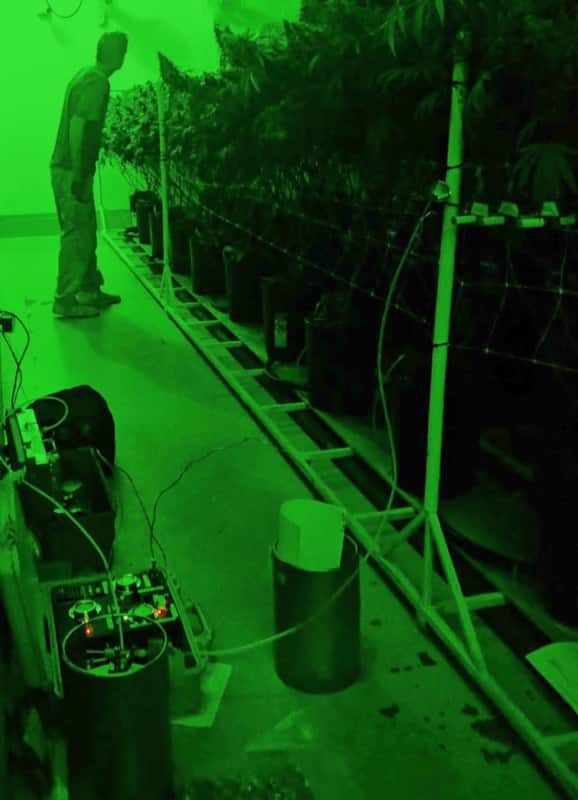
A scientist from the Desert Research Institute measures air quality inside of a cannabis growing facility. Credit: Vera Samburova/DRI. 2019.
At one of the four cannabis growing facilities visited during this study, the team measured emission rates over time, to learn about the ozone-forming potential of each individual plant. The results show that the BVOCs emitted by each cannabis plant could trigger the formation of ground-level (bad) ozone at a rate of approximately 2.6g per plant per day. The significance of this number is yet to be determined, says Samurova, but she and her team feel strongly that their findings have raised questions that warrant further study.
“This really hasn’t been studied before,” Samburova said. “We would like to collect more data on emissions rates of plants at additional facilities. We would like to take more detailed measurements of air quality emissions outside of the facilities, and be able to calculate the actual rate of ozone formation. We are also interested in learning about the health impacts of these emissions on the people who work there.”
The cannabis facility personnel that the DRI research team interacted with during the course of the study were all extremely welcoming, helpful, and interested in doing things right, Samburova noted. Next, she and her team hope to find funding to do a larger study, so that they can provide recommendations to the growing facilities and WCHD on optimum strategies for air pollution control.
“With so much growth in this industry across Nevada and other parts of the United States, it’s becoming really important to understand the impacts to air quality,” said Mike Wolf, Permitting and Enforcement Branch Chief for the WCHD Air Quality Management Division. “When new threats emerge, our mission remains the same: Implement clean air solutions that protect the quality of life for the citizens of Reno, Sparks, and Washoe County. We will continue to work with community partners, like DRI, to accomplish the mission.”
This research was funded by the WCHD and DRI. Members of the DRI team included Vera Samburova, Ph.D., Dave Campbell, M.Sc., William R. Stockwell, Ph.D., and Andrey Khlystov, Ph.D. To view this study online, please visit: https://www.tandfonline.com/doi/full/10.1080/10962247.2019.1654038
###
The Desert Research Institute (DRI) is a recognized world leader in basic and applied interdisciplinary research. Committed to scientific excellence and integrity, DRI faculty, students, and staff have developed scientific knowledge and innovative technologies in research projects around the globe. Since 1959, DRI’s research has advanced scientific knowledge, supported Nevada’s diversifying economy, provided science-based educational opportunities, and informed policy makers, business leaders, and community members. With campuses in Reno and Las Vegas, DRI serves as the non-profit research arm of the Nevada System of Higher Education. For more information, please visit www.dri.edu.
The Washoe County Health District has jurisdiction over all public health matters in Reno, Sparks, and Washoe County through the policy-making Washoe County District Board of Health. The District consists of five divisions: Administrative Health Services, Air Quality Management, Community and Clinical Health Services, Environmental Health Services and Epidemiology & Public Health Preparedness. To learn more, visit Washoe County Health & Safety.