Stone tool assemblage recovered from the Gault Site. Credit: Produced by N Velchoff, The Gault School of Archaeological Research.
Luminescence dating confirms human presence in North America prior to 16 thousand years ago, earlier than previously thought
July 20, 2018 (Reno, NV) – For decades, researchers believed the Western Hemisphere was settled by humans roughly 13,500 years ago, a theory based largely upon the widespread distribution of Clovis artifacts dated to that time. Clovis artifacts are distinctive prehistoric stone tools so named because they were initially found near Clovis, New Mexico, in the 1920s but have since been identified throughout North and South America.
In recent years, though, archaeological evidence has increasingly called into question the idea of “Clovis First.”Now, a study published by a teamincluding DRI’s Kathleen Rodrigues, Ph.D. student, and Amanda Keen-Zebert, Ph.D., associate research professor, has dated a significant assemblage of stone artifacts to 16-20,000 years of age, pushing back the timeline of the first human inhabitants of North America before Clovisby at least 2,500 years.
Significantly, this research identifies a previously unknown, early projectile point technology unrelated to Clovis, which suggests that Clovis technology spread across an already well-established, indigenous population.
“These projectile points are unique. We haven’t found anything else like them,” said Tom Williams, Ph.D., Postdoctoral Research Associate in the Department of Anthropology at Texas State University and lead author of the study. “Combine that with the ages and the fact that it underlies a Clovis component, and the Gault site provides a fantastic opportunity to study the earliest human occupants in the Americas.”
The research team identified the artifacts at the Gault Site in Central Texas, an extensive archaeological site with evidence of continuous human occupation. The presence of Clovis technology at the site is well-documented, but excavations below the deposits containing Clovis artifacts revealed well-stratified sediments containing artifacts distinctly different from Clovis.
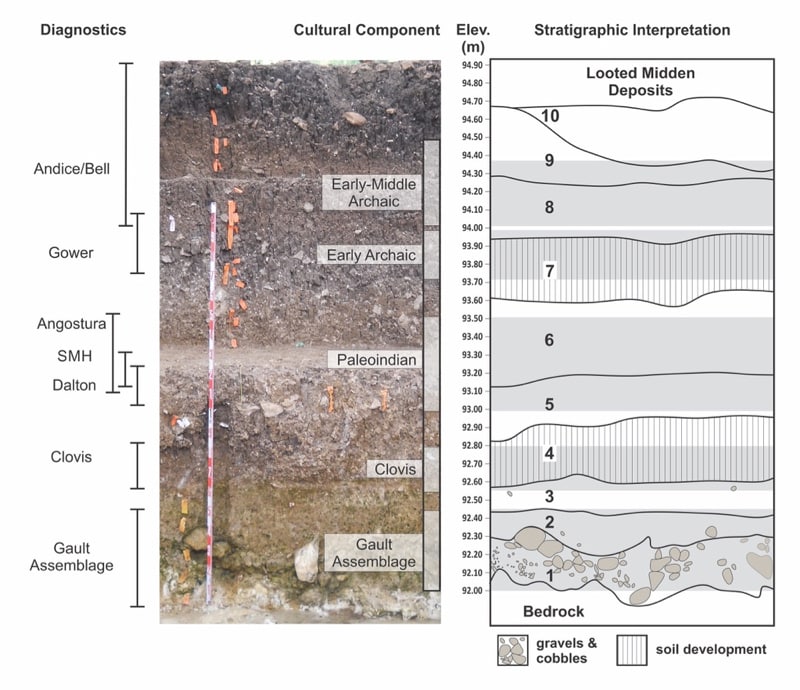
To determine the ages of these artifacts, Rodrigues, Keen-Zebert, and colleagues used a process called optically stimulated luminescence (OSL) dating on the sediments surrounding them. In OSL, researchers expose minerals that have long been buried under sediment layers to light or heat, which causes the minerals to release trapped potassium, uranium, and thorium electrons that have accumulated over time due to exposure to ambient, naturally occurring radiation.When the trapped electrons are released, they emit photons of light which can be measured to determine the amount of time that has elapsed since the materials were last exposed to heat or sunlight.
“The fluvial nature of the sediments deposited at the Gault Site have created a poor environment for preservation of organic materials, so radiocarbon dating has not been a useful technique to apply in this region,” said Kathleen Rodrigues, graduate research assistant in DRI’s Division of Earth and Ecosystem Sciences. “This made luminescence dating a natural choice for dating the archaeological materials here. We are really pleased with the quality of the results that we have achieved.”
The study was published on July 11th in the journal Science Advances and is available here: https://advances.sciencemag.org/content/4/7/eaar5954.
For more information on DRI’s optically stimulated luminescence dating capabilities, visit https://www.dri.edu/luminescence-lab.
Jayme Blaschke of the Texas State University Office of Media Relations contributed to this release.
###
The Desert Research Institute (DRI) is a recognized world leader in investigating the effects of natural and human-induced environmental change and advancing technologies aimed at assessing a changing planet. For more than 50 years DRI research faculty, students, and staff have applied scientific understanding to support the effective management of natural resources while meeting Nevada’s needs for economic diversification and science-based educational opportunities. With campuses in Reno and Las Vegas, DRI serves as the non-profit environmental research arm of the Nevada System of Higher Education. For more information, please visit www.dri.edu.