Brittany Kruger, Ph.D., is a staff research scientist in geobiology with the Division of Hydrologic Sciences at the Desert Research Institute in Las Vegas, NV. She specializes in the study of microbes that live in deep underground environments, such as those found inside of deep mines. Brittany is a Minnesota native, and holds a Ph.D. and Master’s Degree in Water Resources Science from the University of Minnesota, Duluth. Her work has taken her to diverse environments, including Lake Superior, Lake Malawi in Africa, Woods Hole, MA, Japan, and a mile-deep abandoned gold mine in South Dakota. She has been a member of the DRI community since 2014, when she moved to Las Vegas for a position in Dr. Duane Moser’s Environmental Microbiology Lab. In her free time, Brittany enjoys rock climbing in Red Rock Canyon and making trips into the Sierras.
DRI: What do you do here at DRI?
BK: I am a staff scientist here at DRI. I support a number of different projects that focus on deep biosphere life, which essentially means we try and examine life as deep as we can access it underground. Specifically, we look for microbial life and try and understand how those organisms are functioning given the stresses that they encounter deep underground.
DRI: How do you access deep underground environments?
BK: There are a couple different ways you can access the deep biosphere. One way is to actually go there – you can go down in deep mines, for example. In that scenario we can actually bring instruments and equipment down with us. One of our most recently active field sites is an old gold mine in South Dakota, where we are able to go about a mile underground.
Another option to access subsurface life is to use deeply drilled wells that access water or aquifers that are very far underground. This is the approach that we use at active field sites in the Death Valley and Armargosa Valley areas. There aren’t a lot of places in the world where you can access the very hottest, deepest part of the earth quite as easily as we can in this area, because that surface layer of the earth is a little bit thinner here, particularly in the Death Valley region.
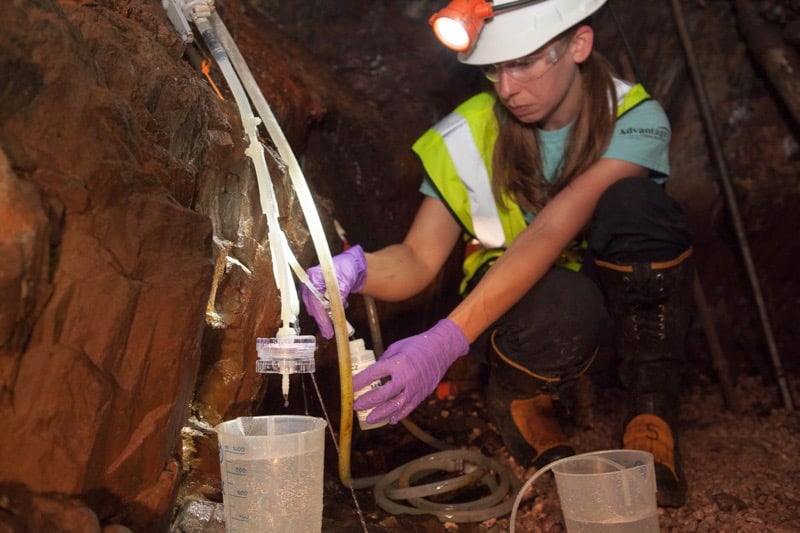
Brittany Kruger collects samples from an underground mine site.
DRI: We understand that some of your research has implications for life on other planets. Can you tell us about that?
BK: One of the projects that I’ve been focusing on since I started here at DRI is the NASA Astrobiology Life Underground Project. I have served as continental fieldwork coordinator for that project since joining DRI. We try to access the deep biosphere in multiple locations to install experimentation and collect samples, and we use what we learn about the way microbes are metabolizing and surviving in those locations to help us understand how life might be functioning on other planets that experience the same or similar stressors, like extreme heat, temperature, pressure, radiation, lack of sunlight, etc.
Right now, we’re installing experiments that focus on better understanding exactly what chemical reactions microbes are using to live in these deep environments. If you think about it, the majority of life that we understand well, the life on the surface of the planet, uses sunlight for energy at some point in their food chain. But these microbes deep underground do not. Instead they’re able to rely on dissolved metals or other compounds to produce the energy they need to live. Sometimes they need to be in actual physical contact with these compounds, and attach to those surfaces to live. It’d be similar to us having to go touch a rusty car in order to breathe. So we’re installing various mineral materials into these deep biosphere environments and studying the microbial populations that colonize them.
As an additional component to that project, we also work closely with members of the SHERLOC instrument team at the NASA Jet Propulsion Laboratory, who are developing an instrument slated to fly on the Mars 2020 Rover that uses Raman and Luminescence scanning to detect organics and chemicals. A lot of the field samples and experiment results are analyzed with that instrument to learn more about our samples and to help provide background data for the instrument prior to its Mars deployment.
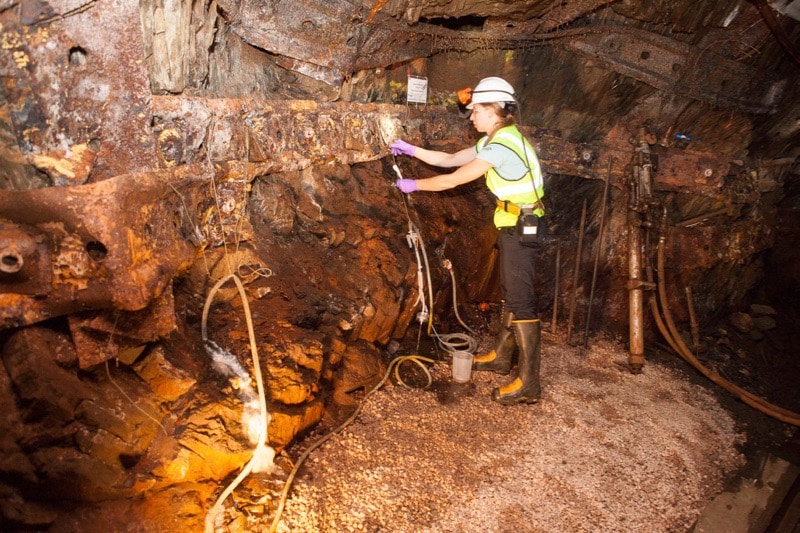
Brittany Kruger collects samples from an underground mine site.
DRI: What is it like to work deep underground?
BK: It’s great. I love it. I’m always excited to go down. It’s absolute pitch black, and it gets hotter the deeper you go. At our hottest underground site, it is something like 90 degrees and 90 percent humidity. It is uncomfortable to be there for a long time, for sure. But the facility we work in does a really good job of trying to mitigate air flow while we’re there to keep that a little more comfortable.
One of the best parts is also spending time with the old miners. I go to South Dakota every few months, and spend multiple days underground accessing our sites in what was once the Homestake Gold Mine. Mining has ceased in the facility, and the entire mine has now been dedicated solely to science and is called the Sanford Underground Research Facility. So it’s a really unique facility where people who previously mined the workings are now employed as underground guides for scientists. There are extremely high-level physics labs located about a mile underground on the deepest accessible level. You’d never know you were underground in those labs; they’re like any state of the art aboveground facility.
But, that’s not where we want to go – we want to go to the far away, dirty, dark, hot places where it’s not maintained and where we can access the unaltered water flowing out of the mine wall. So, we get to hang out with the old miners that know the mine, and know how to access those places and know how to do it safely. So that’s fantastic – we get to see some really exciting things and some really awesome old history. It’s fun.
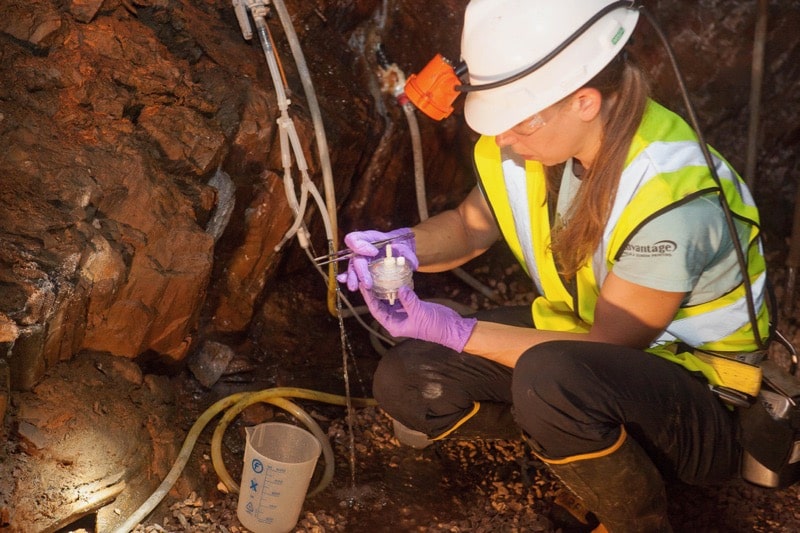
Brittany Kruger collects samples from an underground mine site.