
Trey Flowers, Ph.D., P.E., joined DRI in March as the new Executive Director of the Division of Hydrologic Sciences. He brings a wealth of expertise in hydrology research and water resources management, having previously worked at the National Oceanic and Atmospheric Administration (NOAA), the U.S. Agency for International Development (USAID), the U.S. Environmental Protection Agency (EPA), the Bureau of Indian Affairs (BIA), and Exponent. Immediately before joining DRI, he was leading the Analysis and Prediction Division at the National Weather Service’s Office of Water Prediction in Tuscaloosa, Alabama.
Growing up in Kentucky, Flowers became enamored with environmental sciences and hydrology while spending time hiking, camping, and kayaking in the Daniel Boone National Forest. He completed his bachelor’s degree in civil engineering at the University of Kentucky before coming west to study environmental engineering as a graduate student at the University of California, Berkeley.
In the following interview, Flowers shares some of his proudest accomplishments, why he considers DRI’s biggest challenges to be our greatest opportunities, and his unexpected passion for learning to drive race cars.
DRI: Tell us about your background and what brought you to DRI.
Flowers: Well, my academic expertise is in contaminant fate and transport, and for my dissertation, I studied how perchlorate and other high density salt solutions (brines) move through the environment. After that, I worked for a company in the Bay Area doing primarily litigation support but also had the opportunity to pursue some scientific investigations. I was involved in a project supporting the restoration of the wetlands at the confluence of the Tigris and Euphrates rivers in Iraq. I really enjoyed the international component of the work and working on environmental issues in different countries and geographies. So, when I decided that I was ready to leave that position, I got a job with the U.S. Environmental Protection Agency, with the goal of eventually working for the United Nations Environmental Program (UNEP).
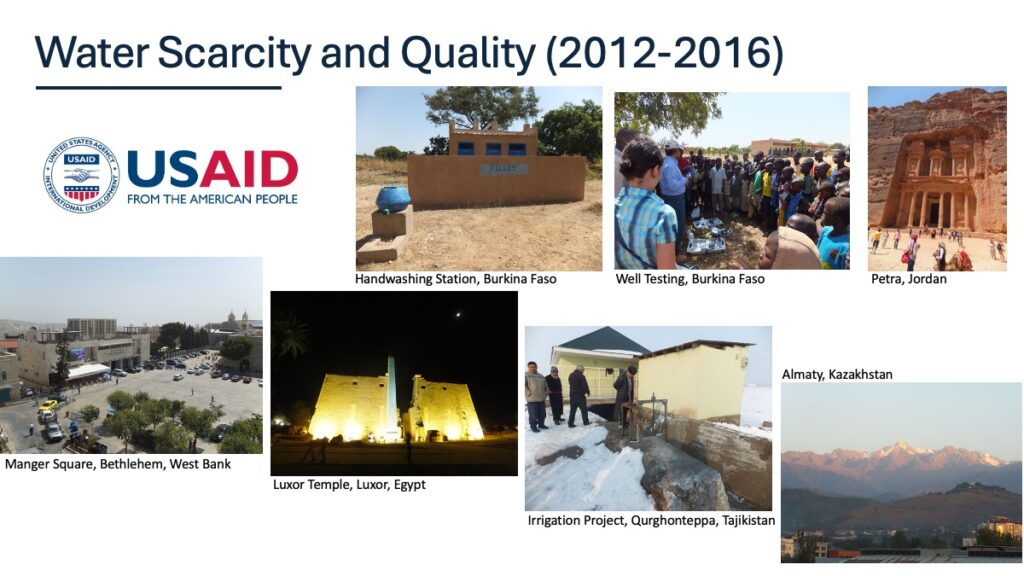
When nothing ever came available at UNEP, I became the first chief for the Water Resources Branch at the Bureau of Indian Affairs, where I worked to help tribes assert and defend their water rights. One day, while riding the bus in DC, somebody sat next to me who worked for the U.S. Agency for International Development. When I told her what I did, she told me that USAID was looking for engineers. I had moved to DC hoping to do international work, so I applied to USAID, was lucky enough to receive an offer, and was there for five years where I got to travel the world supporting water resources projects in developing nations. My niche was water resources in arid environments, particularly how water quality affects beneficial use. I did a lot of work in the Middle East, North Africa, Central Asia, Sub-Saharan Africa, and a little bit in Southeast Asia. After that, I moved to the National Weather Service, where I worked for the last 10 years. I was leading the water resources modeling portfolio; all the freshwater forecast models for the country were developed or supported out of the division that I led. When I got to the point where I was ready for a change, I saw that the Executive Director of the Division of Hydrologic Sciences position was open. Of course, I knew of DRI, had collaborated with a scientist here while I was in graduate school, and have a tremendous amount of respect for the organization. Once again, I got extremely lucky and was offered the position.
DRI: How did you originally become interested in specializing in water resources?
Flowers: I grew up in the Daniel Boone National Forest, and one of my passions as a kid was whitewater rafting. We had a wonderful run from Cumberland Falls down river about 12-miles. I used to do that several times a summer — I just loved water. One of the rapids was called the screaming right turn, and when the water was high, we had to be careful with how we ran it. So, I just became fascinated with water.
I grew up backpacking, hiking all through the woods, and just loved being outside. That started my interest in environmental sciences and engineering. Then, when I went to school in Kentucky, it did not have an environmental sciences program at the time. They had a civil engineering program, and I always wanted to be an engineer. So, I started out in civil with the idea that I would eventually become an environmental engineer and so I did that. But it was growing up playing in the woods, and that deep love of nature and being outside and the rivers and the lakes, that just resonated with me.
DRI: What are some of the big research questions you’re interested in?
Flowers: My background is in water quality and environmental chemistry. I’m an environmental chemist as much as I am an environmental fluid mechanics person, which goes along with studying contaminated transport. So, I’m very interested in the work that DRI is doing on emerging contaminants. The work that Monica Arienzo does with microplastics and snow is just fascinating to me, because it shows how everything in our environment is connected, and how contamination issues that we’re seeing here in Reno will eventually impact communities and ecosystems far downstream.
I’d be a little remiss if I didn’t mention some of the work that has inspired me through the last 10 years, including flash flooding and protecting people from extreme weather events. You know, one of the unfinished things that I left at NOAA was having a good flash flood forecasting model. NOAA does not have one right now, so if you look at NOAA forecasts in flash flood season, it’s all based on rainfall alone, not based at all on hydrologic information and hydrologic intelligence. And there’s a lot of work that needs to be done to create a competent flood watch and warning system that is based on hydrologic intelligence. And then I’m still fascinated by the interplay — particularly in water scarce areas — between how to build water resilience and how to build community resilience to changes in water resources.
DRI: What are some of the projects you’re excited about?
Flowers: Honestly, I haven’t seen or heard of a project at DRI where I didn’t say, ‘Wow, that is really cool. What amazing work you’re doing.’ Everybody that I’ve talked to is doing something really cool that I want to dive right into.
One of the things that I would really like to do is get DRI involved in some of the forecasting model development, like for flash flooding, that I mentioned earlier. I’d like to get us involved in some of the work that my old office was doing, because they have a lot of technical needs and technical challenges they’re facing, particularly on what we call their dry site hydrology. They have a water supply mission that their current modeling suite needs to be developed to support. And we can bring a lot of our expertise in arid land hydrology to help that program.
My role, I think, is focused on enabling the environment for the researchers to be successful. That’s what I enjoy doing more at this point in my career.
DRI: What are some of the opportunities and challenges you foresee with leading DHS in the near future?
Flowers: Diversifying our portfolio, leveraging new sponsors and new partners, developing those relationships, collaborating with people that we haven’t collaborated with before. Our biggest challenge is going to drive us to those opportunities with new people and partners, and that’ll help us be more resilient as an organization.
DRI: What research or work are you most proud of?
Flowers: When I started at NOAA, the National Water Model was in its infancy. It was a bit rushed into operations to meet a requirement from Congress to have an operational system. So, there were some decisions made to deliver it that probably would have been made differently if they’d had more time for the prototype. So, in year three of developing the National Water model, I approached my supervisors about starting over. I made the business case that the modeling suite we were using to develop the National Water model was great for the initial operationalimplementation, but it wouldn’t be sufficient to help us get to where we wanted to be with continental scale water forecasting. So, in early 2020 — right before the pandemic started — we had our first code commit on the new architecture for the National Water Model, and we rolled out full water model capability at a continental scale at the 2024 AGU annual meeting. It was just three and a half years that we that we took to develop it from the first line of code.
So, I’m most proud of that because we looked at the current situation and determined that it was great for what it had done, but it wasn’t going to get us to where we wanted to go. I was able to convince NWS and NOAA leadership that we wanted to take an entirely new approach; they had the courage to take that approach, and we were able to deliver. I’m pretty proud of taking that from conception all the way through to full prototype. It was very much like working for a startup for a long time.
DRI: What do you want your DRI colleagues to know about you?
Flowers: I really want people to know that I’m very approachable, and I want people to come see me, particularly if they’re facing a challenge that they can’t think through on their own. I always tell people I can’t solve problems that I don’t know about. I want people to come see me and come talk to me. You know, I’m a heck of a nice guy, so I don’t ever want the position that I’m in to be a barrier for people to approach me.
DRI: What do you like to do when you’re not working?
Flowers: I love spending time outside with my 12-year-old golden retriever, who I like to call my perpetual puppy. Her name is Asali, which is Swahili for honey.
I would also really like to learn how to drive a race car. I took my first competition driving class on my 49th birthday, and my goal is to have a competition race license before my 60th birthday.
DRI: If you could recommend one book to your colleagues, what would it be?
Flowers: The one that’s really made the most difference for me has been ‘Getting to Yes.’ It teaches you about negotiation and how to solve problems through partnering with somebody, even when you’re in an adversarial situation, rather than seeing that person as an opponent. It’s something that I use every day.