Seeking answers from the ashes
January 20, 2022
RENO, NEV.
By Kelsey Fitzgerald
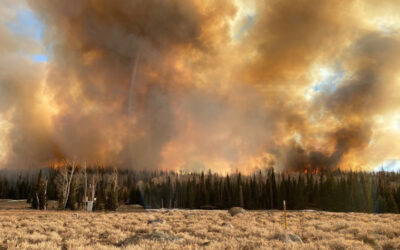
Above: A soil collection field site located within the perimeter of Dixie fire. November 18, 2021.
Credit: Vera Samburova.
DRI scientists study soil dynamics in the wake of Sierra Nevada wildfires
After a wildfire, soils in burned areas become temporarily water-repellent, resulting in increased risk of flooding and erosion in the months that follow. Scientists and land managers have never thoroughly understood why or how this happens – but when last summer’s Dixie, Tamarack, and Caldor fires burned through the Sierra Nevada in close proximity to DRI’s Reno campus, scientists Brad Sion, Ph.D., Vera Samburova, Ph.D., and Markus Berli, Ph.D., jumped into action.
The team, led by Sion, obtained a Rapid Response Research grant from the National Science Foundation for a new project aimed at exploring the impacts of wildfires on physical and chemical properties of burned soils.
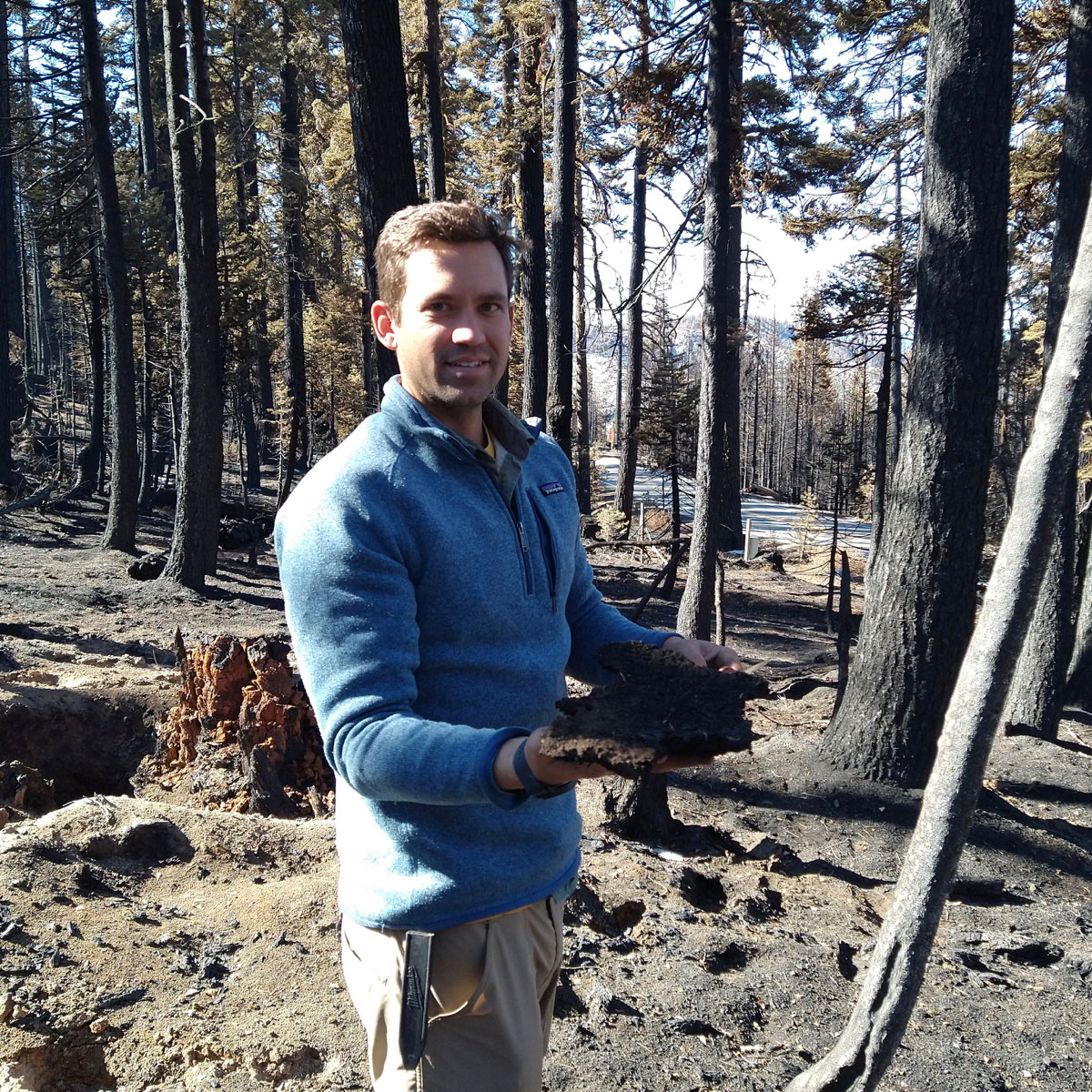
Above, left: Brad Sion, Ph.D., Assistant Research Professor of Geomorphology, holds a frozen chunk of burned soil at a soil sample collection site near Kirkwood in the wake of the Tamarack Fire.
Credit: Vera Samburova.
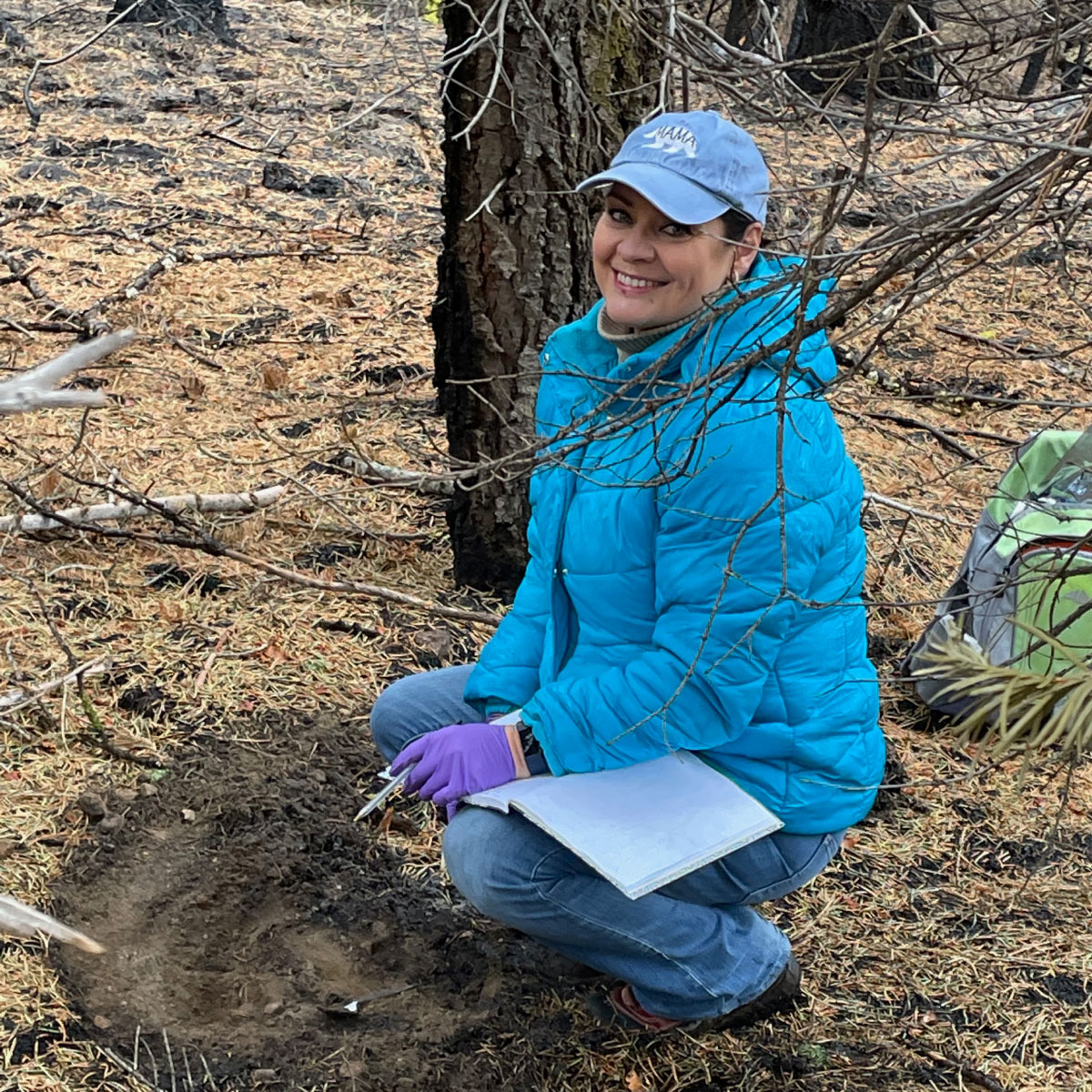
Above, right: Vera Samburova, Ph.D., inspects soils in a burned area near Frenchman Lake that was affected by the Beckwourth Complex Fire.
Credit: Brad Sion.
To collect soil samples before the burned areas were impacted by rain or snowfall, time was of the essence. In October, the team made several trips to nearby fire sites to collect soil samples and to conduct field measurements of soil water repellency.
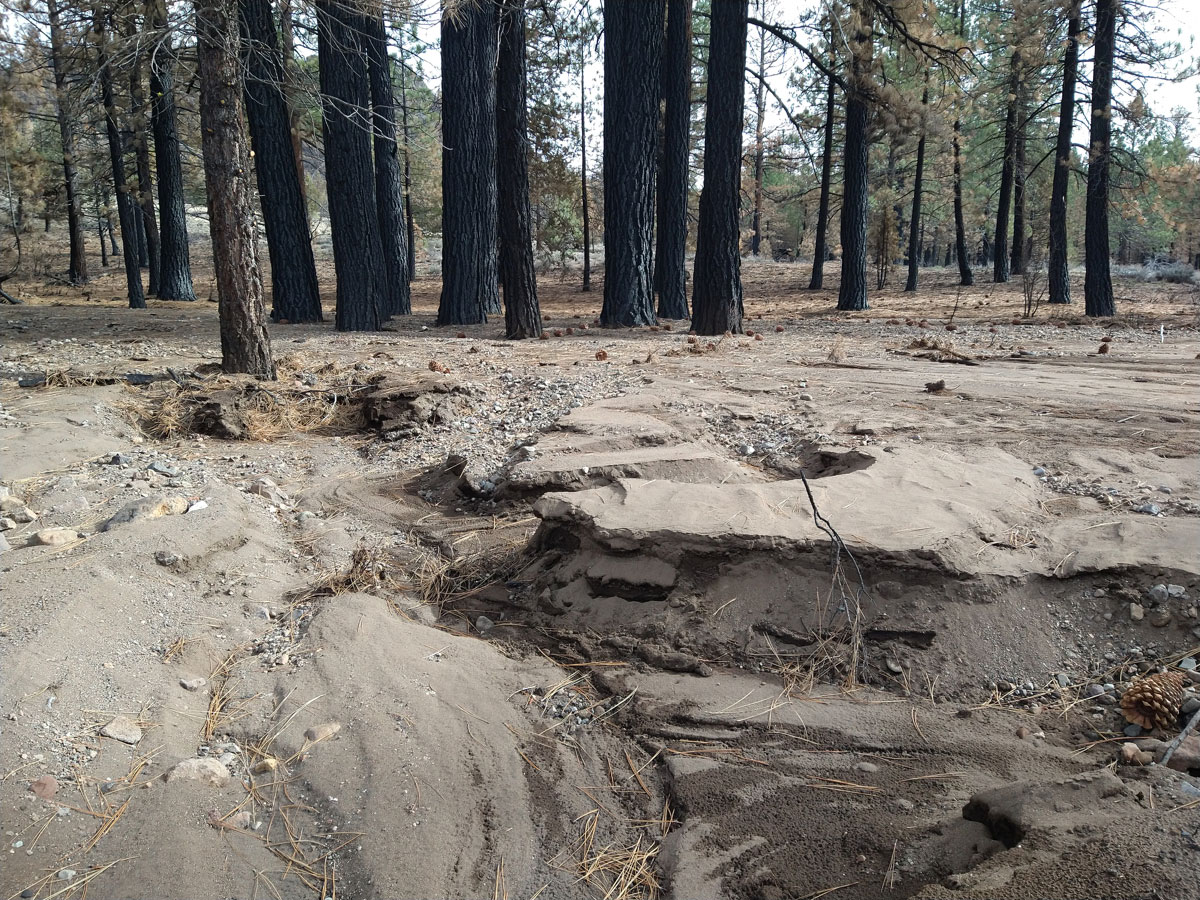
Then, in late October, a major atmospheric river storm came through. The team’s next visit to the fire sites revealed a changed landscape – a real-world example of how wildfires and water repellent soils can impact ecosystems and infrastructure.
“When we first went out into the field, the sites were very dry and ash-covered,” said Samburova. “When we went back out after the atmospheric river storm, we saw lots of mudslides along the roads, and even dirt on top of the road in some places. The soil was very mushy at the surface, but bone dry within centimeters below. And a lot of water was staying on the surface. It was hard to walk on – very slippery.”
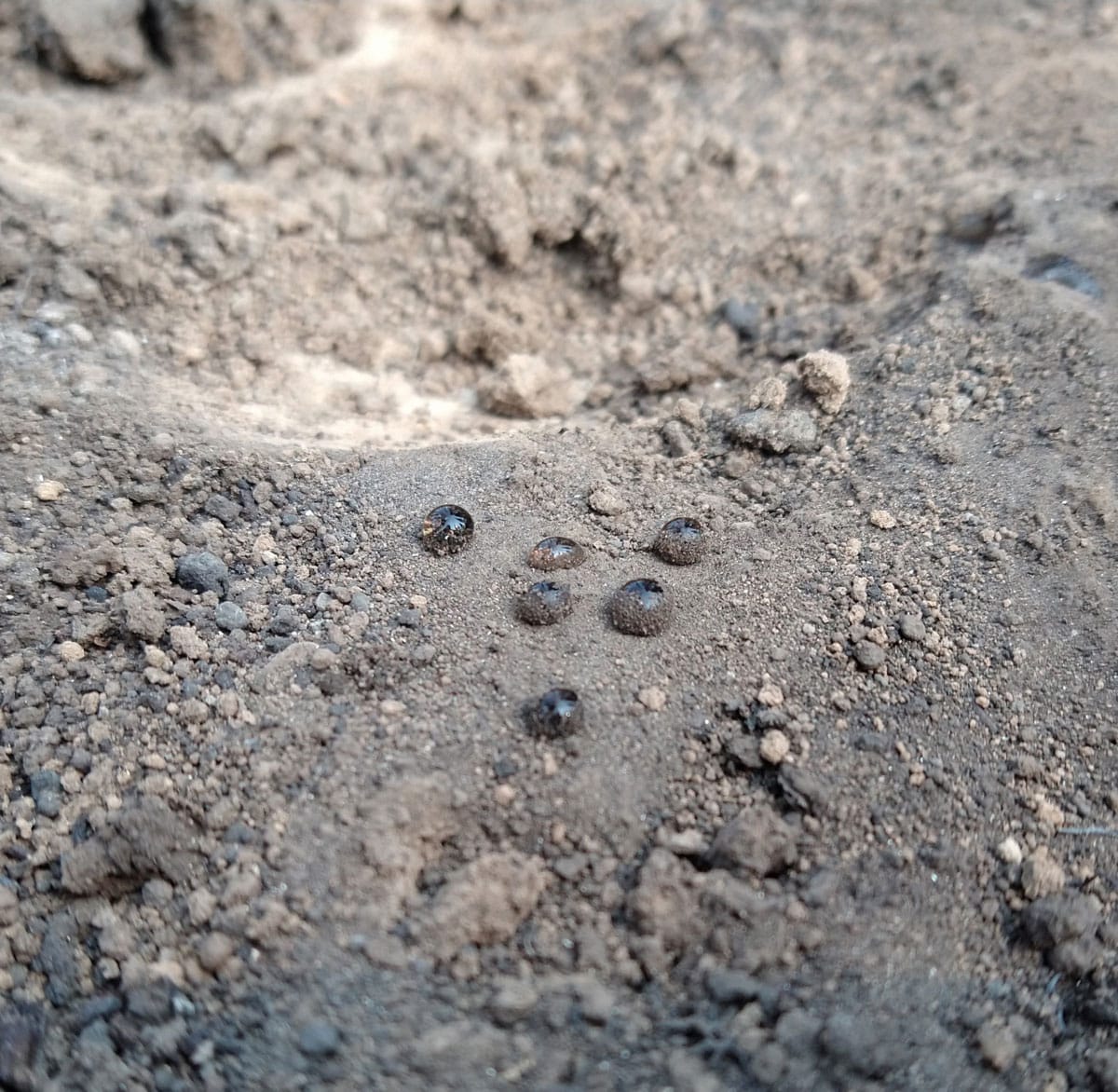
Above, left: The results of a water droplet penetration test on burned soils at the Dixie fire show a high degree of soil water repellency.
Credit: Vera Samburova.
Above, right: After a late October atmospheric river storm passed through the region, researchers observed erosion and mudslides field sites at the Dixie fire.
Credit: Vera Samburova.
An interdisciplinary approach
Although previous studies have examined impacts of fire on soils in a controlled laboratory setting, the new DRI study will be one of the first to investigate changes in soil properties and their interrelationships using samples collected directly from freshly burned forests. This work builds upon earlier research by co-investigators Samburova and Berli, which investigated the impacts of fire smoke on water repellency of sand samples.
The team, which includes experts from all three of DRI’s research divisions, is approaching their research questions from several angles. Sion is leading the effort to measure the hydraulic (water-related) and thermal (heat-related) properties of burned soils. Samburova is analyzing organic compounds found in the burned soil samples, and Berli is conducting tests to assess the degree of soil water repellency.
Together, their results will provide new insight into linkages between fire burn severity, changes in soil thermal and hydraulic properties, and more.
“Our goal is to understand from a basic science perspective, what the cause is for these various soil characteristics pre- and post- fire,” said Sion. “If we can look at different fire conditions and the soil conditions that result, then we can say something about how a soil may respond in the future, and eventually that information can be extrapolated to different landscape settings.”
At present, the researchers have completed sample collection and are analyzing samples in their respective laboratories in Reno and Las Vegas. They plan to return to their field sites next fall to see how the soil water repellency changes over time.
As climate warms and western wildfire activity increases, Sion and his colleagues believe that understanding how forest fires impact soil properties will continue to be a topic of growing importance.
“Climate change and wildfires are not problems that are unique to the Sierras,” Sion said. “Whether you’re in the Pacific Northwest, Canada, Alaska, or elsewhere, you’re seeing increases in fire activity. People are thinking about the landscape responses and what they mean.”

Diana Brown, Staff Research Scientist of Geomorphology, analyzes samples in the Soil Characterization and Quaternary Pedology laboratory in Reno. The soil samples have been saturated with water and contain tensiometers and heat probes to analyze hydraulic and thermal properties of the soil.
Credit: DRI.
Funding for this study is provided by the National Science Foundation (award # 2154013). Additional DRI scientists participating in this project include Hans Moosmüller, Ph.D., Diana Brown, M.S., Chris Baish, M.S., Janelle Bustarde, Palina Bahdanovich, Shelby Inouye, Adam Hackbarth, Zimri Mena and Kendrick Seeber.
###
About DRI
The Desert Research Institute (DRI) is a recognized world leader in basic and applied environmental research. Committed to scientific excellence and integrity, DRI faculty, students who work alongside them, and staff have developed scientific knowledge and innovative technologies in research projects around the globe. Since 1959, DRI’s research has advanced scientific knowledge on topics ranging from humans’ impact on the environment to the environment’s impact on humans. DRI’s impactful science and inspiring solutions support Nevada’s diverse economy, provide science-based educational opportunities, and inform policymakers, business leaders, and community members. With campuses in Las Vegas and Reno, DRI serves as the non-profit research arm of the Nevada System of Higher Education. For more information, please visit www.dri.edu.