Hausner is an assistant research professor with DRI’s Division of Hydrologic Sciences, and specializes in ecohydrology, the study of interactions between water and ecological systems. His research has increased our understanding of how heat and water move through the environment, how climate change and disturbance affect those processes, and how to assess the resultant impacts to various aspects of the hydrologic setting and the ecosystem.
“I am honored to be recognized by the Board of Regents for my work in the field of hydrology,” Hausner said. “I look forward to continuing to explore new questions about how water and ecosystems affect one another throughout my career.”
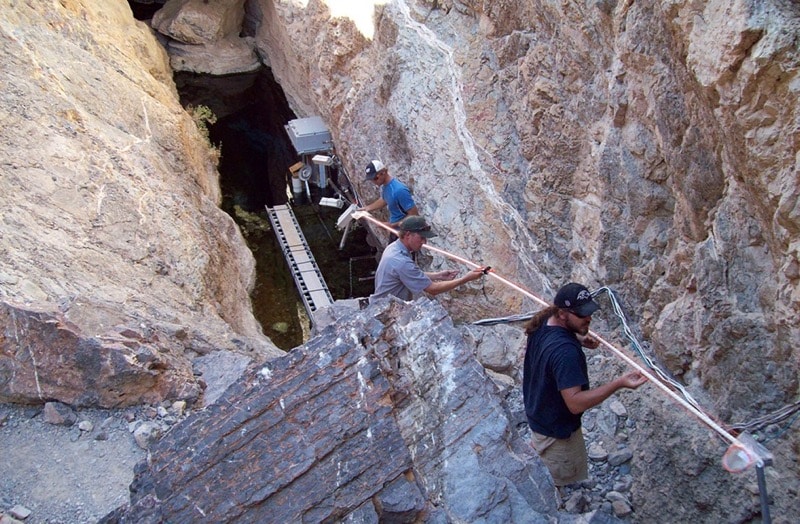
Mark Hausner (right) installs temperature sensors in Devils Hole with researchers from the US National Park Service and US Fish and Wildlife Service. 2010.
Much of Hausner’s recent work focuses on the use of satellite imagery to fill in information gaps about the impacts of human activity on riparian landscapes in the Western US. He has worked extensively on Devils Hole in southern Nevada, a unique geologic formation that provides the only naturally occurring habitat for the endangered Devils Hole Pupfish. Hausner’s other notable projects include studies of groundwater-surface water interactions, as well as applied science support for the US military, US Department of Energy, and resource managers such as the South Tahoe Public Utility District and Tahoe Regional Planning Agency.
Since beginning his career at DRI in 2014, Hausner has given over 60 presentations at national scientific conferences and workshops and published 18 peer reviewed publications to high quality journals such as Groundwater and Water Resources Research. He has successfully developed and funded more than 15 grants and contracts from diverse sources such as the Department of Energy, Oregon Department of Fish and Wildlife, NASA, and the Death Valley Conservancy, a total of more than $938,000 in funded projects.
Hausner holds a B.S. in civil and environmental engineering from Cornell University, and M.S. and Ph.D. degrees in hydrologic sciences and hydrogeology form the University of Nevada, Reno. He joined DRI in 2014 as a postdoctoral fellow, and transitioned to an assistant research professor in 2016.
For more information about Hausner and his work, please visit his directory page.
###
The Desert Research Institute (DRI) is a recognized world leader in basic and applied interdisciplinary research. Committed to scientific excellence and integrity, DRI faculty, students, and staff have developed scientific knowledge and innovative technologies in research projects around the globe. Since 1959, DRI’s research has advanced scientific knowledge, supported Nevada’s diversifying economy, provided science-based educational opportunities, and informed policy makers, business leaders, and community members. With campuses in Reno and Las Vegas, DRI is one of eight institutions in the Nevada System of Higher Education.