Q&A with AGU presenter Christine Albano

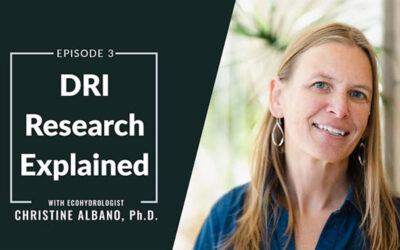
Christine Albano is a hydrologist and graduate student pursuing her Ph.D. She’ll be attending AGU for the first time this year.

DRI: In a couple of sentences, what is the ‘plain English’ summary of what you are presenting at AGU?

Christine Albano: Through our research, we are examining how the nature and magnitude of atmospheric river impacts vary across the western US in terms of contributions to snowpack, soil moisture, and river flows. We further describe the relative roles of atmospheric and land surface conditions during atmospheric river storms in determining how precipitation is partitioned into soil moisture, river flow, and snowpack.

DRI: What are you most looking forward to at AGU this year? What do you hope to learn, or who do you hope to connect with?

CA: This is my first AGU, so I’m looking forward to (and bracing for!) the spectacle of 25,000+ scientists gathering all in one place. I’m also really looking forward to connecting with others from across the country who are working on similar research questions and to the exposure to research topics that I don’t even know exist yet.

DRI: There’s a challenge on Twitter right now for AGU presenters called #HaikuYourResearch that asks scientists to communicate their research in the form of a Haiku, a 3-line poem that uses just 5 syllables in the first line, 7 syllables in the second line, and 5 syllables in the final line. Would you be interested in attempting a haiku about your research?

CA:
Rivers in the sky
Where will the rainwater go?
The VIC model tells

DRI: The theme of this year’s meeting is “What Science Stands For.” From your perspective, what does science stand for?

CA: To me, science stands for the pursuits of truth, understanding, and discovery. It stands for the progress of humankind, understanding the universe in which we live, and our ability to create.

Meet Christine at her AGU poster, “Spatial and Temporal Variability of Atmospheric River Hydrologic Impacts across the Western U.S.,” happening Monday, December 10th during the morning session. (Session H11V-0754 in the program.)

###

This Q&A is part of a series of profiles of DRI scientists who will be participating in the 2018 AGU Fall Meeting, to be held in Washington DC during the week of December 10th. Learn more about this annual meeting of 24,000 scientists from a wide range of disciplines here: https://fallmeeting.agu.org/2018/.
You May Also Like…

DRI’s Monty Majumdar is Working with an International Team of Researchers to Create a Digital Twin of India’s Ganges River Basin

DRI’s Monty Majumdar is Working with an International Team of Researchers to Create a Digital Twin of India’s Ganges River Basin

DRI’s Sayantan (Monty) Majumdar, Assistant Research Professor of Hydrologic Science and Remote Sensing, is joining forces with an international team of researchers to create a digital twin of the entire river basin that will support decision-makers as they work to protect this critical resource. Originally hailing from the river’s fertile lands, Majumdar is now based on DRI’s Reno campus, where he contributes to a wide range of research on water management issues in the Western U.S. As a no-cost Co-Principal Investigator (similar to a volunteer consultant role) on the project, he is excited to contribute the knowledge and models developed by teams like the OpenET project and apply them to India in order to expand their reach and test their efficacy in different climates.

Cloud Seeding for Local Precipitation Enhancement: An Interview With Atmospheric Scientist Frank McDonough

Cloud Seeding for Local Precipitation Enhancement: An Interview With Atmospheric Scientist Frank McDonough

Frank McDonough is a research and forecast meteorologist who leads DRI’s cloud seeding program. His research interests span cloud physics, aviation icing forecasting, and precipitation enhancement.

In this interview, Dr. McDonough answers frequently asked questions about how cloud seeding works and what makes DRI’s program unique. This is the second in a new series of FAQ videos with DRI researchers.

Meet Prakash Gautam 

Meet Prakash Gautam 

Prakash Gautam, Ph.D., is an Assistant Research Professor in the Division of Atmospheric Sciences and the Director of DRI’s Optics Lab: “Gautam Laboratory for Advanced Aerosol Dynamics and Light Scattering Research.” He has been with DRI since August 1, 2022, when he first joined as a Postdoctoral Researcher. Gautam also serves as Graduate Faculty in the Physics and Atmospheric Sciences departments at the University of Nevada, Reno (UNR), where he contributes graduate teaching, mentorship, and research collaboration. His work seeks to understand how atmospheric particles interact with light in order to better understand atmospheric components. 

In the following interview, Gautam shares his dual passions for physics and tennis and offers insight on creating a successful career in science.

Share This