The mystery location of a giant volcanic eruption that caused global cooling in 1831 has finally been solved.
Reno, Nev. (January 2, 2025) – DRI scientists Joe McConnell and Nathan Chellman are co-authors on a new study that sheds light on a historical mystery that has plagued historians and scientists alike for nearly two centuries. Using Arctic ice core records, the team identified the volcano responsible for an enormous eruption in 1831 that caused global cooling of around 1°C, leading to crop failures and famines around the world.
By matching the chemical composition of microscopic pieces of volcanic ash preserved in the ice records with samples collected from the Zavaritskii Volcano, the study identified it as the source of the devastating eruption. The volcano is located on Simushir Island, part of the Kuril Islands that stretch from Russia’s Kamchatka Peninsula to Hokkaido, Japan, along the so-called “Ring of Fire” due to frequent tectonic and volcanic activity. The island chain is a disputed territory between Russia and Japan.
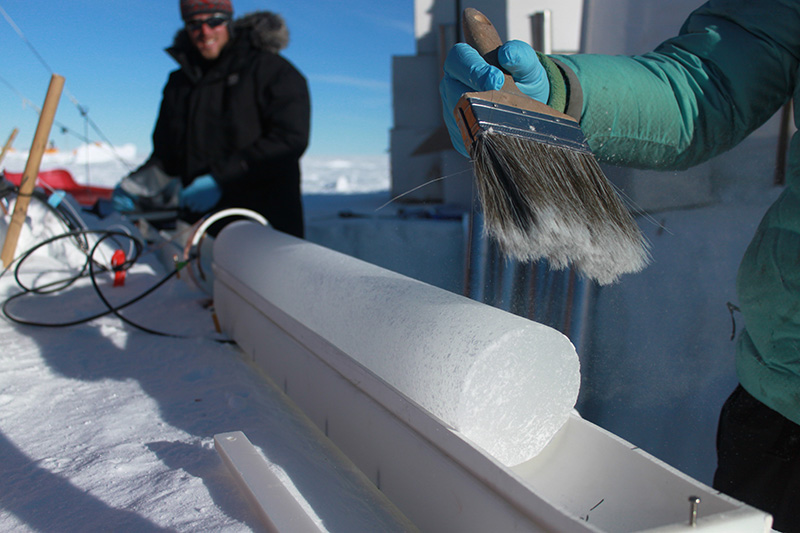
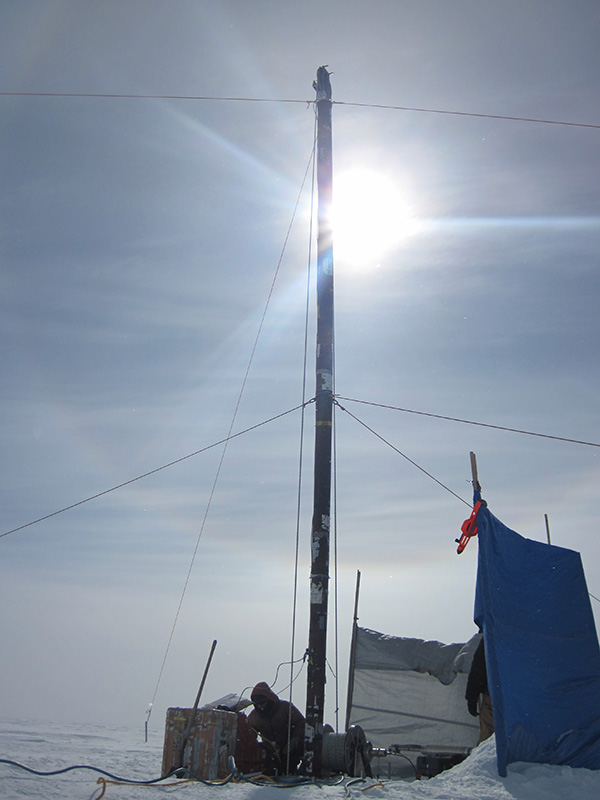
The study was led by the University of St. Andrews and relied on several ice cores collected in Greenland by the DRI ice core team. “Many of the high-resolution chemical measurements in Greenland and Antarctic ice underpinning the study were developed using DRI’s unique continuous ice core analytical system,” says Joe McConnell, Director of DRI’s Trace Chemistry and Ice Core Laboratory. “These included measurements of sulfur and insoluble particles that were crucial for documenting the magnitude of the fallout and pinpointing layers in the ice containing minute volcanic ash particles called tephra.”
Beyond helping to identify the volcano responsible, the DRI equipment also allowed the research team to examine a broader range of elements within the ice that were used to pinpoint the precise season and year of the eruption. “The magnitude, location, and seasonal timing of the eruption are all important for understanding and modeling potential climate impacts,” says Chellman, Assistant Research Professor of Snow and Ice Hydrology at DRI.
Read the full press release from the University of St. Andrews below:
The mystery location of a giant volcanic eruption that has puzzled scientists for almost 200 years has finally been solved, thanks to researchers from the University of St Andrews.
In 1831, a massive volcanic eruption spewed sulphurous gases into the atmosphere, reflecting sunlight and causing a global cooling of approximately 1°C. This cold weather, well-documented worldwide, led to widespread crop failures and devastating famines.
The composer Felix Mendelssohn even wrote about the catastrophic weather during his summer journey through the Alps in 1831: “Desolate weather, it has rained again all night and all morning, it is as cold as in winter, there is already deep snow on the nearest hills…”
The eruption in 1831 is Earth’s most recent “mystery eruption.” While scientists knew it was a major event that caused climatic change and societal upheaval, the identity of the volcano responsible remained unknown and fiercely debated, until now.
New research, led by Dr Will Hutchison from the School of Earth and Environmental Science at the University of St Andrews and published in the journal Proceedings of the National Academy of Sciences (Monday 30 December), reveals how the team analysed ice core records from the 1831 event and identified a “perfect fingerprint match” of the ash deposits.
“Only in recent years have we developed the ability to extract microscopic ash shards from polar ice cores and conduct detailed chemical analyses on them. These shards are incredibly minute, roughly one-tenth the diameter of a human hair,” explained Dr Hutchison.
Dr Hutchison and his team were able to accurately date and match the ice core deposits to Zavaritskii volcano on the remote, uninhabited island of Simushir, part of the Kuril Islands. The islands are a disputed territory between Russia and Japan. Currently controlled by Russia, they operate as a strategic military outpost. During the Cold War, in a plotline reminiscent of a Bond film, the Soviets used Simushir as a secret nuclear submarine base, docking vessels in a flooded volcanic crater.
“We analysed the chemistry of the ice at a very high temporal resolution. This allowed us to pinpoint the precise timing of the eruption to spring-summer 1831, confirm that it was highly explosive, and then extract the tiny shards of ash. Finding the match took a long time and required extensive collaboration with colleagues from Japan and Russia, who sent us samples collected from these remote volcanoes decades ago.
“The moment in the lab when we analysed the two ashes together, one from the volcano and one from the ice core, was a genuine eureka moment. I couldn’t believe the numbers were identical. After this, I spent a lot of time delving into the age and size of the eruption in Kuril records to truly convince myself that the match was real.”
This work highlights the Kuril Islands as a poorly studied yet extremely productive volcanic region.
The volcano responsible for the 1831 eruption was very remote, yet it had a significant global impact on climate and severe consequences for human populations. Identifying the sources of these mystery eruptions is crucial, as it allows scientists to map and monitor the regions on Earth most likely to produce climate-altering volcanic events.
Dr Hutchison added, “There are so many volcanoes like this, which highlights how difficult it will be to predict when or where the next large-magnitude eruption might occur.
“As scientists and as a society, we need to consider how to coordinate an international response when the next large eruption, like the one in 1831, happens.”