Erick Bandala, Ph.D., is an assistant research professor of environmental science with the Division of Hydrologic Sciences at the Desert Research Institute in Las Vegas. Erick specializes in research related to water quality and water treatment, including the use of nanomaterials in developing new water treatment technologies. He is originally from Mexico, and holds a bachelor’s degree in chemical engineering from Veracruz State University, a master’s degree in organic chemistry from Morelos State University, and a Ph.D. in Engineering from the National Autonomous University of Mexico. Erick has been a member of the DRI community since 2016, when he moved to Las Vegas to begin his current job. In his free time, Erick says that he enjoys doing nothing – a passion that is not shared by his wife of nearly 30 years, who enjoys doing many things.
DRI: What do you do here at DRI?
EB: My work here is to develop advanced technologies for water treatment, such as processes that can deal with the pollutants in the water that are not removed by conventional water treatment methods.
DRI: We understand that a lot of your work involves nanomaterials. What are nanomaterials, and how do you use them in your research?
EB: Nanomaterials are materials that are so small that if you compare the size of one of these materials with a basketball, it’s like comparing the size of the basketball with the size of the earth. These nano-sized materials have applications in many different fields.
In my case, what I’m doing with the nanomaterials is using them to promote reactions in the water that can produce chemical species capable of destroying contaminants. Not only to remove the contaminants, but to destroy them from the water.
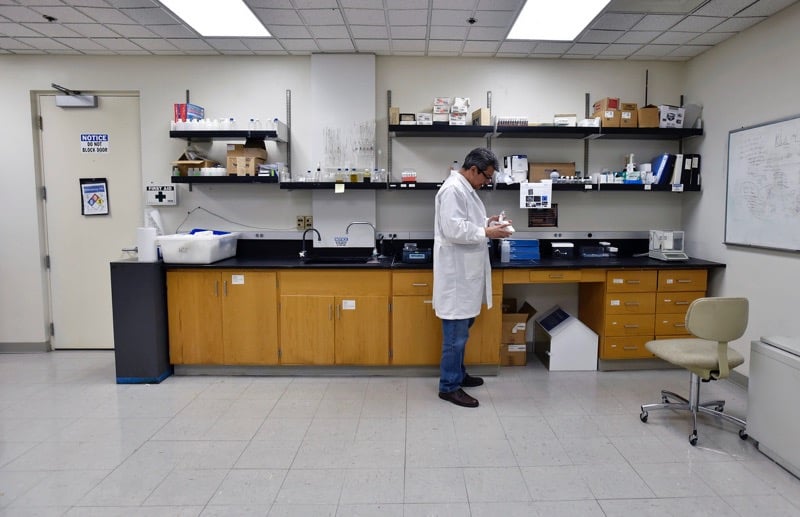
Erick Bandala, Ph.D. at work in DRI’s Environmental Engineering Lab. Credit: Dave Becker, Nevada Momentum.
DRI: What type of contaminants do you hope to remove? Can you tell us about one of your projects?
EB: Right now, we are trying to get nanoparticles made of something called zerovalent iron, which is iron with no charge on it. We are planning to use this to remove antibiotics from water. As you know, we all use antibiotics every now and then. And when you use them, the antibiotics get into your body and you will probably only use about 15 percent of the total amount that is present. Whatever remains is discarded with your feces or urine into the wastewater.
Once the wastewater arrives at the water treatment plant, the conventional water treatment processes will probably not be able to remove the antibiotic. So, the antibiotic passes through the wastewater treatment system and keeps going with the treated effluent. In the case of Las Vegas for example, it goes back to Lake Mead. This is a problem, because we are learning now that bacteria can become resistant to antibiotics just by exposure – and when bacteria in the environment become resistant to the antibiotics, there is no way for people to treat infections.
So, in our work, we hope to use nanoparticles to destroy the contaminants in the wastewater. At the moment we are just running some trials in the lab, but we eventually hope to run the experiment at pilot level to see if we can treat wastewater coming back from plants to the lake, and ensure that we will not have these contaminants going back to our environment.
Another part of my research is on how to use solar energy to remove contaminants from water. This way you can save some money by using an energy source that is common in Nevada, widely available. We have a lot of sunshine here.
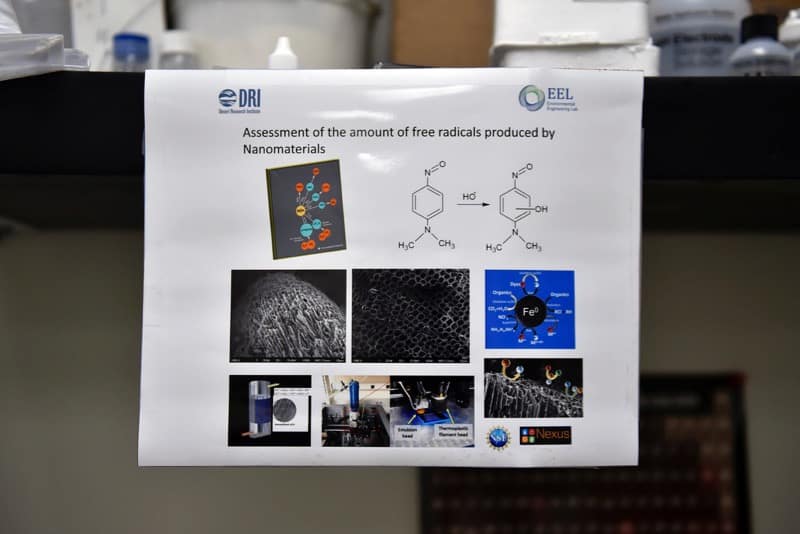
Information about nanomaterials from DRI’s Environmental Engineering Lab. Credit: Dave Becker, Nevada Momentum.
DRI: How did you become interested in working on water treatment and water quality?
EB: My very first job was working in a research institute in Mexico that was devoted entirely to water. The group that I arrived to work with was dealing with water quality and treatment in wastewater and drinking water. So, I started down this path just because it was available and I needed the job – but my plan was to spent two years working on this and now it has been more than 25 years. I feel very passionate about this field of work. I feel like this is the way that I have to try to help people, and I love it.
DRI: You are originally from Mexico. What brought you to DRI?
EB: When the position at DRI opened three years ago, I started learning about the water related issues that Nevada and particularly Las Vegas was facing, and was fascinated. The city gets its water supply from Lake Mead then sends treated wastewater back to the lake — so having almost 100 percent recycling of the water is something that caught my attention immediately. Not only because it’s wonderful, but that it may also result in other problems like the recycling of some pollutants that you probably don’t want in your drinking water. That idea really captured me. So I decided to apply for the job, and have had three years of great fun trying to deal all of those problems and promote some solutions that may help to deal with the reality we’re facing in Las Vegas. Reno is not that different – we all need water when we’re living in places where water resources are so scarce. I was really intrigued by how to deal with all of these problems and how I might help.
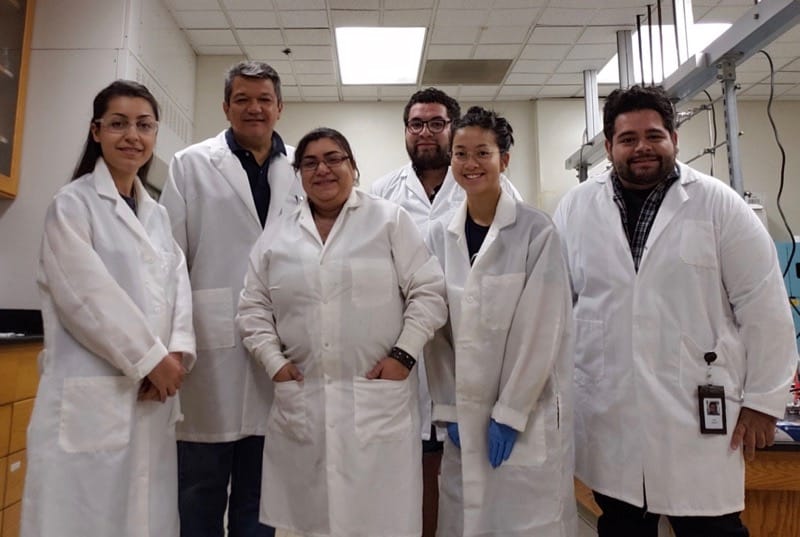
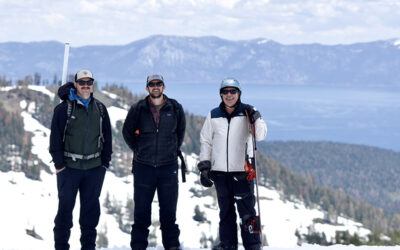
Erick Bandala (second from left) and his colleagues from DRI’s Environmental Engineering Lab.
For more information about Erick and his research, please visit https://www.dri.edu/directory/erick-bandala.