WASH Capacity Building Program Alumni Share Career Impacts
July 28, 2021
RENO, NEV.
By Kelsey Fitzgerald
Water, Sanitation and Hygiene (WASH)
Sustainability
Education
Successful international training program provides education in the field of water, sanitation and hygiene (WASH) and environmental issues.
Alumni from the Desert Research Institute’s WASH Capacity Building Program (WASHCap) recently gathered for an online Zoom panel to share some of the positive impacts that the program has had on their careers in the areas of water, sanitation and hygiene (WASH) across Africa and India.
The WASHCap program is led by DRI’s Center for International Water and Sustainability (CIWAS), in partnership with the University of Nevada, Reno (UNR), Drexel University, and World Vision. Students complete a series of courses on topics related to WASH, some of which are taught online and others in a face-to-face setting in locations such as eSwatini, Ghana and Uganda.
Since launching in 2016, five cohorts of students have graduated from WASHCap program – a total of 133 students from 25 countries. A sixth cohort of 38 students is currently enrolled, and includes for the first time students from Latin America and the Caribbean.
More than 75 WASHCap alumni, friends, colleagues, and students attended the online panel discussion, which featured dynamic and lively dialogue among the current and previous students of the program, and remarks by Margaret Shuler, Senior Vice President of International Programs at World Vision and Jodi Herzik, Interim Vice Provost of Extended Studies at UNR.

WASHCap program alumni Martin Mutisya is currently a program manager for WASH WorldVision in Sudan.
Credit: DRI.
The discussion was moderated by Braimah Apambire, Ph.D., Director of CIWAS at DRI. Several instructors from the WASHCap program including DRI’s Rosemary Carrol, Ph.D., Alan Heyavert, Ph.D., and Erick Bandala, Ph.D., and Drs, Emmanuel Opong, John Akudago and Eleanor Wozei also participated in the discussion, asking program alumni to reflect on ways in which the program has helped them to improve their careers, implement new business plans, understand complex issues related to WASH, network with other professionals, and more.
Martin Mutisya, Program Manager for WASH World Vision Sudan, appreciated the breadth of knowledge that was covered during a course called “Cross-cutting issues in WASH”, which helped him understand issues of gender and social inclusion, and the importance of covering them in WASH plans.
Alexander Pandian from World Vision India said that the WASHCap program helped him to feel more comfortable serving as a technical point person for WASH, and allowed him to help develop the first World Vision country strategy on WASH for India.
Rose Riwa, a hygiene specialist from World Vision in Tanzania, credited the WASHCap program for helping her to understand how WASH integrates with other issues, and for helping her to progress in her career as a leader in WASH in her country.
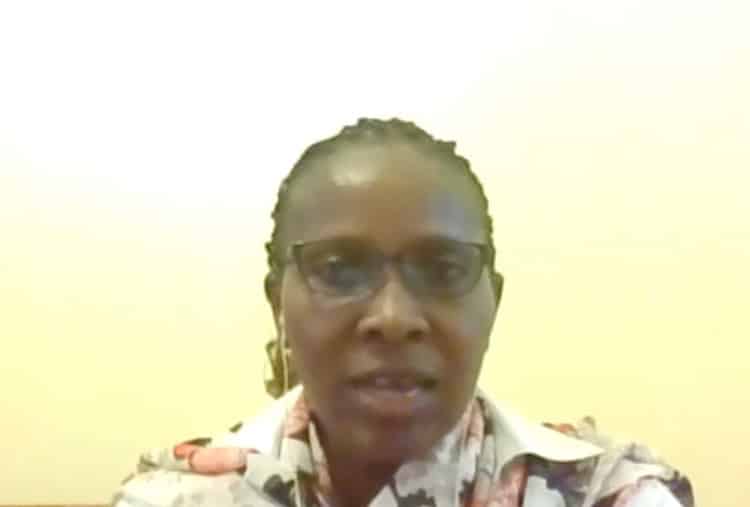
WASHCap program alumni Pamela Wamalwa is currently a program manager for WASH WorldVision in Kenya.
Credit: DRI.
Pamela Wamalwa of World Vision Kenya said that because of the training she received in conducting research and presenting term papers during the WASHCap program, she now feels more comfortable doing research in her job and presenting her findings at professional conferences.
“During the training, I gained a lot of courage,” Wamalwa said. “Before I was not able to present papers, but during the training, I realized that I can actually do research and present in conferences. It was an experience I couldn’t have gotten if I didn’t attend this program.”
Other panelists spoke to the value of the program in building their knowledge, research skills, presentation skills, confidence, and networks within the WASH sector. Many graduates of the WASHCap program have gone on to lead WASH programs and projects across Africa and India, including many who are now employed by World Vision.
“It was very powerful to hear about the positive impact that this program has had on the careers of so many of our graduates, and to be able to share that message with students who are in the program now,” Apambire said.
Additional information:
- For information about CIWAS, please visit: https://www.dri.edu/ciwas
- For information on the WASHCap program, please visit: https://www.dri.edu/ciwas/wash-capacity-building-program/
###
About DRI
The Desert Research Institute (DRI) is a recognized world leader in basic and applied environmental research. Committed to scientific excellence and integrity, DRI faculty, students who work alongside them, and staff have developed scientific knowledge and innovative technologies in research projects around the globe. Since 1959, DRI’s research has advanced scientific knowledge on topics ranging from humans’ impact on the environment to the environment’s impact on humans. DRI’s impactful science and inspiring solutions support Nevada’s diverse economy, provide science-based educational opportunities, and inform policymakers, business leaders, and community members. With campuses in Las Vegas and Reno, DRI serves as the non-profit research arm of the Nevada System of Higher Education.