Native Waters on Arid Lands project featured in World Drought Atlas

By Kelsey Fitzgerald

DRI’s Native Waters on Arid Lands project was recently featured in the 2024 World Drought Atlas, a 175-page hardcover reference book for decision-makers detailing drought impacts and adaptation solutions from around the world.

Published by the European Commission Joint Research Centre and the United Nations Convention to Combat Desertification (UNCCD), the World Drought Atlas was provided to world leaders from 196 countries and the European Union at the sixteenth Conference of the Parties (COP16) to the UNCCD in Riyadh, Saudi Arabia, during December 2024. “The atlas aims to provide decision-makers with a systemic perspective on drought risks and impacts, illustrates how risks are interconnected across sectors and offers guidance on proactive and prospective drought management and adaptation,” said Ibrahim Thiaw,Executive Secretary of UNCCD and Under-Secretary General of the UN, in the book’s forward.

The Drought Atlas provides an overview of our current understanding of what droughts are and how they impact societies at global and regional levels. Native Waters on Arid Lands, which was featured in the book’s “Regional Perspectives” chapter, was selected as a representative example from the Southwestern US. This section describes drought impacts in the Southwest, how Indigenous communities are being impacted, and showcases some of the response actions that the Native Waters team explored.  
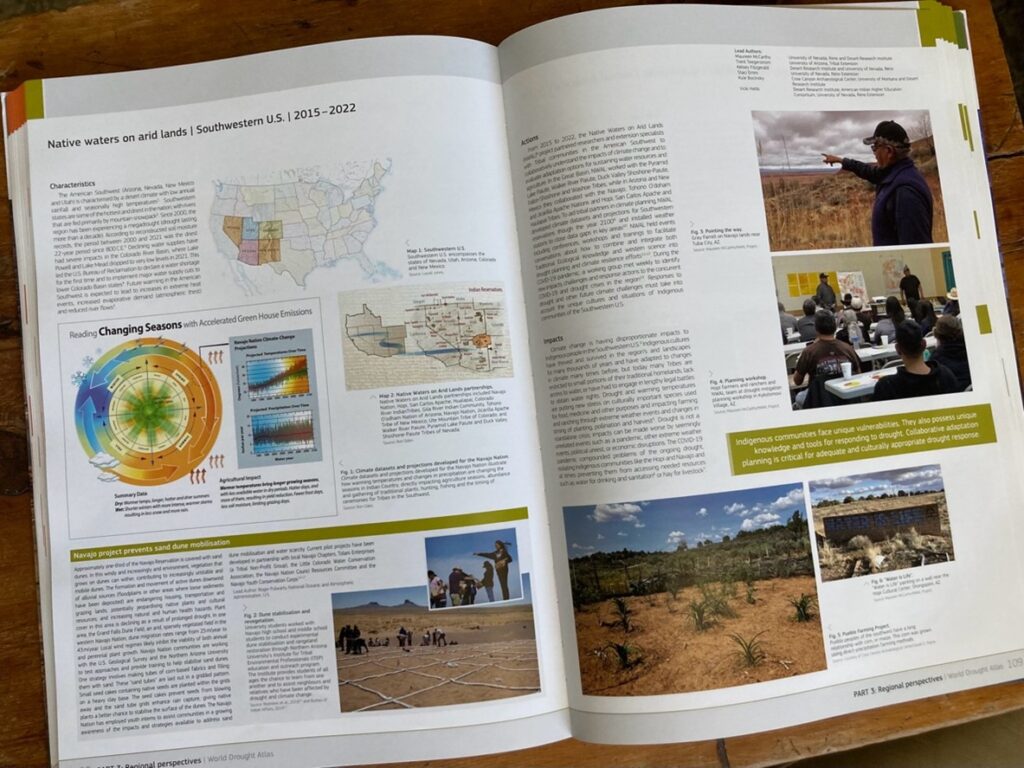
An open book that features information on drought in the Southwest U.S.
A two-page spread in the “Regional Perspectives” chapter of the Drought Atlas features the work of the Native Waters on Arid Lands project in the Southwestern U.S. 

“Our approach brought together Indigenous knowledge and western science to support Native farmers, ranchers, and resource stewards in dealing with drought and other climate impacts,” said Maureen McCarthy, project director of Native Waters on Arid Lands and research professor of environmental science at DRI. “We were thrilled to be featured in the Drought Atlas and to highlight Tribal climate resilience in the Southwest.”

Native Waters on Arid Lands, which was funded by USDA-NIFA (grant no. 2015-69007-23190), partnered researchers and extension specialists with Indigenous communities in the Southwest, Great Basin, and Northern Plains to collaboratively understand the impacts of climate change on water resources and agriculture. Although this project came to a close in 2022, many members of the Native Waters project team continue to support agricultural adaptation efforts in partnership with Native and Indigenous communities of across the West through the work of the Native Resilience project. 

To view the World Drought Atlas online, please visit: https://www.unccd.int/sites/default/files/2024-12/World%20Drought%20Atlas%202024.pdf


You May Also Like…

DRI’s Monty Majumdar is Working with an International Team of Researchers to Create a Digital Twin of India’s Ganges River Basin

DRI’s Monty Majumdar is Working with an International Team of Researchers to Create a Digital Twin of India’s Ganges River Basin

DRI’s Sayantan (Monty) Majumdar, Assistant Research Professor of Hydrologic Science and Remote Sensing, is joining forces with an international team of researchers to create a digital twin of the entire river basin that will support decision-makers as they work to protect this critical resource. Originally hailing from the river’s fertile lands, Majumdar is now based on DRI’s Reno campus, where he contributes to a wide range of research on water management issues in the Western U.S. As a no-cost Co-Principal Investigator (similar to a volunteer consultant role) on the project, he is excited to contribute the knowledge and models developed by teams like the OpenET project and apply them to India in order to expand their reach and test their efficacy in different climates.

Preparing Communities for the Future of Wildfire 

Preparing Communities for the Future of Wildfire 

Last year saw DRI’s inaugural global initiative aimed at advancing community resilience and adaptability in the face of rapid global change – AWE+, for an Adaptable World Environment. The event brought together hundreds of scientific experts, policymakers, resource managers, and other stakeholders to discuss ways to strengthen our communities against the growing threat of wildfires. To maintain momentum on the topic and continue building relationships that advance resilience, DRI’s 2025 AWE+ event sought to build on these conversations, again focusing on wildfire and bringing experts together from across the nation.

DRI Launches Collaborative New Project Investigating PFAS and Microplastics for Department of Defense 

DRI Launches Collaborative New Project Investigating PFAS and Microplastics for Department of Defense 

DRI’s Monica Arienzo, Director of the Microplastics and Environmental Chemistry Laboratory, was recently awarded $250,000 by the Department of Defense to investigate laundering and textile degradation as a possible source of PFAS and microplastic pollution. The one-year grant will fund laboratory studies and analysis led by Arienzo, with DRI’s Daniel Saftner and Yeongkwon Son contributing to the work. Matt Reeves of Western Michigan University is partnering with the DRI scientists for the project.  

Share This