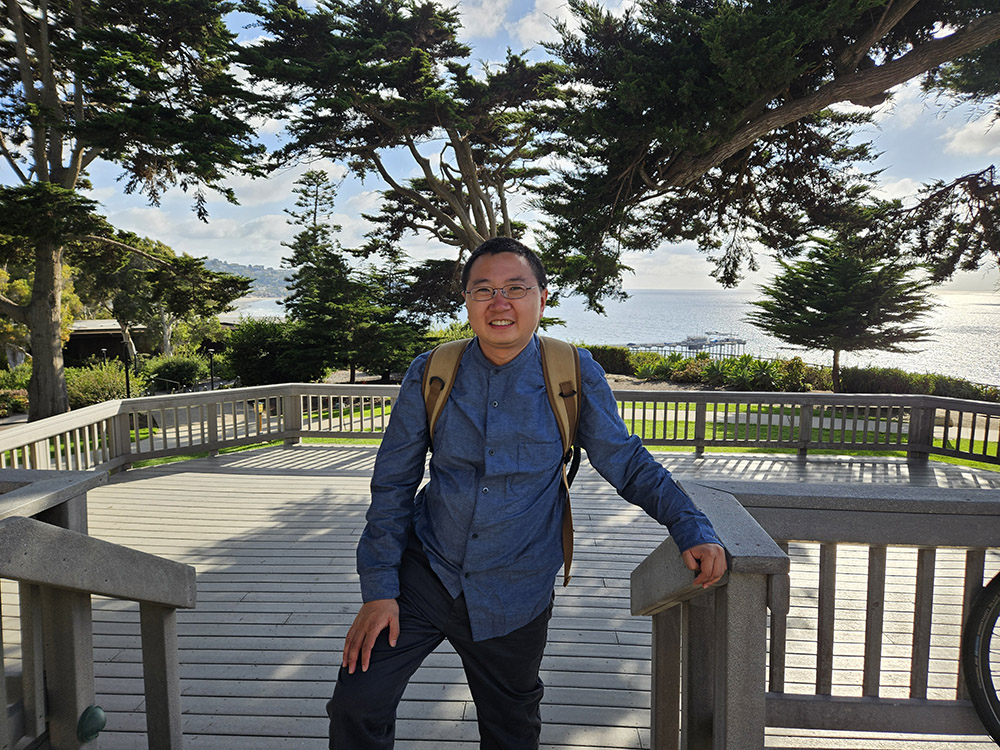
Ziming Ke is an atmospheric scientist who joined DRI in March 2025. He has extensive expertise in earth system modeling and is producing groundbreaking research that integrates wildfire science into global and regional models, including a recent publication that is the first to successfully replicate wildfire-induced thunderstorms in earth system models. He joined DRI as a postdoctoral researcher working with Hans Moosmuller. Ke completed an undergraduate degree in China, a master’s in oceanography at the University of South Carolina, and a Ph.D. in atmospheric physics and chemistry at Georgia Tech.
In the following interview, Ke shares his enthusiasm for wildfire science, spending time in Reno’s wetlands, and watching soccer games.
DRI: Tell us about your background and what brought you to DRI.
Ke: Well, I actually did a master’s degree in oceanography about 10 years ago, but then realized that I was more passionate about atmospheric science, so I made a big shift and switched to atmospheric physics and chemistry for my Ph.D. work. That’s when I began studying wildfires, so I went to the University of Wyoming to work with Professor Xiaohong Liu, one of the best experts in the field of aerosol and cloud dynamics, for my first postdoc. We later moved the entire lab to Texas A&M, so I spent two years in Texas during the pandemic years. My primary project then was improving aerosol modeling for climate models. After that, I had an opportunity to join Lawrence Livermore National Lab in California to work on wildfire models. When my contract there ended, I decided to join DRI this past spring, because DRI has a lot of excellent work on wildfires, dust, and air pollutants. I also think that my global modeling scale can get some synergy at DRI, because I can build on the existing expertise here to contribute more of a regional to global scale modeling perspective.
DRI: How did you become interested in atmospheric modeling?
Ke: It started as a passion for wildfire science, which is a synergy of several disciplines, where the atmosphere, ecosystems, and the land all interface together. I’m really passionate about that, and I feel there is lots of work that can be done in this field.
DRI: What did you want to be when you were a kid?
Ke: I wanted to be scientist. That’s always been my dream. I had no idea what an atmospheric scientist was yet, though. Neither of my parents are scientists, but they have always been very supportive.
DRI: What does your day to day look like?
Ke: I check in with my collaborators at the Pacific Northwest National Lab and do some debugging on our climate model, which focused on the impact of volcanic aerosols on the global climate. I also check in with my collaborator at Texas A&M on model development for a new dust model. And I work on my wildfire modeling project that simulates 2024 Nevada and California wildfires.
DRI: What are some projects you’re working on now?
Ke: My main project is creating a predictive model for wildfires that also evaluates their impact across Nevada’s landscapes. The current phase is focused on better predicting the movement of the fire front as it relates to local response and fire fighter crew safety. The study I published recently, about wildfire-induced thunderstorms, is related to this work, because the lightning generated by these storms can cause new ignitions and make containment very challenging. This is also a very hazardous situation for firefighters, who might be fighting a fire front only to be surrounded by flames if a new fire is started on the other side of them.
DRI: What are you most excited for in your new role?
Ke: I’m excited to work on more local-scale wildfire modeling and to increase collaboration between DRI, fire departments, and land management departments. These collaborations could help us acquire more first-hand data and experience about how wildfires work. I’m also working with Vera Samburova to investigate how wildfires impact soils and how these pollutants would impact air and water quality, as well as land slide risk. We have this amazing wildfire research ecosystem at DRI, not only to study wildfire itself but also their causes and consequences. I’m so grateful to have colleagues here like Hans Moosmuller, Eden Furtak-Cole, Andrey Khlystov, Tim Brown, Prakash Gautam, Vera Samburova, Kabir Rasouli, and Farnaz Hosseinpour with such deep expertise on these topics.
One of my science missions is to improve our understanding of two important aerosol sources, wildfires and dust – dust is the most abundant aerosol in our atmosphere, and wildfire is another important source of aerosols, including black carbon and organic carbon. I want to investigate how dust and wildfire events interact with each other in the atmosphere and improve their integration in Earth system models. I also want to look at how dust and wildfire pollutants are impacting snowpacks in the Sierras and the Arctic region.
DRI: What work or research are you most proud of?
Ke: I’m very proud of my contribution to the Energy Exascale Earth System Model (E3SM model) — a state of the art, global model, led by the Department of Energy (DOE). I developed the new generation of the aerosol module for the model and received the Outstanding Contribution Award earlier this year for my role on the project.
I’m also quite proud of my recently published paper which used the DOE global scale model to look at local scale wildfire events. That allowed me to make the connection between local events that have an impact on the global climate.
I am grateful for DRI’s internal research support, which is enabling me to begin AI-driven wildfire research in 2026, and I look forward to collaborating with Dr. Xiaoliang Wang on pioneering battery-energy-storage fire research to further strengthen DRI’s expertise in emerging fire and energy-infrastructure hazards. I am also grateful for the support and encouragement from DRI DAS Director Dr. Naresh Kumar and DRI Vice President for Research Dr. Vic Etyemezian, whose leadership has been instrumental in enabling the above studies.
DRI: What do you like to do when you’re not working?
Ke: I cherish time with my family, especially with my daughter. She’s already 13 and in four years she will leave home, so this time is important for me. I also like hiking, and Reno is fantastic for this. I love hiking around beautiful Lake Tahoe and the wetlands in south Reno. There are so many birds and they’re a great place to take a walk or go for a bike ride.
DRI: If you could recommend one book to your colleagues, what would it be?
Ke: Lord of the Rings — it’s just a fascinating story. I haven’t read the English version, but the Chinese translation was fantastic. It’s so creative.
DRI: Is there anything else that you want the DRI community to know about you?
Ke: I like watching soccer, and I’m excited for the World Cup games in 2026. It would be great to get a group together to watch some games in Reno or maybe even go to a match in San Francisco! I’d also love to get the community together to watch some UNR games. Let me know if you’re interested!
DRI: Do you have a team?
Ke: I support the Argentina intentional team, and for club teams I like Inter Milan. It’s a team that was founded more than 100 years ago when it branched off from the other Milan-based team, AC Milan, to include players who weren’t Italian citizens. So, it was also kind of a movement.