Maxey Fellowship Supports Graduate Student Water Resources Research

The George Burke Maxey Fellowship, or Maxey Fellowship, was established in 1988 by fourth-generation Nevadan Elizabeth “Betty” West Stout to support research in water resources by a University of Nevada graduate hydrology student. A year later, she was appointed a trustee of the DRI Foundation. Betty Stout was a paleontologist, trustee emerita of the DRI Foundation, and in 1997 she was awarded the DRI President’s Medal. Because of Betty’s significant support, the Stout Conference Center located at DRI’s Northern Nevada Science Center in Reno is named in her honor.  Betty was a friend and colleague of George Burke Maxey, a scientific trailblazer in water resources who completed his career as Executive Director of DRI’s Water Resources Center. The Maxey Fellowship Endowment, which was permanently endowed in 1993 by Betty Stout, recently received support from the Charles H. Stout Foundation, established by Betty’s late husband, Charles “Chick” Stout.

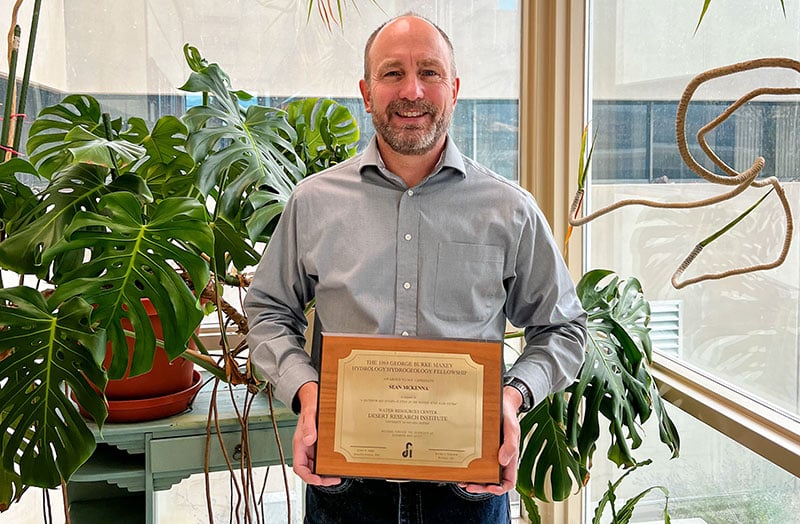
The Maxey Fellowship is a one-year award given to a current or incoming DRI graduate research assistant enrolled either in the University of Nevada, Las Vegas Water Resources Management or University of Nevada, Reno Graduate Program in Hydrologic Sciences pursuing discretionary research in water resources. DRI Executive Director for Hydrologic Sciences Sean McKenna, Ph.D., was the Maxey Fellowship’s second recipient, awarded to him in 1989.

“I was fortunate to meet Betty Stout when I received my award in 1989,” said McKenna. “She was a remarkable woman who believed in the work we were doing at DRI. Because of her generosity, we have been able to provide more than 25 annual fellowships and recruit highly sought-after graduate students from UNR and UNLV to work with DRI faculty.”

Endowments like the George Burke Maxey Fellowship Endowment provide DRI funding in perpetuity. To support DRI’s George Burke Maxey Fellowship Endowment or for more information on how to make a gift to support DRI, please contact Kristin Burgarello, director of advancement, at 775.673.7386 or Kristin.Burgarello@dri.edu.
sean mckenna holds maxey fellowship plaque

You May Also Like…

Remembering the Legacy of Sue Wagner, Long-Time DRI Supporter and Pioneering Woman in Nevada Politics

Remembering the Legacy of Sue Wagner, Long-Time DRI Supporter and Pioneering Woman in Nevada Politics

Sue Wagner built the foundation for state support for DRI. She joined the staff of DRI in 1981 and served as Special Assistant for Government and Legislative Affairs for nine years, and ending when she was elected Lieutenant Governor. One of her major achievements at DRI was shepherding of special legislation through the U.S. Congress to establish the DRI Dandini Research Park. Sue remained active in local and state politics and continued to play a role in supporting promising scientists from DRI and beyond.

Take Charge of Your Estate: DRI Foundation Partners with Community Foundation for 7-Week Series

Take Charge of Your Estate: DRI Foundation Partners with Community Foundation for 7-Week Series

Interested in learning more about estate planning and want to take charge of your estate matters? Sign up for the Family Estate Planning Series, presented by the Community Foundation of Northern Nevada and PBS Reno! The free, in-person 7-week Spring Family Estate Planning Series will take place on Wednesdays, March 18 – April 29, 2026. Each week will feature subject-matter experts as guest speakers and cover the fundamentals of estate planning.

Join DRI’s Conservation Ecology Lab in Protecting Desert Flora & Fauna

Join DRI’s Conservation Ecology Lab in Protecting Desert Flora & Fauna

The DRI Conservation Ecology Lab, led by Tiffany Pereira and Tsvetelina Stefanova, helps guide the conservation and restoration of the Southwest’s diverse flora and fauna through basic and applied ecology and collaboration with federal agencies, community non-profits, and more. Central to the Conservation Ecology Lab’s mission to protect desert ecosystems is addressing and educating the public on the detrimental effects of invasive species, particularly on rare and threatened species.

Share This