Mountain Rain or Snow Project Invites Community Members Around the Country to Contribute Real-Time Weather Observations
Community members across Utah, the Great Basin, and around Lake Erie and Lake Ontario are invited to join people across the country in contributing winter weather observations. The data is collected by scientists for a NASA-funded project that seeks to improve the accuracy of winter weather predictions.
Information collected by community scientists will help researchers from Lynker, DRI, and the University of Nevada, Reno, improve the technology that drives predictions for when precipitation will fall as rain or snow. Currently, satellite technologies struggle to differentiate snow from rain near the freezing point in mountainous regions, with impacts on flood predictions, avalanche forecasting, snowpack water storage, and road safety.
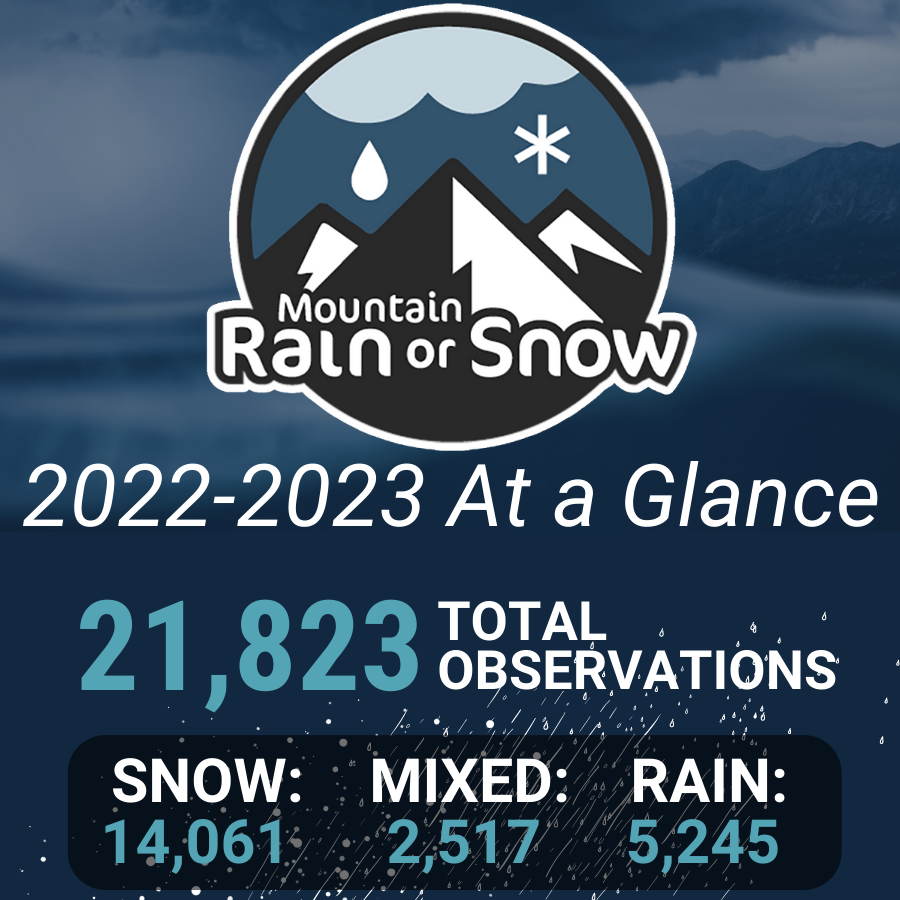
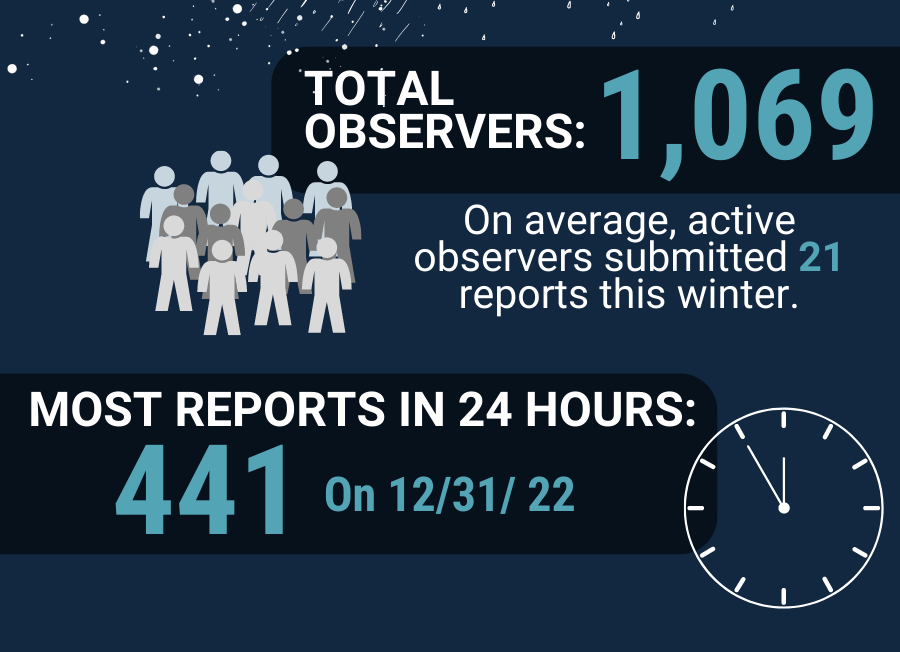
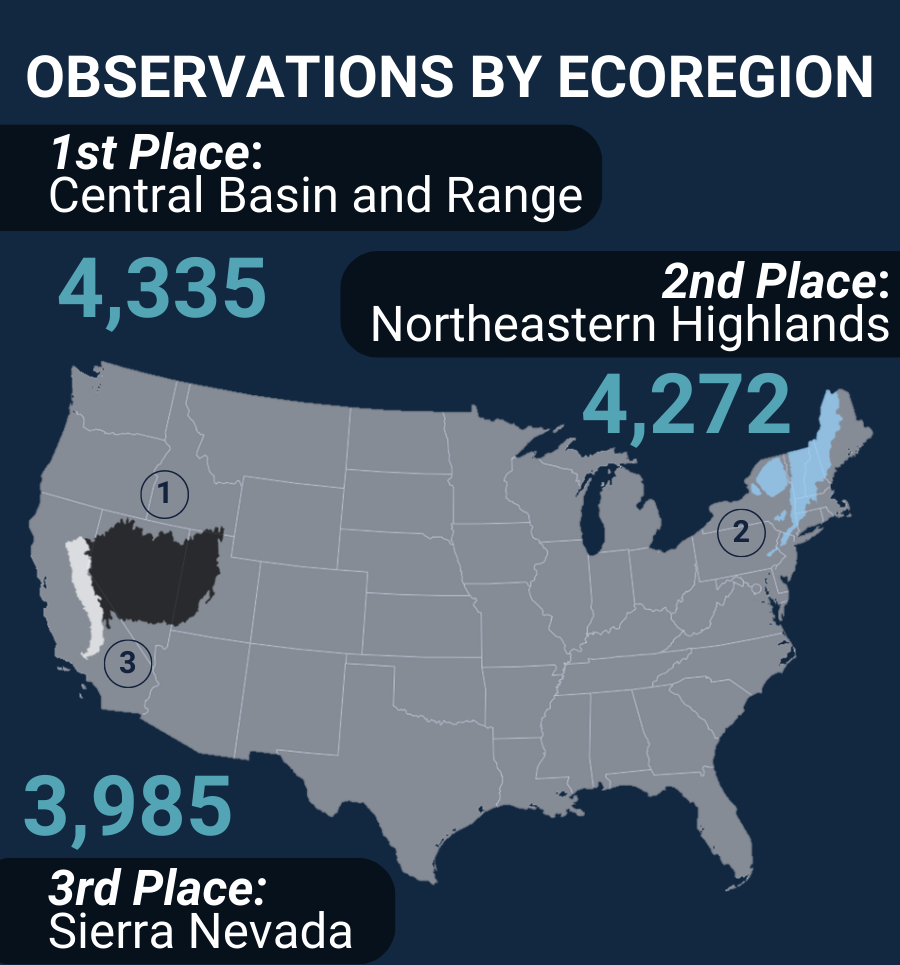
The project began in the Sierra Nevada in 2019 and has since expanded to include mountain regions across the country. Last winter, more than 1,100 people in the Sierra Nevada, Pacific Northwest, Rocky Mountains, Western Montana, and the Northeast submitted over 23,000 real-time reports of rain, snow, or mixed precipitation. Expanding the project to new regions will help improve winter weather predictions that account for regional environmental influences, such as the lake-effect snow of the Great Lake region.
“With the help of community observers, we are amassing a very large database of observations of rain, snow, and mixed precipitation. These will ultimately help to ‘ground-truth’ and improve the predictive technologies that satellites use,” says Meghan Collins, M.S., associate research scientist at DRI. “The data the community observers have helped us collect is a big step towards being able to make those improvements. We understand the state of the problem much better now and will use the next three years to advance the solution.”
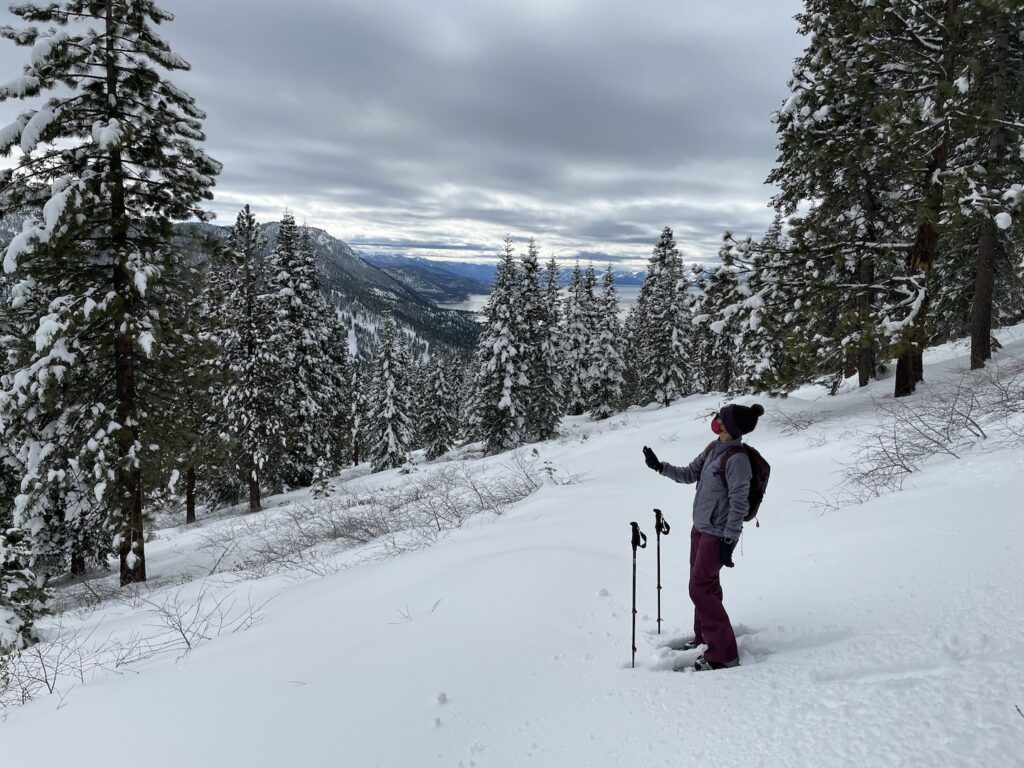
Community members sign up to receive text alerts when storms with predicted temperatures near freezing are in the forecast, and submit observations of the type of precipitation they are seeing. To sign up, observers find the keyword that corresponds to their region at www.rainorsnow.org. Then, text the keyword to 855-909-0798 for guidance on how to participate. Keywords for new focal regions are included below.
- Utah: WASATCH
- Eastern Great Lakes: LakeEffect
- Great Basin: GreatBasin
Mountain Rain or Snow is a collaboration between Lynker, Desert Research Institute, and the University of Nevada-Reno. In addition to the large network of community observers, the project team includes: Keith Jennings of Lynker; Monica Arienzo, Meghan Collins, and Anne Heggli of DRI; Anne Nolin of the University of Nevada, Reno; and several student researchers. The group has expertise in hydroclimatology, hydrology, and geospatial analysis.
###
About Lynker
Lynker delivers innovative solutions to support global environment security and economic prosperity as a trusted partner to governments, communities, industry, and nonprofits. We are a premier science, engineering, and technology company supporting some of the nation’s most important missions from atmosphere to ocean. We are scientists, engineers, conservationists, divers, observers, developers, technologists, educators, outreach specialists, artists, economists, policy specialists, and managers.
About DRI
The Desert Research Institute (DRI) is a recognized world leader in basic and applied environmental research. Committed to scientific excellence and integrity, DRI faculty, students who work alongside them, and staff have developed scientific knowledge and innovative technologies in research projects around the globe. Since 1959, DRI’s research has advanced scientific knowledge on topics ranging from humans’ impact on the environment to the environment’s impact on humans. DRI’s impactful science and inspiring solutions support Nevada’s diverse economy, provide science-based educational opportunities, and inform policymakers, business leaders, and community members. With campuses in Las Vegas and Reno, DRI serves as the non-profit research arm of the Nevada System of Higher Education. For more information, please visit www.dri.edu.
About the University of Nevada, Reno
The University of Nevada, Reno, is a public research university that is committed to the promise of a future powered by knowledge. Nevada’s land-grant university founded in 1874, the University serves 21,000 students. The University is a comprehensive, doctoral university, classified as an R1 institution with very high research activity by the Carnegie Classification of Institutions of Higher Education. Additionally, it has attained the prestigious “Carnegie Engaged” classification, reflecting its student and institutional impact on civic engagement and service, fostered by extensive community and statewide collaborations. More than $800 million in advanced labs, residence halls and facilities has been invested on campus since 2009. It is home to the University of Nevada, Reno School of Medicine and Wolf Pack Athletics, maintains a statewide outreach mission and presence through programs such as the University of Nevada, Reno Extension, Nevada Bureau of Mines and Geology, Small Business Development Center, Nevada Seismological Laboratory, and is part of the Nevada System of Higher Education. Through a commitment to world-improving research, student success and outreach benefiting the communities and businesses of Nevada, the University has impact across the state and around the world. For more information, visit www.unr.edu.
Media Contact:
Elyse DeFranco
Science Writer, DRI
Elyse.defranco@dri.edu
775-673-7336