View of the inside of a cave with large stalactites and stalagmites

NSHE Secures $750,000 NASA EPSCoR Grant for Research into Underground Ecosystems That Could Inform the Search for Life Beyond Earth

The Nevada System of Higher Education (NSHE) has secured a $750,000 grant from NASA’s Established Program to Stimulate Competitive Research (EPSCoR) to study unique underground ecosystems powered by radiation instead of sunlight. The findings could help guide NASA’s search for life beneath the surfaces of Mars and icy worlds elsewhere in the solar system.

A van parked in a mountain landscape.

Keep Tahoe Blue, The Tyre Collective, and DRI launch innovative pilot program to protect Lake Tahoe’s air and water 

Today, Keep Tahoe Blue, The Tyre Collective, and Desert Research Institute (DRI) announced a groundbreaking collaboration with the Emerald Bay Shuttle and its operator, Downtowner, that brings together science, technology, and alternative transportation to protect Lake Tahoe’s world-renowned water clarity.  The pilot program employs The Tyre Collective’s proprietary technology — discrete, compact devices affixed to a vehicle’s undercarriage — to capture harmful tire wear particles directly at the wheel.  

A museum exhibit featuring solar radiation.

DRI, Atomic Museum Launch Free Field Trip Program Titled “Exploring the Invisible” for Grades 6-12

DRI, in partnership with the Atomic Museum, announces an innovative and accessible field trip program titled “Exploring the Invisible: A Hands-On Journey into Radiation Science.” Designed to ignite curiosity in science, technology, engineering and mathematics (STEM) as well as connect students to Nevada’s rich history, the field trip includes free admission and transportation for participants.

Student researchers sorting through microplastics on the beach.

DRI Internships Offer TMCC Students Insight Into Science Careers 

This summer, DRI brought eighteen students from Truckee Meadows Community College (TMCC) to our Reno campus for a paid, immersive research experience. Over the course of the ten week program, students worked under the mentorship of DRI faculty members to learn about the process of using scientific research to solve real-world problems. This unique internship program welcomes all students, not only those pursuing majors in science.  

Buildings and tents in a snowy landscape

Hidden Life Beneath Antarctic Ice: Microbial Diversity and Survival Strategies Revealed in Mercer Subglacial Lake 

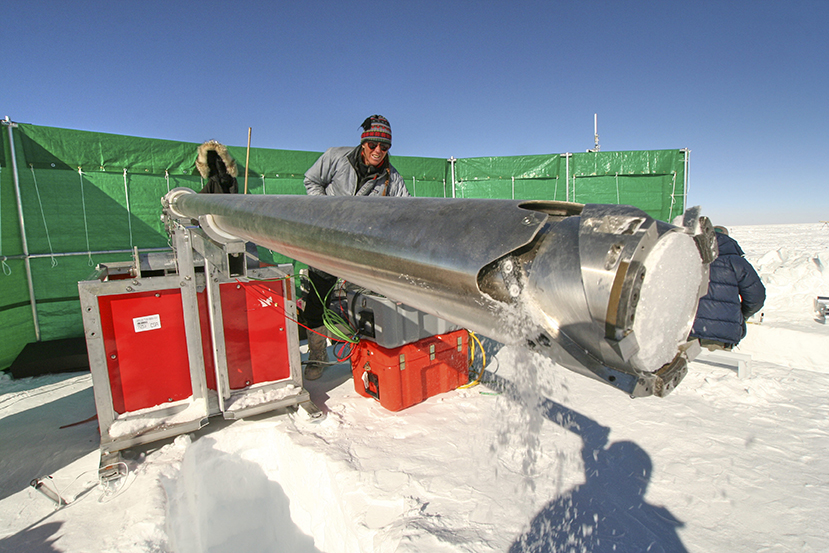
Hundreds of lakes exist beneath the Antarctic ice sheet, and very few have ever been explored by scientists. Now, an international research team has published their findings from an ambitious effort to drill over 1,000 meters into the ice to sample the life hidden in one known as Mercer Subglacial Lake. The project, referred to as the Subglacial Antarctic Lake Scientific Access (SALSA) project, was documented in detail for the film The Lake at the Bottom of the World.  

DRI Contributes to Study Using AI in Wastewater Surveillance for Detection of Emerging Virus Pathogens 

DRI Microbiologist Duane Moser co-authored a new study which introduces an AI-driven approach for the rapid detection and characterization of emerging variants during wastewater surveillance. The research builds on his earlier work helping to establish wastewater monitoring as a cost-effective tool for tracking pathogens during the COVID-19 pandemic. 

Two researchers in orange winter gear stand next to their tent on the side of a snowcapped mountain.

Scientists Find the First Ice Core From the European Alps That Dates Back to the Last Ice Age

The new study, published in the June issue of PNAS Nexus, examines a 40-meter long ice core from Mont Blanc’s Dôme du Goûter. Using radiocarbon dating techniques, the research team found that the glacier provides an intact record of aerosols and climate dating back at least 12,000 years. Aerosols are small droplets and particles in the air such as desert dust, sea salts, sulfur from volcanic eruptions, soot from forest fires, as well as pollutants and other emissions from human activities.

View of side walk in front of Bellagio in Las Vegas with trees lining the right side.

A New, Detailed Analysis of the Benefits and Trade-offs of Urban Street Trees in Las Vegas

Earth is hotter than it has been in 125,000 years, scientists say, and Las Vegas continues to break temperature records. Planting and preserving the city’s street trees is one method that brings many benefits, from the cool air of their shade to their ability to store carbon. Now, a new study takes a deeper look at just how much trees can offer Sin City, as well as the water tradeoffs inherent in growing trees in a desert.