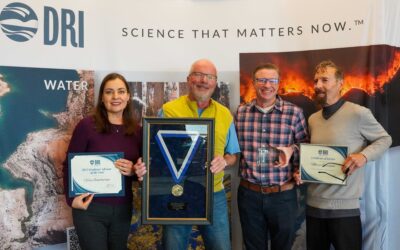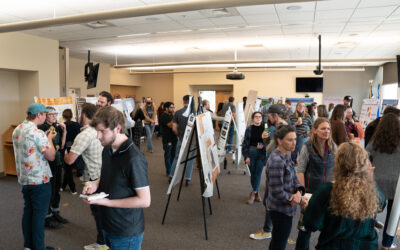
The Nevada System of Higher Education (NSHE) Board of Regents awards Andrey Khlystov, Ph.D., with the 2026 Regents’ Distinguished Career Award and Nathan Chellman, Ph.D., with the Jason Geddes Rising Researcher Award.
DRI scientist Dr. Andrey Khlystov is this year’s recipient of the Regents’ Distinguished Career Award from the Nevada System of Higher Education (NSHE) Board of Regents, in recognition of his significant accomplishments and contributions to the field of atmospheric science.
Dr. Khlystov is a Research Professor in DRI’s Division of Atmospheric Sciences (DAS) and Director of the Organic Analytical Laboratory who has been with DRI since 2014. His career spans fundamental atmospheric chemistry, instrument innovation, and applied environmental health research. A pioneer in developing artifact-free, high-time resolution instruments for aerosol characterization, Dr. Khlystov’s innovations have been commercialized and deployed in air pollution monitoring networks worldwide. His groundbreaking research encompasses electronic cigarette emissions — where his team first demonstrated the link between flavoring compounds and toxic aldehyde production — and wildfire aerosol characterization, including the first quantification of individual compound contributions to light absorption and brown carbon effects on snow albedo.
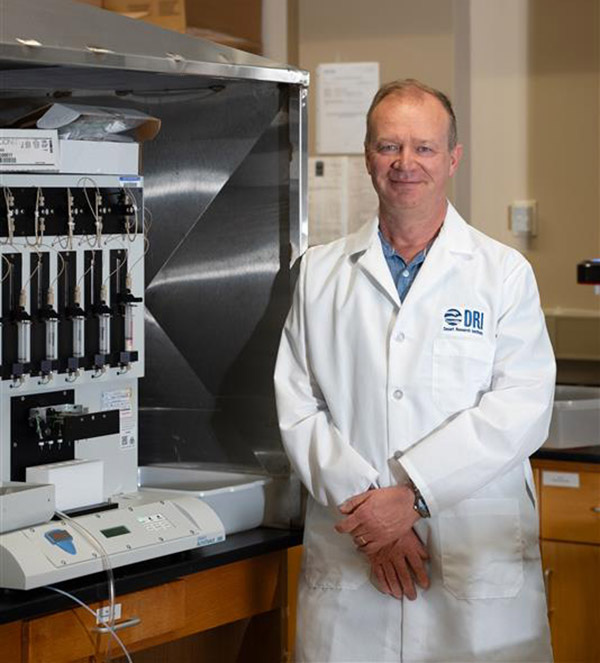
Dr. Khlystov’s wildfire research addresses one of the country’s most pressing environmental challenges. His group was the first to quantify individual compound contributions to light absorption by biomass burning aerosols and their atmospheric transformation. Working with toxicologists, his group demonstrated that wildfire smoke impacts on human lung cells vary by fuel type. His work contributed to the discovery that brown carbon reduces snow albedo, potentially accelerating snowmelt, which has profound implications for Nevada’s water resources and the broader mountain west. This work positions Nevada at the forefront of understanding wildfire impacts on air quality, climate, and public health.
“I am deeply honored to receive this award,” Dr. Khlystov said. “My sincere gratitude goes to my colleagues at DRI whose exceptional contributions and collaborative spirit were instrumental in the research that led to this recognition. I look forward to continuing and growing such partnerships in the future.”
Throughout his career, Dr. Khlystov has garnered numerous honors including the DRI Science Medal (2023), NSF CAREER Award, and invitations to deliver keynote addresses at international conferences. He is an editorial board member for leading journals, such as Toxics and Atmosphere, and regularly serves as a reviewer for the NSF Major Research Instrumentation and NSF Mid-range Infrastructure programs. His commitment to Nevada’s academic mission extends beyond research to extensive service on DRI committees and the Faculty Senate, teaching in the Atmospheric Sciences Graduate Program since 2016, and mentoring over 20 graduate students and postdocs, many of whom have gone on to receive prestigious awards.
“Dr. Khlystov exemplifies the excellence and impact that the NSHE Regents’ Researcher Award recognizes, combining groundbreaking research achievements with dedicated mentorship and substantial contributions to Nevada’s academic community,” said Naresh Kumar, Ph.D., Executive Director of DRI’s Division of Atmospheric Sciences. “His work has not only advanced scientific understanding but has also elevated Nevada’s international profile in atmospheric science and health impacts research.”
NSHE Jason Geddes Rising Researcher Award
In addition to Dr. Khlystov’s recognition, DRI scientist Dr. Nathan Chellman was awarded the 2026 Jason Geddes Rising Researcher Award in recognition of his outstanding early-career accomplishments and potential for advancing scientific knowledge in the field of hydrologic sciences.
Dr. Chellman is an Assistant Research Professor in DRI’s Division of Hydrologic Sciences and Director of the Ice Core Lab. His research is focused on the collection and analysis of ice cores from ice sheets, glaciers, and ice patches from around the world. Dr. Chellman utilizes state of the art tools developed at DRI over the past 30 years to analyze the chemical composition of ice cores and then uses those results to infer climatic and environmental conditions over different historical timescales ranging from as recent as a few decades to as long as over one hundred thousand years ago. This work also involves linking events in human history with evidence of changes in the environment, such as volcanoes or fires, trapped in the ice. Closer to home, Dr. Chellman has put his instrumentation and analysis skills to use to create subsurface radar surveys of historic Nevada cemeteries to identify the locations of unmarked or lost gravesites.
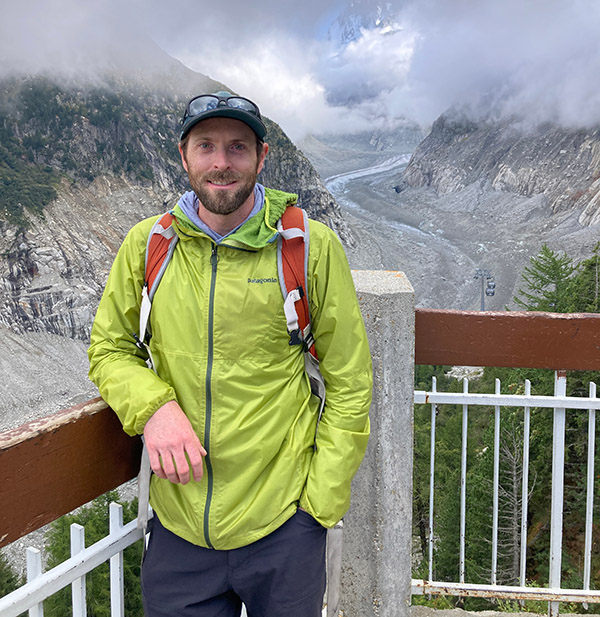
“I’m humbled and honored to receive this award,” said Dr. Chellman. “I’m very proud of the research we do here at DRI and have enjoyed being here throughout a significant portion of my academic career. It has been a great place to work and I hope to continue and expand the scope of my research in the coming years.”
Dr. Chellman began at DRI as a high school intern and returned as a graduate student before becoming an Assistant Research Professor in 2022. He has excelled in publishing his research with more than 50 peer-reviewed journal articles that have been cited over 3500 times according to Google Scholar and gained international interest. Many of these publications have been in high impact journals including Nature Communications, Proceedings of the National Academy of Science, Nature Geoscience and Geophysical Research Letters. Dr. Chellman is also a frequent subject of media interviews offering his expertise to connect how studying past climates and environments can inform on our current environment. He and his work were featured by National Geographic and in an upcoming PBS production.
In addition to his impressive research portfolio, Dr. Chellman’s current educational responsibilities include teaching graduate level coursework, including the Isotope Hydrology course in the Graduate Program in Hydrological Sciences (GPHS) at UNR that he co-taught with Dr. Sophia Wensman in 2024 . He serves as the primary advisor for one UNR Ph.D. student, and serves on graduate committees for students at UNR and other institutions. In addition, Dr. Chellman has taken on educational responsibilities to mentor undergraduate students in the DRI Ice Core Lab and at Georgia Tech.
He has also contributed to several outreach platforms targeted at K-12 students and the Osher Lifelong Learning Institute (OLLI). Dr. Chellman hosts faculty and visiting researchers from other institutions at DRI and organized a workshop involving atmospheric chemists, ocean researchers, ice core scientists, and modelers from institutions across the U.S. to foster interdisciplinary collaboration.
“Nathan is a great example of a highly successful early career scientist at DRI,” said DRI Vice President for Research Vic Etyemezian, Ph.D. Since the beginning of his time here, he has done a terrific job balancing the ongoing needs of DRI’s long-established ice core program including field, laboratory, and data analysis with the requirements of keeping the program’s amazing accomplishments at the forefront of the scientific discussion through tantalizing publications and public outreach efforts.”
###
About DRI
We are Nevada’s non-profit research institute, founded in 1959 to empower experts to focus on science that matters. We work with communities across the state — and the world — to address their most pressing scientific questions. We’re proud that our scientists continuously produce solutions that better human and environmental health.
Scientists at DRI are encouraged to follow their research interests across the traditional boundaries of scientific fields, collaborating across DRI and with scientists worldwide. All faculty support their own research through grants, bringing in nearly $5 to the Nevada economy for every $1 of state funds received. With more than 600 scientists, engineers, students, and staff across our Reno and Las Vegas campuses, we conducted more than $59 million in sponsored research focused on improving peoples’ lives in 2025 alone.
At DRI, science isn’t merely academic — it’s the key to future-proofing our communities and building a better world. For more information, please visit www.dri.edu. To support our work pursuing science that matters now, visit www.dri.edu/donate.