Braimah Apambire, Ph.D., is the Director of the Center for International Water and Sustainability (CIWAS) at the Desert Research Institute (DRI), and an expert in international Water, Sanitation and Hygiene (WASH). He leads DRI’s WASH Capacity Building Program, which is funded by humanitarian non-governmental organization World Vision and subsidized by the University of Nevada, Reno (UNR) and DRI. The program provides technical capacity training and action research to field staff across Africa and other developing countries. We recently sat down with Braimah to get an update on the WASH Capacity Building Program and to learn some of the history behind his and DRI’s involvement in the WASH sector in Ghana.
DRI: What is WASH, and what are some of the issues that experts in WASH work to address?
BA: “WASH” stands for water, sanitation, and hygiene. For people to obtain the maximum benefits of clean water, they also need access to improved sanitation facilities (toilets), and they need to be educated on how to best use the water and sanitation facilities in hygienic ways. In many parts of Africa, people – especially children – don’t understand the connection between unsafe water and disease, or poor sanitation and disease. So, people working in the sector of WASH work to improve health outcomes in children and adults by providing sources of clean drinking water, improved sanitation facilities, and education in basic hygienic practices like hand-washing.
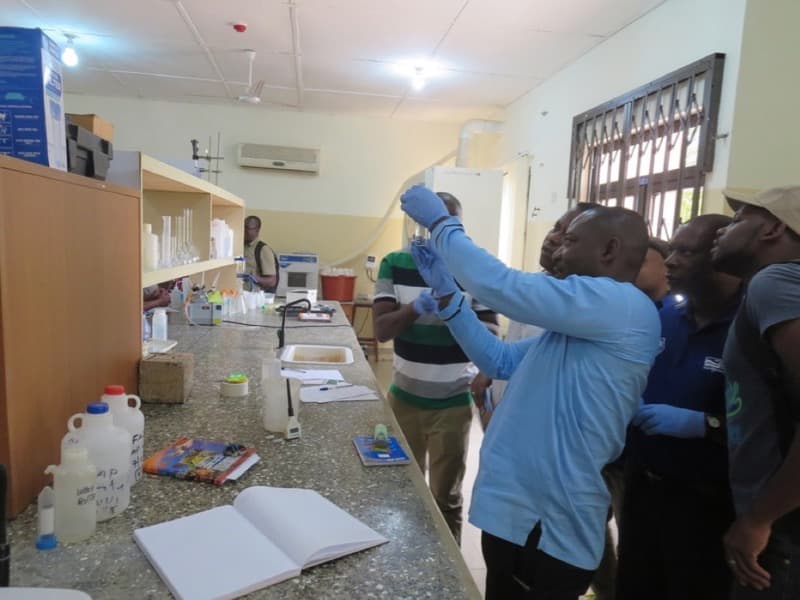
Students from the second Cohort of the WASH Capacity Building Program in a World Vision water quality lab in northern Ghana in 2017. Credit: Braimah Apambire/DRI.
DRI: CIWAS’s successful WASH Capacity Building Program launched in 2015, and now provides WASH training to field staff in Ghana and across Africa. How is the program going?
BA: We are working in partnership with the University of Nevada, Reno, Drexel University, and World Vision to provide technical capacity training to field staff who work in the WASH sector in developing countries. Our biggest accomplishment so far is that as of December 2019, we will have graduated close to 100 students from 21 African countries.
The students earn a post-graduate certificate in International WASH from UNR. They complete 12 credits of coursework related to WASH and environmental issues, and also a lot of research on issues of importance to them in developing countries. We also teach what we call “cross-cutting” issues in WASH, which include climate change impact of water resources, environmental and health impacts assessments, and integrated water resources management. During the program, students take most of their classes online, but we meet twice for face-to-face coursework sessions — the first is held in Ghana, and the second is held at varying locations. We’ve done it in Rwanda, Uganda, Eswatini, and next year will probably be somewhere else.
The program has equipped these students with knowledge and working skills that allow them to go back and implement their programs in a better way to bring water and sanitation services to the poor in Africa. WASH is a combination of disciplines: It’s engineering, it’s science, it’s health, it’s social work, it’s advocacy. It deals with disease prevalence, sanitation systems, and how water can address that. And you also have to create awareness and advocacy to get money to solve the problem. It’s difficult to have one place that students can go to take these courses, but this program allows that. We bring all of these disciplines together in one place, which you can hardly get anywhere else in the world.
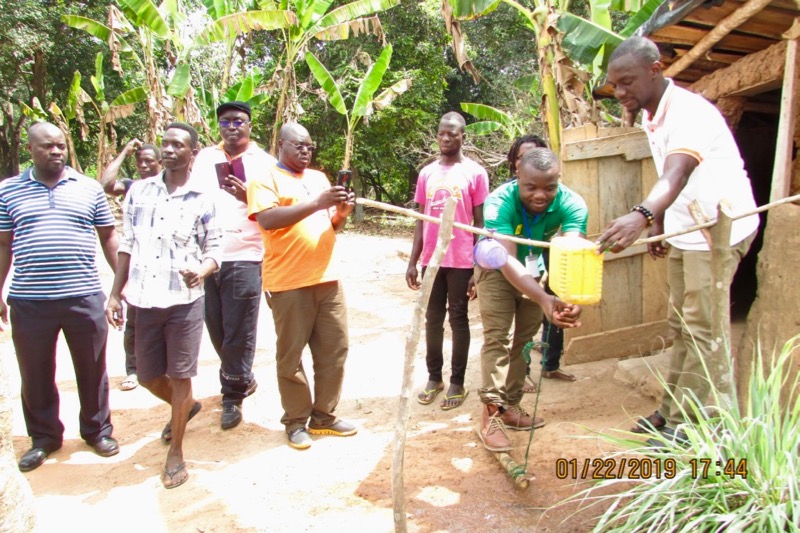
Students in Cohort 4 of the WASH Capacity Building Program in Ghana use a Tippy Tap, a hygienic and hands-free device to wash hands. January 2019. Credit: Braimah Apambire/DRI.
DRI: Many people don’t know that DRI scientists have worked in Ghana, West Africa for nearly 30 years. What is the history of our involvement in this region?
BA: DRI’s work in Ghana began back in the early 1990s, when we partnered with the Conrad N. Hilton Foundation and World Vision on a project to eradicate Guinea Worm Disease from the Afram Plains region of northern Ghana. Guinea Worm Disease is a terrible parasitic infection by the Guinea worm, which can grow up to three feet in length inside the body of an infected person. The eggs are spread to humans when they drink untreated water, so the Hilton Foundation and World Vision funded an effort to drill more than 500 boreholes (wells) and conduct community education in health, hygiene, sanitation, and the importance of clean water.
The Afram Plains is a very remote region with difficult geology. You can’t reach water easily. So, DRI scientists came to Ghana with GIS satellite imagery to see if they could improve on the success rate of drilling. We provided training to World Vision Ghana staff on the geophysical methods in locating favorable sites for well drilling, and helped them standardize how the data was reported internally and externally. We also helped to build a water quality laboratory in Ghana. As a result of this project, DRI helped to eradicate Guinea Worm Disease in the Afram Plains region. It is now gone completely in Ghana. It is also almost eradicated in the world.
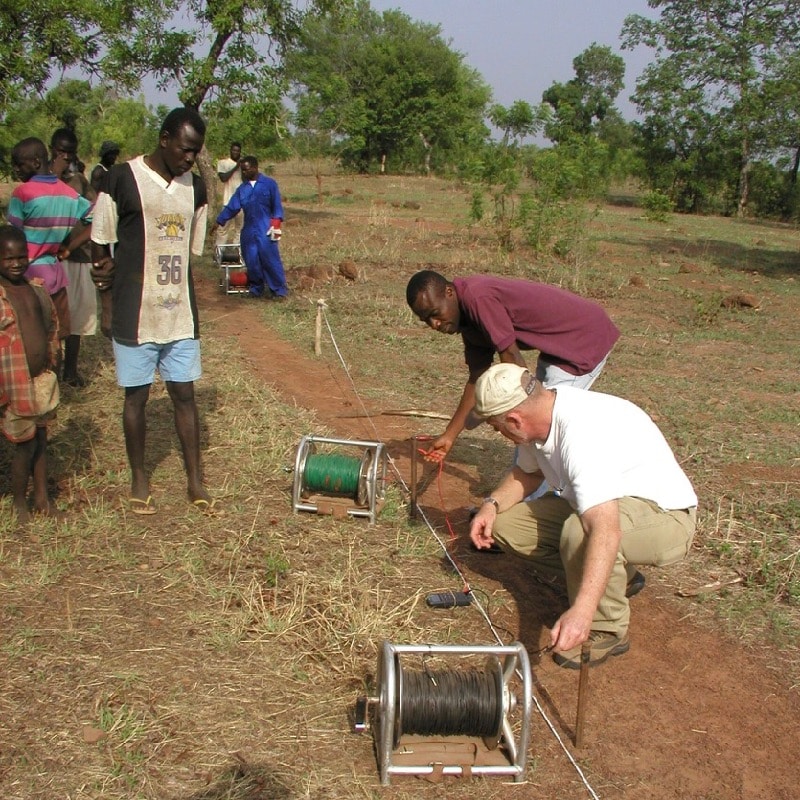
DRI consultant Ron Petersen training World Vision Ghana staff in geophysics in the Afram Plains in 1996. Credit: Braimah Apambire/DRI.
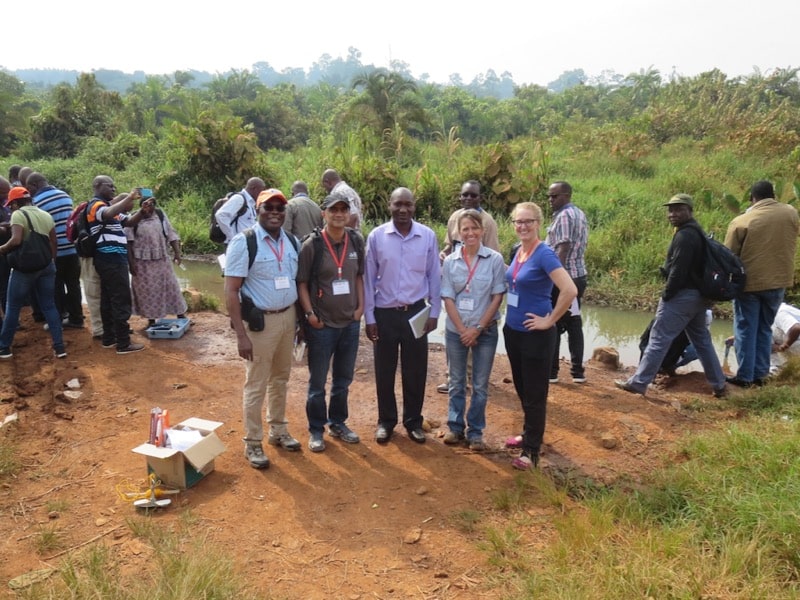
From left to right, Braimah Apambire (DRI), Kumud Acharya (DRI), Kenan Okurut (Ugandan Christian University), Rosemary Carrol (DRI) and Susan Davis (DRI consultant) work with the first cohort of the WASH Capacity Building Program to conduct a water quality field trip at the Ugandan Christian University in 2016. Credit: Braimah Apambire/DRI.
DRI: A photo from a recent WASH Capacity Building Program field trip in Ghana won DRI’s 2019 employee photo contest (shown below). What is the story behind the winning shot?
BA: This photo was taken at Bomso Primary School in Ghana, where students from our WASH Capacity Building Program were visiting to observe the school’s mechanized well and sanitation facilities. One of the problems in developing countries is that a lot of schools don’t have drinking water. So, children bring their own water in a bottle, but when they finish drinking it they have to drink contaminated water. They also don’t have toilets and hygienic places for girls who are menstruating to take care of themselves, so a lot of them drop out of school. So, here, WorldVision helped them get a mechanized water system powered by solar. The school has also created what we call a health club, which asks students to join, and tries to spread messages of good hygiene practices to students.
In the photo, you can see the joy in the children. When you go to a school in Africa like this as visitors, you will make their day. They will talk about this the whole month. It will be in their minds probably until they graduate college. Some of these visits change them.
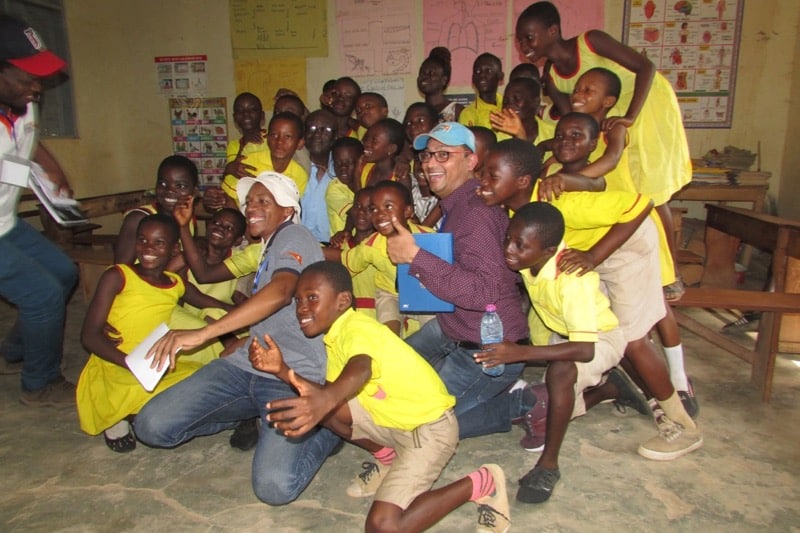
Students Pawan Daniel and Cebolenkhosi Mavimbela from Cohort 4 of the WASH Capacity Building Program in Ghana alongside Dr. Opong (DRI instructor) visit Bomso Primary School to observe their mechanized well and sanitation facilities. January 2019. Credit: Braimah Apambire/DRI.
DRI: You are originally from Ghana. What brought you to DRI?
BA: I grew up in a village in Ghana where we didn’t have water during the dry season. When a borehole was drilled in front of our village home, I saw the relief it brought to my mother and aunts and sisters, it made me want to work in that field – designing and constructing water and sanitation systems. I studied geology and finished college there in Ghana, and then started to work with World Vision Ghana on the Guinea Worm Disease project.
When the DRI scientists came to Ghana to train World Vision staff, I was actually one of the recipients of that training. I have old photos with DRI crossing the river to the Afram Plains (shown below). There wasn’t any road, you could only access the place by boat or by foot. I later went to Canada to do my master’s degree, and then came to DRI as a Graduate Research Assistant and went to the University of Nevada, Reno for my Ph.D. After that, I worked at DRI briefly and went to work for World Vision and the Hilton Foundation, then came back to DRI with funding from the Hilton Foundation to start the Center for International Water and Sustainability (CIWAS) in 2013.
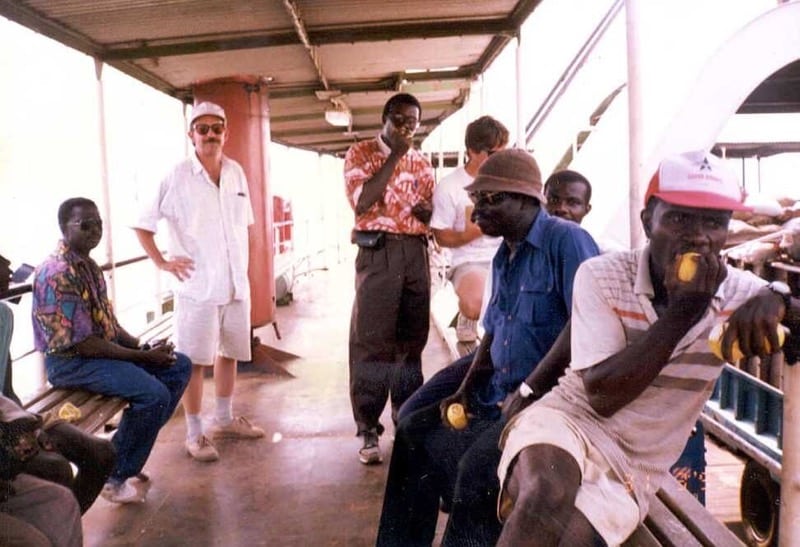
From left to right: Steve Acheampong (DRI graduate student), Alan McKay (DRI) , Braimah Apambire (World Vision), Mat Chelsey (DRI), and other World Vision Ghana Rural Water Project staff cross a river to the Afram Plains of Ghana by boat in 1993. Credit: Braimah Apambire/DRI.