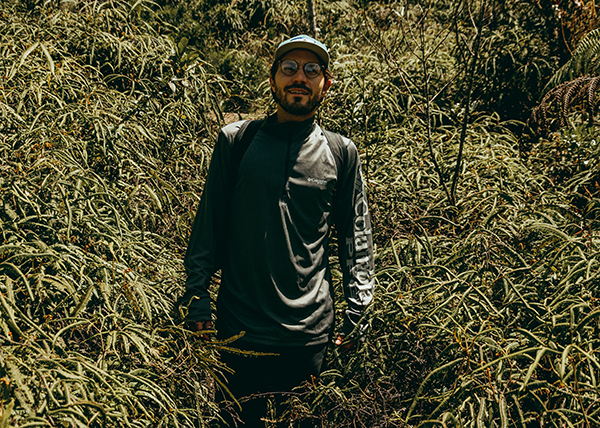
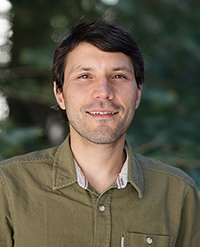
Juan Henao, Ph.D., is a new postdoc in atmospheric sciences working with John Mejia, Ph.D. Originally from Medellin, Colombia, he spent six months on DRI’s Reno campus in 2018 while working with Mejia during his doctoral studies. His primary project will be contributing to atmospheric and air quality modeling efforts, including using digital twins to investigate the effectiveness of urban heat mitigation measures.
In the following interview, Henao discusses how growing up in the tropical climate of Medellin fostered his interest in meteorology and air quality studies, his research demonstrating the impact of air pollution on precipitation, and his interests outside of work.
DRI: Tell us about your background and what brought you to DRI.
Henao: My background is in environmental engineering, because we actually don’t have meteorology or atmospheric sciences programs in Colombia. But during my Ph.D., I spent six months working with John Mejia here at DRI in Reno, and I’ve been working in atmospheric modeling since then. My work uses atmospheric and air quality models to study the interactions between pollutant emissions, air quality and meteorology. With these coupled models we can study aerosol-cloud and aerosol-radiation interactions. So not only the meteorological model is driving the air quality model, but both of them are interacting and sending information to each other. When I saw the postdoc position opening, I thought that it would be a good fit, because I like working with John and find the work interesting.
DRI: Why did you originally choose to study atmospheric science?
Henao: Well, I’m from Colombia, and in the tropics, we don’t really have seasons, but the weather changes rapidly. We have huge thunderstorms, and I’ve always been fascinated by clouds and weather phenomena in general. I became interested in air quality because Medellin, where I was born, is a very narrow valley with 4 million inhabitants and a lot of traffic in a very small, urban area. So, it gets really, really polluted sometimes. That’s how I became interested in studying and understanding how modeling works.
DRI: What research are you excited to pursue here at DRI?
Henao: I’m really excited about working with John and other colleagues on urban heat modeling — I think it’s super important. And it is connected with pollution as well. We’re focused on producing digital twins of Houston, Phoenix, and Las Vegas. We’re trying to find a way to introduce the impact of planting street trees to see the effect of the shade they provide and the effect on wind and other meteorological impacts. Hopefully, we’ll be starting work on a digital twin for Reno as well.
I’m also excited to contribute to the upcoming Reno heat mapping project this summer. These efforts produce really valuable data that we can then integrate into our modeling work. I’ll also be volunteering the day of the campaign to drive around town with the temperature and humidity sensors and help connect with other volunteers from the Spanish-speaking community.
DRI: What research are you most proud of?
Henao: Probably a study I worked on about the effects of anthropogenic aerosols in Phoenix, which was in collaboration with John Mejia and Frank McDonough. We found that atmospheric aerosols from Phoenix actually delay precipitation and part of it will fall on the other side of the mountain – basically, the air pollution over Phoenix decreases precipitation over the city. Precipitation on the other side of the mountain is increased, and this is called the spillover effect. So, the pollution creates smaller particles that take more time to grow big enough to precipitate.
DRI: What do you like to do outside of work?
Henao: I like hiking and cycling. When I was here in 2018, I hiked some beautiful trails around Tahoe. I used to play a lot of soccer but after a few injuries, I now try to avoid contact sports. I also like to read.
DRI: If you could recommend one book to your DRI colleagues, what would it be?
Henao: The Invention of Nature by Andrea Wulf. It’s about Alexander von Humboldt’s work and life. The author weaves together a beautiful story about his life, from his discoveries, to his relationship with his family, to how people thought he was kind of crazy for venturing into the unknown.
DRI: Anything else you think is important to share?
Henao: I’m just really excited about being here at DRI. I really hope I can collaborate not only with John, but with other faculty on new ideas and projects.