Photo caption: Smoke from wildfires covering the city of Sparks, Nevada. Credit: GChapel, Adobe Images.
Reno, Nev. (Sept. 22, 2020) – For people who suffer from asthma, wildfire smoke is more hazardous than other types of air pollution, according to a new study from the Desert Research Institute (DRI), the Renown Institute for Health Innovation (Renown IHI) and the Washoe County Health District (WCHD).
The study, which published last month in the journal Environmental Health, examined associations between airborne particulate matter (PM) from sources such as wildfire, transportation and industry, and medical visits for asthma at Renown Health’s emergency departments and urgent care centers in Reno, Nev. during the six-year period from 2013-2018.
According to their results, on days when wildfire smoke was present, elevated levels of PM2.5 (fine particles of 0-2.5 micrometers in size, about 30 times smaller than a human hair) led to a 6.1 percent increase in medical visits for asthma patients when compared with days of similar pollution levels that came from non-wildfire sources.
“Since we found significantly stronger associations of PM2.5 with asthma visits when wildfire smoke was present, our results suggest that wildfire PM is more hazardous than non-wildfire PM for patients with asthma,” said lead author Daniel Kiser, M.S., Data Scientist with DRI and Renown IHI.
Above, a timelapse video from DRI’s Western Regional Climate Center shows an impressive smoke front move into the city of Reno on August 18, 2013. The smoke, which rolls in at approximately 1:05 in the video, was from the American River fire near Sacramento, Calif.
An increase in the harmfulness of PM from wildfires compared to PM from other sources may be attributable to differences in the chemical composition of PM or changes in human behavior, since people are more likely to be outdoors in the summer, when wildfires typically occur. The research team notes that caution should be used when applying these results to other areas of the country, such as the Southeastern United States, since the harmfulness of wildfire smoke may be affected by the type of fuel that is being burned. Other factors, such as the distance that wildfire smoke was carried by the wind and burn temperature, may also play a role in the harmfulness of wildfire smoke.
The researchers found that air quality in the Reno area was affected by wildfire smoke on a total of 188 days during the study period. A total of 18,836 asthma-related emergency room and urgent care visits occurred over the same five-year period of time, indicating that the influences of wildfire smoke and other types of air pollution on this medical condition are important to understand.
“In places like Reno, where wildfire events occur regularly during parts of the year and are expected to become more frequent in the future, an accurate understanding of the impacts of wildfire smoke on population health is critical,” Kiser said.
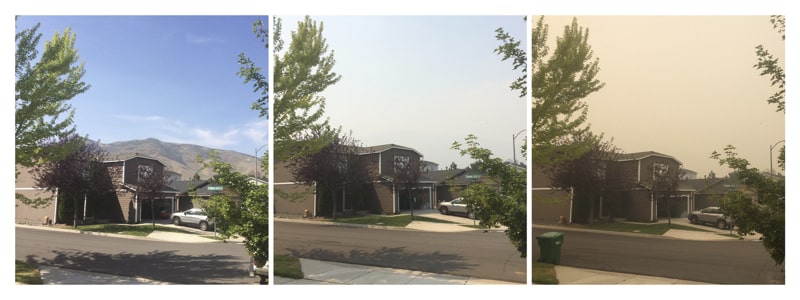
From left to right, this series of three photos documents recent air quality conditions on clear, moderate, very smoky days in Stead, Nev. Credit: Daniel Kiser/DRI.
Additional Information:
The full text of the article “Particulate matter and emergency visits for asthma: a time-series study of their association in the presence and absence of wildfire smoke in Reno, Nevada, 2013–2018,” is available from Environmental Health: https://ehjournal.biomedcentral.com/articles/10.1186/s12940-020-00646-2
To learn more about the Renown Institute for Health Innovation, please visit: https://www.dri.edu/renown-ihi/
###
About the Desert Research Institute
The Desert Research Institute (DRI) is a recognized world leader in basic and applied interdisciplinary research. Committed to scientific excellence and integrity, DRI faculty, students, and staff have developed scientific knowledge and innovative technologies in research projects around the globe. Since 1959, DRI’s research has advanced scientific knowledge, supported Nevada’s diversifying economy, provided science-based educational opportunities, and informed policymakers, business leaders, and community members. With campuses in Reno and Las Vegas, DRI serves as the non-profit research arm of the Nevada System of Higher Education. For more information, visit www.dri.edu.