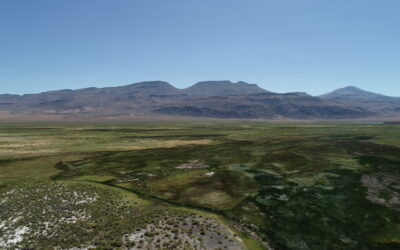
New international research led by the University of St Andrews reveals historical high latitude volcanic eruptions caused dramatic but short-lived climate cooling.
The new study, led by the School of Earth and Environmental Sciences at St Andrews with international colleagues from the Desert Research Institute and others in Switzerland and the USA, and published in The Proceedings of the National Academy of Sciences (PNAS) (6 November 2023), finds that massive volcanic eruptions caused historical global cooling.
Unusually cold decades, such as the 540s, 1450s, and 1600s, are associated with large volcanic eruptions, resulting in volcanic sulfate particles reflecting incoming sunlight. The source of the volcanic eruptions, however, and the amount of sulfate they injected into the upper atmosphere, is uncertain.
To address this, the international team of researchers, led by Andrea Burke, Ph.D., from the University of St Andrews, studied sulfur isotopes in ice cores from Greenland and Antarctica. The isotopes provided a fingerprint of the fraction of the sulfate that reached the stratosphere. The results, correlated with tree-ring climate data, reveal that the largest historical cooling periods were due to volcanic eruptions at high latitudes. The results also show that the amount of sulfate injected into the stratosphere by these eruption events may have been around half that previously estimated, suggesting that summer temperatures may be highly sensitive to high latitude volcanic eruptions.
“Our data show that when Earth’s climate gets altered, other parts of the climate system can kick in to strongly amplify this initial change”, said Burke. “High latitudes feel these amplified climate changes particularly strongly, which is concerning given how rapidly these regions are changing today.”
Joe McConnell, Ph.D., whose research group at the Desert Research Institute in Reno, Nevada, provided most of the ice core samples and underlying chemical data used in the study, said “These new findings lead to a more nuanced understanding of the interplay between explosive volcanism and climate, which ultimately will improve climate models.”
According to the authors, the sensitivity of temperature to high-latitude eruptions highlights the role of climate feedbacks, such as sea ice extent and ocean heat content, in amplifying changes in global climate.
More information: “High sensitivity of summer temperatures to stratospheric sulfur loading from volcanoes in the Northern Hemisphere,” is available from the journal PNAS: https://doi.org/10.1073/pnas.2221810120
Issued by the University of St Andrews Communications Office.
MEDIA CONTACTS:
Christine Tudhope
Head of Communications
Communications Office
Tel: 01334 46 7320
Mobile: 07526 624 243
Email: Christine.Tudhope@st-andrews.ac.uk
Press Office: 01334 462530
&
Elyse DeFranco
Science Writer, DRI
elyse.defranco@dri.edu