
Photo: A collection of marine debris including microplastics. Credit: NOAA Marine Debris Program/Flickr.
Microplastics research at DRI
Even the tiniest pieces of plastic are a big pollution problem.
Microplastics are plastic pieces ranging in size from 5mm to microscopic particles, in other words, the size of a pencil’s eraser or smaller. They come from a variety of sources, including the breakdown of larger products like single-use plastic bottles and from the microbeads in products like facewash and toothpaste.
The extent of microplastic pollution is only just beginning to be understood, with researchers discovering the tiny plastic pieces everywhere from the air we breathe to the deep ocean. Because microplastics are durable, insoluble, and potentially toxic, they could pose threat to natural ecosystems and human health. But to determine the impact of microplastic pollution, researchers must first understand just how much tiny plastic is out there and where it’s coming from.
DRI’s Monica Arienzo, Zoe Harrold, Meghan Collins, Xuelian Bai, and University of Nevada, Reno undergraduate Julia Davidson are exploring these questions in two bodies of freshwater in Nevada: Lake Tahoe and the Las Vegas Wash.
“There has been a lot of work done to understand how much microplastic is in marine environments, but there have been far fewer studies in freshwater, and far fewer even in alpine lakes,” explained Collins, Education Program Manager at DRI. “This study is really well placed to identify what microplastics may be in the water, their sources, and their characteristics.”
The research team is collecting samples from four different sites in Las Vegas—one in Lake Mead and three in the Las Vegas Wash—and six sites in Lake Tahoe. Sites were selected to include areas both high and low human activity, like the Tahoe Keys with significant boat traffic and Emerald Bay State Park where human impact is low. Additional sampling was also conducted at three stormwater outfalls into Lake Tahoe in collaboration with the League to Save Lake Tahoe’s Pipe Keepers citizen science program.
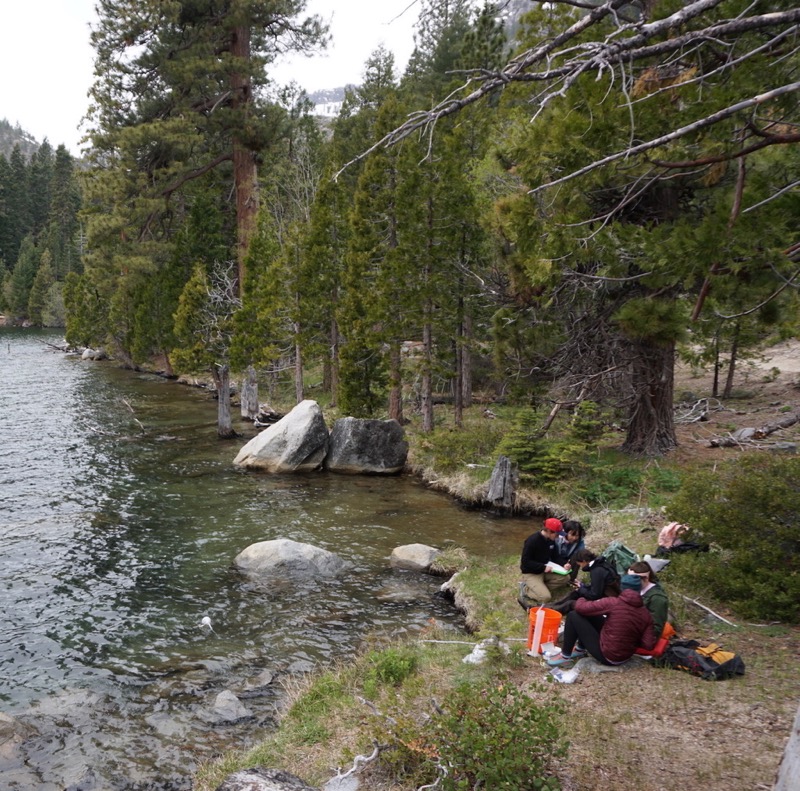
The research team sets up the pump and filter system at Lake Tahoe’s Emerald Bay State Park in May 2019.
“The sampling methods we’re using are unique,” said Arienzo, assistant research professor and project lead. “Past studies collected samples by trailing a large net from a boat or standing with it in a moving stream. Our approach is to sample and filter water in the field for microplastics using a pump, which allows us to filter upwards of 15 gallons of water in locations with still water and in places where boat access is limited.”
“Plus, we don’t have to haul netting around or carry the samples back to the lab—everything we need fits into a backpack, which makes sampling in remote and hard to access locations more feasible,” Arienzo added.
To make this novel method work, researchers place a stake with a funnel clipped to it about 20 feet from the water’s edge. The funnel, positioned on the surface of the water, is connected to tubing that runs back to the pump on shore, which draws water through the tubing and over a series of filters which can capture particles of different sizes.
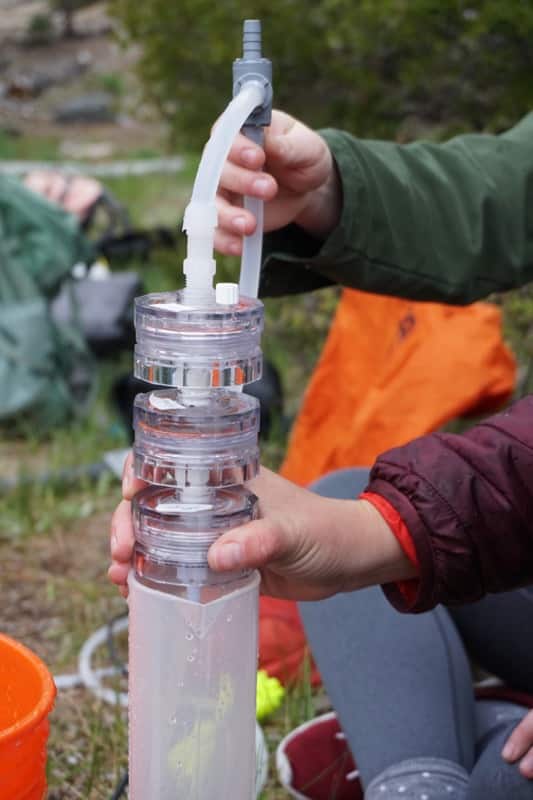
Tubing runs into the column of filters, which capture particles at three different sizes as water flows through.
Tubing runs into the column of filters, which capture particles at three different sizes as water flows through.
Sampling in all locations took place throughout the spring, and now the team is set to process and analyze the samples over the summer.
“To isolate the plastic pieces, we first have to get rid of all the organics, and we’re going to do that by oxidizing them,” explained Harrold, assistant research scientist in DRI’s Division of Earth and Ecosystem Sciences. “It’s a delicate balance between getting rid of the bugs and twigs and whatever else has ended up in there and not dissolving your plastics.”
Once the team oxidizes the organic particles left behind on the filters, they’ll separate the plastics from any remaining sediment using a high-density liquid separation method which will cause the sediments will settle to the bottom while plastics will float to the top.
From there, the team will begin identifying the different kinds of plastic pieces they find. The type of plastic, its size and shape, and the location where it was collected all provide clues about where it may have come from—for example, a nylon fiber may have come from the breakdown of synthetic clothing, and a piece of Styrofoam could have come from a single-use cup.
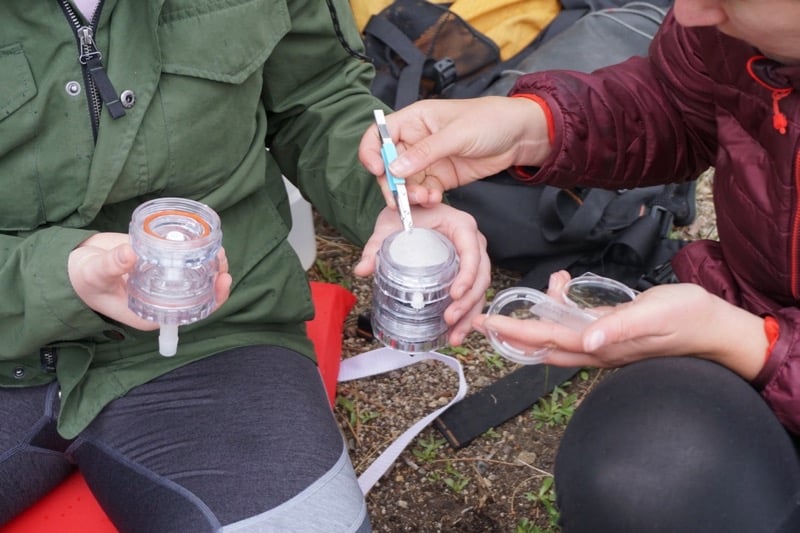
Harrold removes a filter from the sampling instrument to bring it back to the lab for analysis.
However, making determinations about where individual pieces of microplastic originate is far from straightforward.
“We’re only discovering more sources of microplastics,” explained Harrold. “Recent studies have shown that microplastics can be transported through the atmosphere, so though some of what we find might be coming from local sources, the pollution could also be coming from a factory manufacturing plastic on the other side of the world. We just don’t know.”
While it’s daunting that there’s so much still unknown about this increasingly problematic pollutant, the research team also finds it exciting.
“This is the second study ever to be done on microplastics in Lake Tahoe,” said Arienzo. “It’s amazing to be a part of advancing the science in this new area of study.”
The team hopes that this work will contribute to a foundation of scientific information about the extent of microplastics pollution in Nevada freshwater so that scientists will be able to better identify the sources of microplastic, potential harmful effects to plant and animal life, and ways to remove it from the environment.
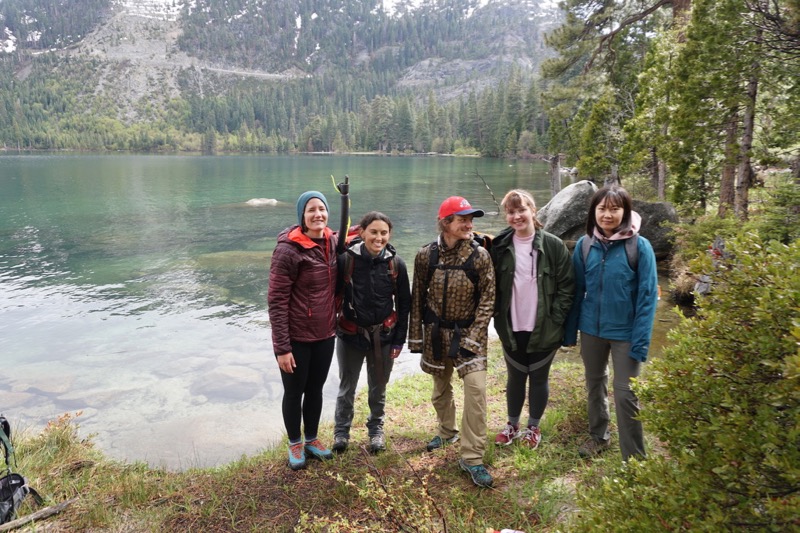
From left: Harrold, Arienzo, Collins, Davidson, and Bai after sampling at Emerald Bay in May 2019.
Funding for this project came from the DRI Foundation’s Innovation Research Program (IRP), which is designed to support DRI faculty and staff as they pursue their very best ideas. The IRP is funded by individual contributions from science enthusiasts like you—if you’d like to donate to the IRP and help make projects like this one possible, please visit: https://www.dri.edu/foundation/innovation-research-program.