Above: Monica Arienzo, Ph.D., is an assistant research professor of hydrology at the Desert Research Institute in Reno and winner of DRI’s first CAREER Award from the National Science Foundation.
Reno, Nev. (May 3, 2021) – The Desert Research Institute (DRI) is pleased to announce that Monica Arienzo, Ph.D., has been awarded a CAREER Award from the National Science Foundation (NSF) – the first such award received by a DRI scientist in the Institute’s 62-year history.
The Faculty Early Career Development (CAREER) Program is one of the NSF’s most prestigious awards and recognizes early-career faculty who have the potential to serve as role models in research and education, and to lead advances in the mission of their organization. The CAREER Award will provide Arienzo with a grant for $550,787 to forward her research into microplastics, tiny (less than 5mm in length) particles of plastic that pollute the environment.
Arienzo is an assistant research professor of hydrology with DRI’s Division of Hydrologic Sciences in Reno. She is the director of DRI’s Microplastics Laboratory, where her research focuses on the sources and concentrations of microplastics found in snowy peaks, lakes, rivers, and drinking water, including the waters of Lake Tahoe.
With the funding from the CAREER award, Arienzo plans to continue her investigation into the sources, transport, and fate of microplastics in snow-dominated environments of the Sierra Nevada in Nevada and California. As part of her project, two Ph.D. students and between four-to-six undergraduate students will be trained on microplastic sampling, laboratory analysis, and hydrology.
“I am incredibly honored to receive the CAREER award and appreciate this opportunity to continue researching an important environmental pollutant while also including additional Ph.D. students and undergraduate students in the research effort,” Arienzo said.
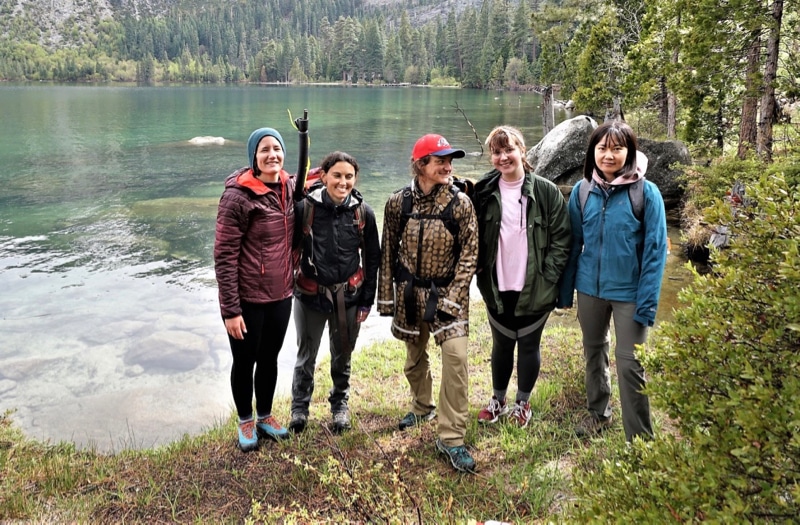
Arienzo (second from left) and the members of the Microplastics Laboratory conduct fieldwork at Lake Tahoe during May 2019.
Arienzo will also integrate her research findings into a middle school mobile teaching kit through DRI’s Green Boxes program. The teaching kit will include a series of lessons on the topics of hydrology, microplastics, anthropogenic pollution, and water quality.
“We are proud of Dr. Arienzo’s accomplishments and the recognition from the NSF of the important research she is conducting in the area of microplastics,” said DRI President Kumud Acharya, Ph.D. “As a result of the grant provided by the CAREER award, Dr. Arienzo is able to expand her research and invest in others.”
Arienzo joined DRI as a post-doctoral fellow in 2014 and was promoted to Assistant Research Professor in 2016. She has worked extensively using geochemical tools to understand climatic changes of the past and human impacts to the environment. She holds a Ph.D. in Marine Geology and Geophysics from the University of Miami, and a B.A. in Geology from Franklin & Marshall College.
More information:
- For more information on Monica Arienzo and her research, please visit: https://www.dri.edu/directory/monica-arienzo/
- For more information the Microplastics Laboratory at DRI, please visit: https://www.dri.edu/labs/microplastics/
###
About Desert Research Institute The Desert Research Institute (DRI) is a recognized world leader in basic and applied interdisciplinary research. Committed to scientific excellence and integrity, DRI faculty, students, and staff have developed scientific knowledge and innovative technologies in research projects around the globe. Since 1959, DRI’s research has advanced scientific knowledge, supported Nevada’s diversifying economy, provided science-based educational opportunities, and informed policy makers, business leaders, and community members. With campuses in Reno and Las Vegas, DRI serves as the non-profit research arm of the Nevada System of Higher Education. For more information, please visit www.dri.edu.