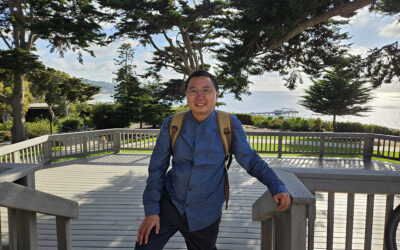
Meet Rishi Parashar, Ph.D. and learn about his research in this Q&A with “DRI’s Behind the Science” Blog.
Rishi Parashar, Ph.D., is an Associate Research Professor of Hydrology with the Division of Hydrologic Sciences at DRI in Reno. He studies the movement of water, contaminants, and other substances through Earth’s subsurface. Originally from India, Rishi holds a B.S. in Civil Engineering from the Indian Institute of Technology in Roorkee, India, and Masters and Ph.D. degrees in Civil Engineering from Purdue University. He has been a member of the DRI community since 2008. In his free time, Rishi enjoys photography, listening to music, and spending time with his wife and three children.
DRI: What do you do at DRI?
Parashar: I study flow and contaminant transport through Earth’s subsurface, which consists of soil as well as rocks. Within rocks you can have fractures, so that is known as fractured media; within soils, there are tiny air or water-filled pores, so they are generally called porous media. My research is largely focused on understanding how water or anything that is mixed into the water – like contaminants, microbes, or heat – flow and disperse through fractured rocks and porous media.
DRI: Why is it important to understand these processes here in Nevada? Can you share an example from your work?
Parashar: When I began at DRI in 2008, I spent a large portion of my first eight or nine years working on problems at the Nevada Test Site, which is now known as the Nevada National Security Site (NNSS). During that time, my work was heavily based on trying to understand how radionuclides might move through fractured rocks. Radionuclides are unstable forms of elements that release radiation as they break down and can have harmful effects on living organisms. So, we were trying to determine how radionuclides that were released into the subsurface after atomic tests might move further by getting into fractured rocks. Understanding how contaminants or water or radionuclides in this case can potentially move through fractured rock is very important in places like the NNSS.
DRI: You recently received a Mid-Career Advancement (MCA) award from the National Science Foundation (NSF) that will allow you to expand your work in some exciting new directions. Can you tell us about your plans?
Parashar: This was the first year that the NSF has offered mid-career awards, which provide time and resources for scientists at the Associate Professor rank to diversify their knowledge by partnering and training with researchers working in complimentary fields. Until now, my research has been mainly focused on understanding flow and transport in fractured rocks and porous media – but one of the major challenges in my field right now is that most computational models are large, computationally heavy, and difficult to scale-up. To take science or modeling of these processes to the next level, I believe that we need to try to combine our work with some of the technological advances that we are seeing in the fields of computer science and applied mathematics.
Some high-fidelity fracture network models cannot be easily scaled up – they allow us to study problems at a small scale, but to apply our models for realistic world problems at a larger scale, we may benefit greatly from tapping into artificial intelligence (AI) or machine learning or quantum computing. With the MCA award, I will be partnering with three collaborators: two are applied mathematicians from the Los Alamos National Laboratory, and the third is a computer scientist from the University of Nevada, Reno with expertise in AI, graph representations of networks, and quantum computing. Together we will explore opportunities of convergence research and see if we can develop more robust computational approaches that would benefit many different areas within the field of hydrology.
DRI: What are some of the applications for your work?
Parashar: The type of modeling I’ve described can help us understand the movement of water, heat, and other quantities of interest through connected networks in the subsurface with applications to geothermal, carbon sequestration, and nuclear waste repositories among others. They can also be useful in studying the transport of viruses and bacteria through porous media, which is important in applications such as water recycling. Here in Nevada, there is interest in treating and cleaning municipal water and reusing it for irrigation and other purposes. One way to clean it is to run it through the ground – but to ensure that the water is being properly cleaned it is important to understand how bacteria and viruses move through the system.
DRI: You are originally from India. How did you end up here at DRI?
Parashar: I came to DRI as a postdoc in 2008. The true story is that in all my life I have only written one job application. In 2008, when I was about to complete my Ph.D., my wife was already well established in the Reno area working for a consulting firm. I wanted to explore opportunities and knew about the good quality of work at DRI. So I approached John Warrick, who was the Division Director at that time, and he informed me about this new position that was about to open. I interviewed in Las Vegas and have stayed here at DRI’s Reno campus ever since.
More information: