Posts by Elyse DeFranco

A wide, murky river cutting through a lush green valley with colorful houses on the cliff sides.

DRI’s Monty Majumdar is Working with an International Team of Researchers to Create a Digital Twin of India’s Ganges River Basin

DRI’s Sayantan (Monty) Majumdar, Assistant Research Professor of Hydrologic Science and Remote Sensing, is joining forces with an international team of researchers to create a digital twin of the entire river basin that will support decision-makers as they work to protect this critical resource. Originally hailing from the river’s fertile lands, Majumdar is now based on DRI’s Reno campus, where he contributes to a wide range of research on water management issues in the Western U.S. As a no-cost Co-Principal Investigator (similar to a volunteer consultant role) on the project, he is excited to contribute the knowledge and models developed by teams like the OpenET project and apply them to India in order to expand their reach and test their efficacy in different climates.

View of mountainous and grassland landscape.

New Study Offers a Glimpse Into 230,000 Years of Climate and Landscape Shifts in the Southwest

Atmospheric dust plays an important role in the way Earth absorbs and reflects sunlight, impacting the global climate, cloud formation, and precipitation. Much of this dust comes from the continuous reshaping of Earth’s surface through the erosion of rocks and sediments, and understanding how this process has shaped landscapes can help us decipher our planet’s history – and its future. Although an ephemeral phenomenon by nature, dust emissions through time can be depicted through natural archives like lake sediment cores. In a new study, scientists examine one such record to peer 230,000 years into the past of the American Southwest.

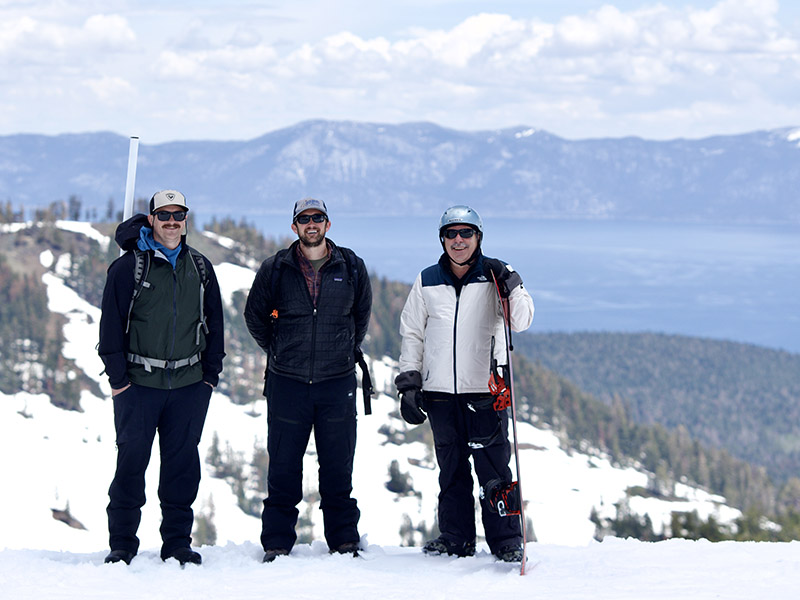
Three men in winter gear and snow board on a peak overlooking the water of Lake Tahoe.

Cloud Seeding for Local Precipitation Enhancement: An Interview With Atmospheric Scientist Frank McDonough

Frank McDonough is a research and forecast meteorologist who leads DRI’s cloud seeding program. His research interests span cloud physics, aviation icing forecasting, and precipitation enhancement.

In this interview, Dr. McDonough answers frequently asked questions about how cloud seeding works and what makes DRI’s program unique. This is the second in a new series of FAQ videos with DRI researchers.

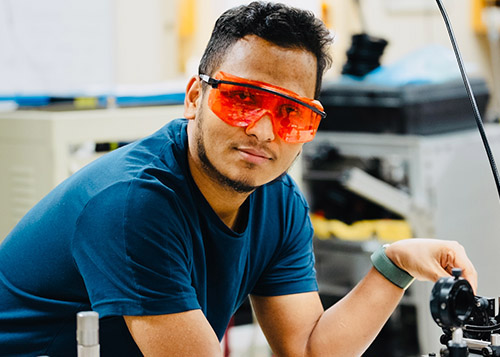
Prakash Gautam in the lab working with equipment and wearing protective eye covering.

Meet Prakash Gautam 

Prakash Gautam, Ph.D., is an Assistant Research Professor in the Division of Atmospheric Sciences and the Director of DRI’s Optics Lab: “Gautam Laboratory for Advanced Aerosol Dynamics and Light Scattering Research.” He has been with DRI since August 1, 2022, when he first joined as a Postdoctoral Researcher. Gautam also serves as Graduate Faculty in the Physics and Atmospheric Sciences departments at the University of Nevada, Reno (UNR), where he contributes graduate teaching, mentorship, and research collaboration. His work seeks to understand how atmospheric particles interact with light in order to better understand atmospheric components. 

In the following interview, Gautam shares his dual passions for physics and tennis and offers insight on creating a successful career in science.

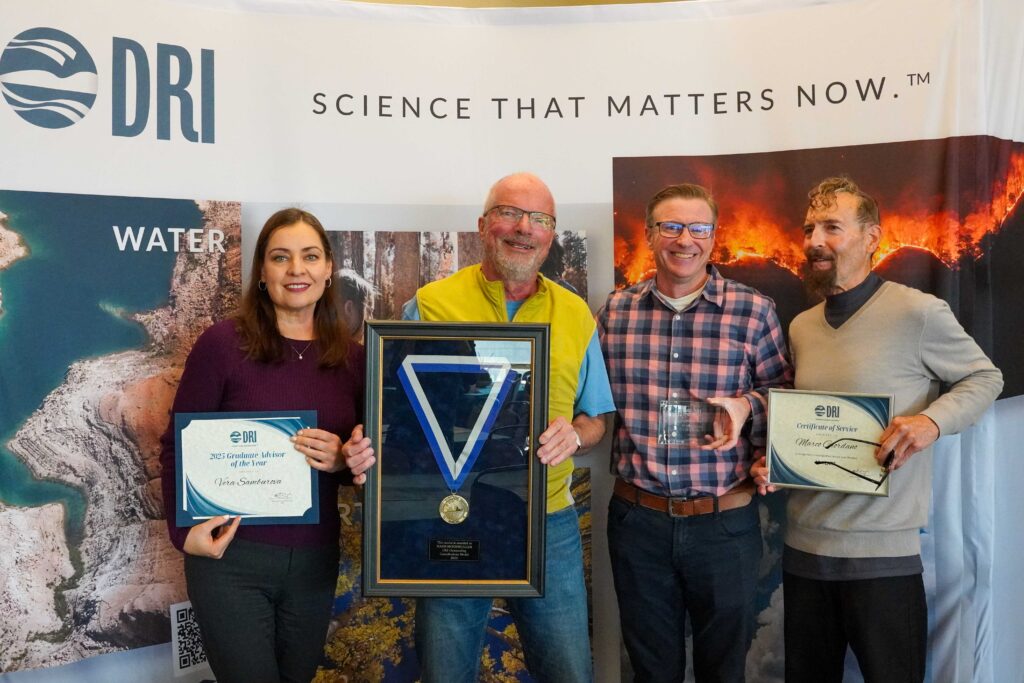
Four people holding up awards they have won.

Annual Awards Presented to DRI Faculty and Staff at 2025 Celebration of Science 

DRI’s annual awards and recognition ceremonies were held at our Reno and Las Vegas campuses in October to honor scientists and staff members for their achievements. Along with the below awardees, several faculty and staff were recognized for their long-term service to the institute. DRI prides itself on fostering a fulfilling workplace that builds internal community and inspires scientific discovery.  

smoke coming from a burning forest

Preparing Communities for the Future of Wildfire 

Last year saw DRI’s inaugural global initiative aimed at advancing community resilience and adaptability in the face of rapid global change – AWE+, for an Adaptable World Environment. The event brought together hundreds of scientific experts, policymakers, resource managers, and other stakeholders to discuss ways to strengthen our communities against the growing threat of wildfires. To maintain momentum on the topic and continue building relationships that advance resilience, DRI’s 2025 AWE+ event sought to build on these conversations, again focusing on wildfire and bringing experts together from across the nation.

A microscope photo of colorful microfibers.

Household Dryers Are Significant Sources of Microfiber Pollution, Study Finds 

The fabrics that fill our homes, from natural cotton towels and bedsheets, to clothes produced with synthetic materials, produce microscopic fibers as they break down over time. Previous research has shown that household washers collect and release these microfibers into the environment, and now a new study uses citizen science to demonstrate how dryer vents also produce microfibers under normal household use.  

Ashley presenting at a podium with a microphone and American flag in the background.

DRI Recognizes Ashley Cornish as the 2025 Peter B. Wagner Memorial Award Winner for Women in Atmospheric Sciences

DRI is pleased to announce that the 27th annual Peter B. Wagner Memorial Award for Women in Atmospheric Sciences has been awarded to Ashley Cornish of the University of Georgia. The Peter B. Wagner Memorial Award for Women in Atmospheric Sciences is an annual competition recognizing the published works of women pursuing a master’s or Ph.D. in the atmospheric sciences or any related program at a university in the United States. The award is presented to women graduate students with outstanding academic publications and includes a $1,500 prize. This award has been presented annually by DRI since 1998 and is the only such honor designated for graduate women in the atmospheric sciences in the United States.

Plane in front of very large clouds.

Scientists Successfully Recreate Wildfire-Induced Thunderstorms in Earth System Models for the First Time

The breakthrough enhances scientific understanding of the dangerous storms and their long-term impacts on the climate. The research, published September 25th in Geophysical Research Letters, represents the first successful simulation of these wildfire-induced storms, known as pyrocumulonimbus clouds, within an Earth system model. Led by DRI scientist Ziming Ke, the study successfully reproduced the observed timing, height, and strength of the Creek Fire’s thunderhead – one of the largest known pyrocumulonimbus clouds seen in the U.S., according to NASA.

A scientist sitting in the snow next to a frozen stream.

Meet Kelly Loria 

Kelly Loria, Ph.D., is a Postdoctoral Researcher and stream ecologist who joined DRI in July 2025. She is working with Monica Arienzo, Brittany Kruger, and Mark Hausner to study the water quality impacts of the 2024 Davis Fire in southern Reno’s Washoe Lake and surrounding streams. In the following interview, Loria shares her passion for the ecology of western mountains and increasing our knowledge of Nevada landscapes.