Meet Victoria Wuest, Graduate Researcher
JULY 5, 2021
LAS VEGAS, NEV.
Ecology
eDNA
Environment
Above: Graduate researcher Victoria Wuest filters wastewater samples for COVID-19 detection in the BSL-2 lab at DRI in Las Vegas.
Credit: Alison Swallow/DRI.
Victoria Wuest is a graduate research assistant with the Division of Hydrologic Science at DRI in Las Vegas, mentored by Duane Moser, Ph.D. She is a Master’s student in Biological Sciences with a concentration in Ecology and Evolutionary Biology at the University of Nevada, Las Vegas. Learn more about Victoria and her graduate research in this interview with DRI’s Behind the Science blog!
DRI: What brought you to DRI? And who at DRI are you working with?
Wuest: I came to DRI to research environmental DNA (eDNA) in two warm springs of Southern Nevada, working under Duane Moser, Ph.D., and with Ali Saidi-Mehrabad, Ph.D. eDNA is DNA that is released from an organism into the environment, and can come from sources like shed skin, mucus, and feces.
In my previous job, I was monitoring endangered species at the Muddy River, one of the study sites for this research. Also, I had previously worked with many biologists from the U.S. Fish and Wildlife Service and Nevada Department of Wildlife who manage this project and both of its study sites — the springs of the Muddy River and Ash Meadows National Wildlife Refuge. I was familiar with the species, the hydrology of these areas, and the management concerns of these precious resources. I had worked with the fish before and care about their survival. I thought I could make a positive impact with this research.
DRI: What research projects have you worked on during your time at DRI?
Wuest: When I first came to DRI, I had the opportunity to study the ancient eDNA excavated from Mule Springs Rockshelter, NV. This research focused on the migration of peoples throughout the Great Basin using DNA found on quids. Quids are chewed and expectorated plant fibers, which essentially served as an unintentional cheek swab. These samples were haplotyped and dated. Some quids turned out to be older than 3,000 years. This was my first experience working with eDNA and was valuable in teaching me the techniques for my project.
On the project at the Muddy River and Ash Meadows National Wildlife Refuge, I have developed a method and markers for using eDNA for early detection of the invasive red swamp crayfish (Procambarus clarkii) and western mosquitofish (Gambusia affinis). I have also been using eDNA to track the movements of two endangered species, the Moapa dace (Moapa coriacea), and Warm Springs pupfish (Cyprinodon pectoralis nevadensis).
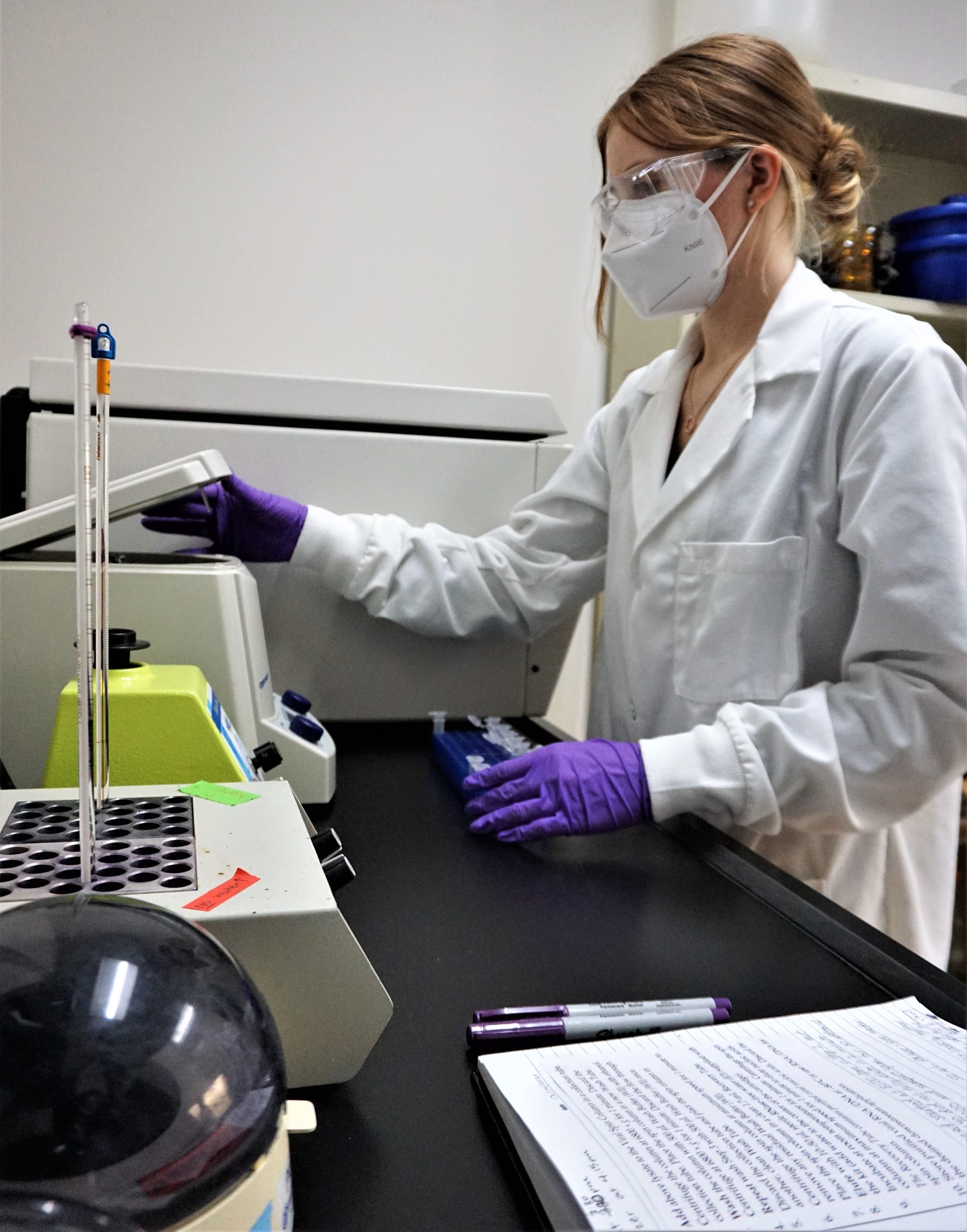
Graduate researcher Victoria Wuest extracts DNA from water samples in the clean lab at DRI in Las Vegas.
Credit: Alison Swallow/DRI.
DRI: What are some of the management concerns at the Muddy River and Ash Meadows project sites?
Wuest: The management of both sites focuses on the recovery of the imperiled species that are endemic to the area. The Moapa dace population has grown from 459 in 2008 to over a thousand. Meanwhile, the Warm Springs pupfish has a very small population of less than 500 individuals. Both species are highly susceptible to disturbances and have very localized distributions. The populations of Moapa dace and Warm Springs pupfish are dependent on the restoration of the streams and removal and monitoring of non-native and invasive species.
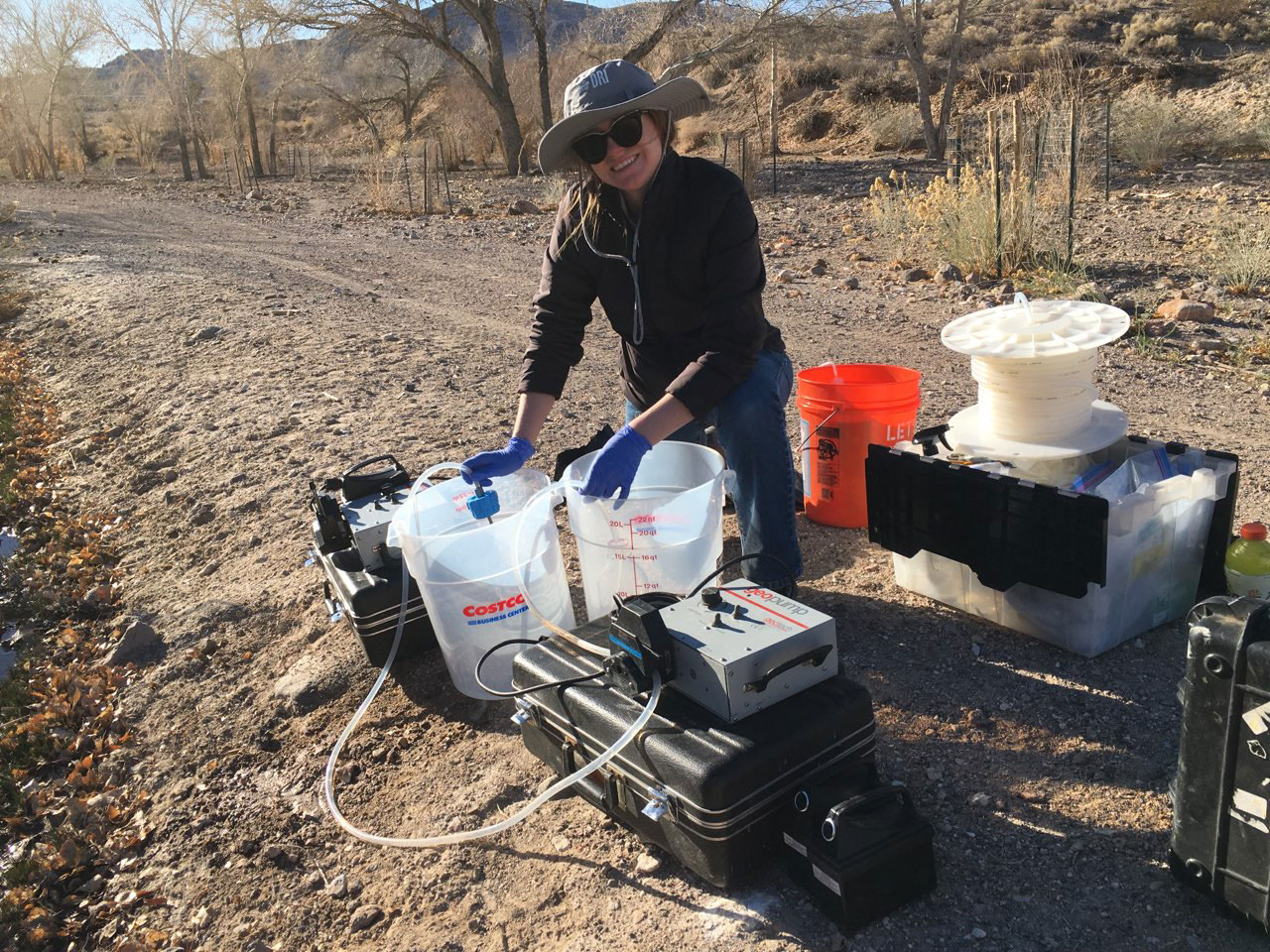
Graduate researcher Victoria Wuest samples stream water in Beatty, NV for the detection of western mosquitofish.
Credit: Duane Moser.
DRI: What are your research goals?
Wuest: My goal is to design markers, or specific, single-stranded DNA sequences, to detect red swamp crayfish , western mosquitofish, Moapa dace, and Warm Springs pupfish and publish these novel markers along with the novel sampling method. This method has the potential to be expanded to detect all the species in these systems with the future goal of tracking abundance. As I near the end of my degree program, I am proud that I have made progress towards using eDNA as a monitoring tool for these sites.
DRI: Tell us about yourself. What do you do for fun?
Wuest: Like many ecologists, I enjoy being outdoors—hiking, hammocking, and kayaking. At Northern Arizona University, my alma mater, these activities were a fundamental part of my college experience and part of the reason I chose that university. It is also the reason I chose to pursue biology.
However, lately, when I truly need a break from science, I find myself turning to art. I enjoy refinishing furniture, knitting gifts for my friends and family, propagating plants, sewing, photography, and honestly any craft that allows me to solve problems by being creative. These activities allow me to take a break from my work while still being fulfilling.
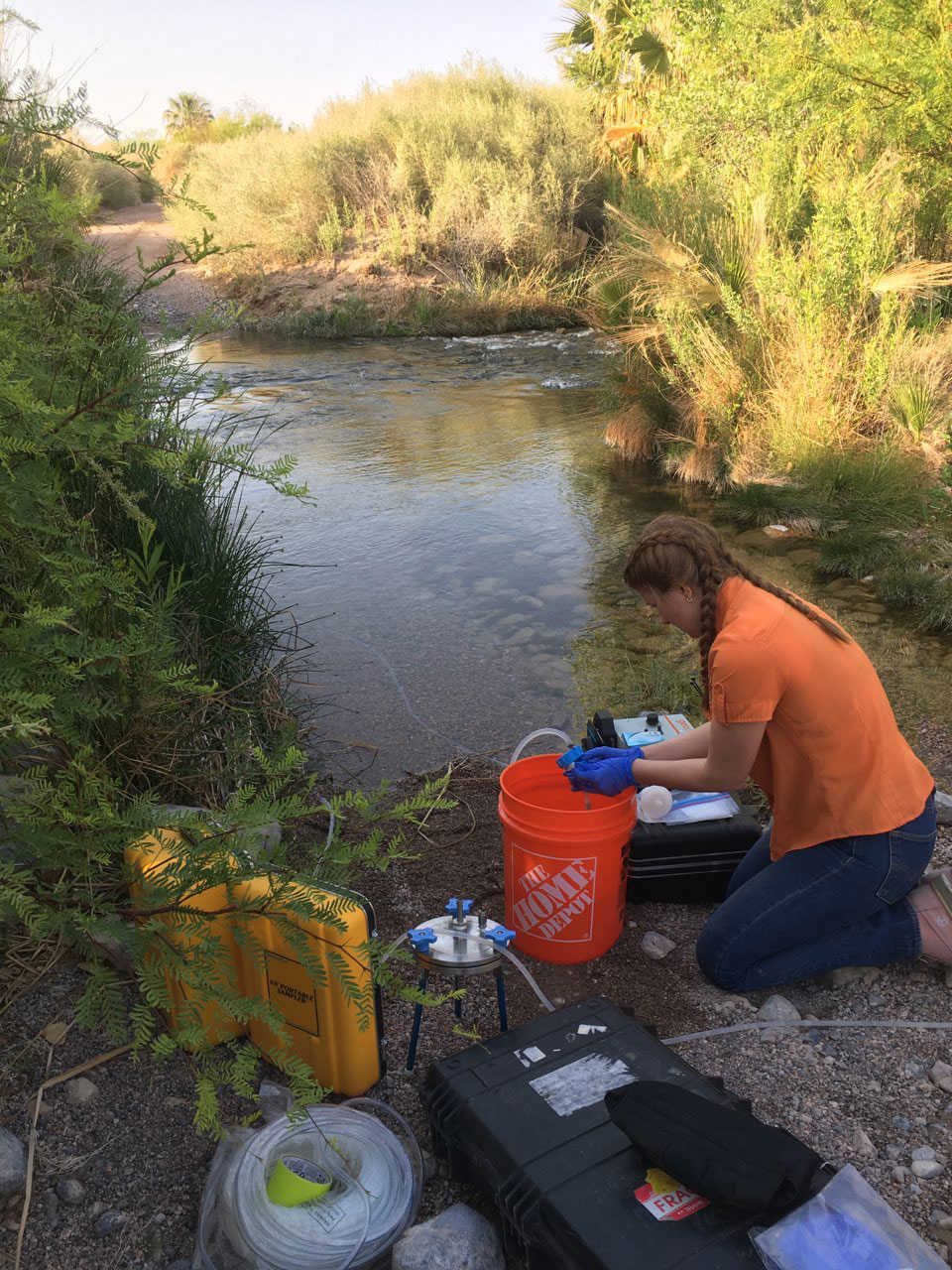
Graduate researcher Victoria Wuest samples the mainstem Muddy River, NV for the detection of invasive species and the endangered Moapa dace.
Credit: Duane Moser.
Additional Information:
For more information on graduate programs at DRI, please visit: https://www.dri.edu/education/graduate-programs/.