DRI Appoints Vic Etyemezian, Ph.D., Vice President for Research
July 6, 2022
LAS VEGAS
Above: The DRI sign at the Las Vegas campus.
Credit: David Becker/Nevada Momentum.
DRI is proud to announce the appointment of Vic Etyemezian, Ph.D., as the institution’s vice president for research, effective July 1, 2022. Etyemezian has served in an interim capacity since September of 2019.
“During Vic’s time as interim vice president for research, he has shown the commitment and vision to lead DRI’s current and future research opportunities,” said DRI President Kumud Acharya, Ph.D. “I am confident in Vic’s abilities, and I look forward to his continued contributions to the advancement of DRI’s research portfolio.”
“I am honored to accept DRI’s Vice President for Research role as a permanent position and to promote the important research our scientists are doing right here in Nevada and around the world,” said Etyemezian. “I look forward to continuing to work closely with our dedicated division directors, research faculty, graduate students, and staff to expand our research and share DRI’s impactful science that inspires solutions.”
Before being named Interim Vice President for Research, Etyemezian was a senior faculty member in DRI’s Division of Atmospheric Sciences. He spent more than two decades working in dust emissions, air dispersion modeling, and data analysis. He has numerous peer-reviewed publications, a record of successfully pursuing intellectual property based on DRI research and is well known and regarded within the dust research community. He holds a Ph.D. from Carnegie Mellon University, Master’s from Johns Hopkins University, and a Bachelor of Science from the California Institute of Technology.
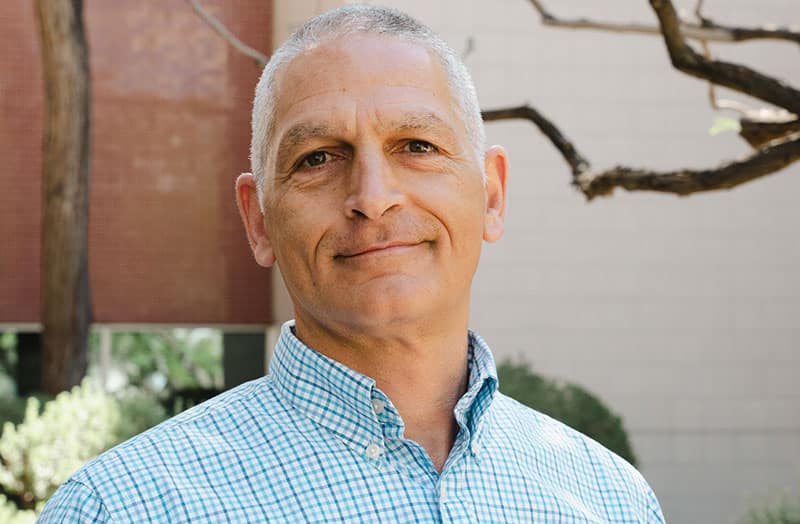
Vic Etyemezia, Ph.D., Vice President for Research at Desert Research Institute (DRI).
Credit: Jessi LeMay/DRI.
###
About DRI
The Desert Research Institute (DRI) is a recognized world leader in basic and applied environmental research. Committed to scientific excellence and integrity, DRI faculty, students who work alongside them, and staff have developed scientific knowledge and innovative technologies in research projects around the globe. Since 1959, DRI’s research has advanced scientific knowledge on topics ranging from humans’ impact on the environment to the environment’s impact on humans. DRI’s impactful science and inspiring solutions support Nevada’s diverse economy, provide science-based educational opportunities, and inform policymakers, business leaders, and community members. With campuses in Las Vegas and Reno, DRI serves as the non-profit research arm of the Nevada System of Higher Education. For more information, please visit www.dri.edu.