Carson City, Nev. – The Desert Research Institute (DRI) has successfully spun out its first research-based company focused on innovative solutions in agriculture with support from the Governor’s Office of Economic Development (GOED) Knowledge Fund.
Tu Biomics Inc., inspired by DRI’s expertise in microbial ecology, is an agricultural biotechnology company that targets the soil health challenges associated with industrial-scale farming. In conjunction with DRI’s plant and molecular biology scientists, Tu Biomics is developing a platform of organically derived biocontrol agents (BCAs) as a sustainable, effective alternative to currently available synthetic chemistry options.
After GOED funded a $350,000 Knowledge Fund research project at DRI, Tu Biomics subsequently received nearly $1 million in seed financing from venture investors and industry partners.
“Identifying and developing the technology further towards market readiness as well as the actual Tu Biomics business formation is an excellent example of how GOED’s Knowledge Fund works,” said Michael Brown, GOED Executive Director.
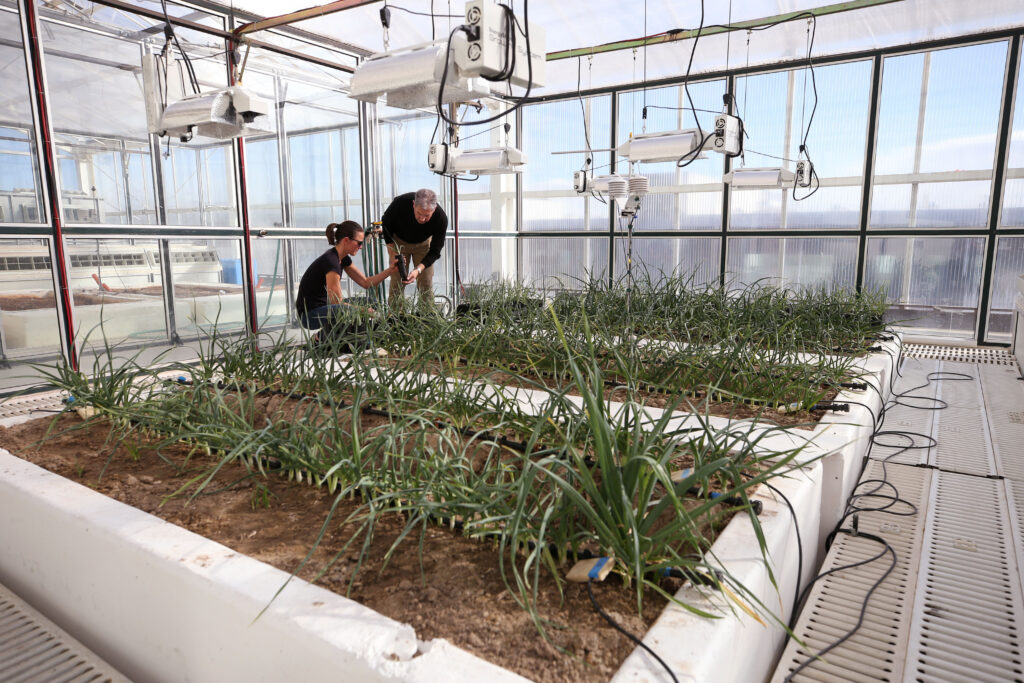
DRI researchers Jay Arnone and Jessica Larsen examine garlic samples grown in DRI’s advanced climate-controlled EcoCell research facility in Reno, Nevada.
Subsequently, the state venture program Battle Born Growth Escalator provided key seed funding. Through the Knowledge Fund and Battle Born Growth Escalator, crucial components of Innovation Based Economic Development (IBED) were reinforced by utilizing GOED’s programs enabling an effective continuum of converting research into launching businesses.
“DRI scientists have long supported Nevada’s agricultural industry. The innovations coming out of our labs were the catalyst in creating Tu Biomics, which is developing commercially viable organic solutions for farmers addressing their biggest crop yield issues,” said Mike Benjamin, President of the Desert Research Corporation, which serves as DRI’s technology commercialization entity.
“The creation of Tu Biomics, with its strong leadership, engaged board of directors and a leading industry partnership, is a validation that Nevada’s higher education research and development engine is working,” Benjamin added. “We will continue to support the research coming out of DRI and tech transfer will continue to thrive by creating solutions for our state and region throughout this adverse economic period.”
In collaboration with the largest garlic grower and shipper in the U.S., the Tu Biomics research team has demonstrated the ability of its BCAs to suppress eight (8) economically significant soil-borne diseases affecting hundreds of agricultural and ornamental plants globally. The team is currently focused on pathogens that impact the key crops of garlic, leafy greens, and strawberries.
“Tu Biomics is another example of the growth of the entrepreneurial and investor community in northern Nevada”, said Brian Speicher, former business development lead at DRI, and CEO of Tu Biomics. “There is a deep reservoir of basic and applied science at DRI, and I believe this is just the first spin-out of many addressing challenges in a number of industries.”
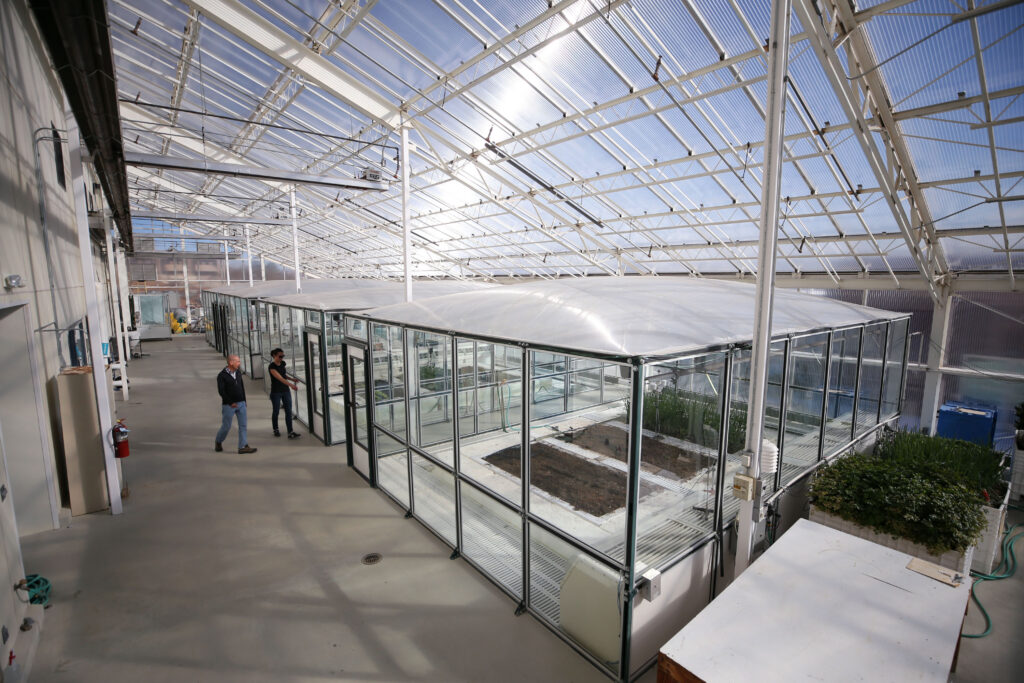
DRI’s Frits Went Laboratory includes four very unique controlled environment chambers. This advanced research facility in Reno, Nevada served as the foundation for DRI researchers to help Tu Biomics develop its lab-to-field trials targeting harmful pathogens in garlic, leafy greens, and strawberry crops.
###
About the Governor’s Office of Economic Development
Created during the 2011 session of the Nevada Legislature, the Governor’s Office of Economic Development is the result of a collaborative effort between the Nevada Legislature and the Governor’s Office to restructure economic development in the state. GOED’s role is to promote a robust, diversified and prosperous economy in Nevada, to stimulate business expansion and retention, encourage entrepreneurial enterprise, attract new businesses and facilitate community development. More information on the Governor’s Office of Economic Development can be viewed at diversifynevada.com.
About the Desert Research Institute
The Desert Research Institute (DRI) is a recognized world leader in basic and applied interdisciplinary research. Committed to scientific excellence and integrity, DRI faculty, students, and staff have developed scientific knowledge and innovative technologies in research projects around the globe. Since 1959, DRI’s research has advanced scientific knowledge, supported Nevada’s diversifying economy, provided science-based educational opportunities, and informed policymakers, business leaders, and community members. With campuses in Reno and Las Vegas, DRI serves as the non-profit research arm of the Nevada System of Higher Education. For more information, visit www.dri.edu.