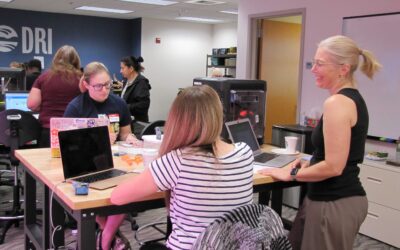
Students assemble a basic electric motor at Gigafactory 1 with Tesla volunteers during Introduce a Girl to Engineering Day 2019. Credit: Tesla
New program to offer K-12 teacher trainings developed by DRI, UNR and UNLV
Reno, Nev. (April 16, 2019) – The Desert Research Institute (DRI), University of Nevada, Las Vegas (UNLV) and University of Nevada, Reno (UNR) are partnering with Tesla to help Nevada’s teachers go from curious to confident in coaching robotics programs.
The Robotics Academy of Nevada – a new statewide professional development program funded by Tesla’s K-12 Education Investment Fund – will launch this summer, facilitated by DRI’s PreK-12 STEM education and outreach program, Science Alive, in partnership with the Colleges of Engineering at Nevada’s research universities.
The Academy is comprised of two week-long teacher trainings designed to help 200 middle and high school teachers to coach robotics programs at their schools, with mentor support throughout the year. Trainings will be held on the universities’ campuses and will be taught by university faculty from the Departments of Engineering and Education, with assistance from college students.
“We are very excited to be given the opportunity to help create this new Academy to directly support Nevada’s teachers,” said Amelia Gulling, Science Alive STEM Education Director at DRI. “The primary highlight of this statewide initiative has been the collaborative partnerships that have been developed with our fellow NSHE institutions, robotics competition programs, and school districts.”
The Academy will introduce engineering and robotics content into the existing curriculum across Nevada, including an introduction to engineering processes, careers and methodologies for integration. Additional content will specifically address the implementation of competitive robotics and computer programming and cyber-literacy. Teachers will be also introduced to other robotics coaches and a network of mentors and others, both inside and outside of the universities, who they can work with year-round.
DRI’s Science Alive program is working with FIRST Nevada and the Robotics Education and Competition Foundation (REC Foundation) in a shared vision to help bring a quality robotics program to every school in Nevada over the next four years.
“The most widely-utilized system for encouraging students to participate in robotics-related activities are competition leagues, FIRST Robotics leagues for example,” said David Feil-Seifer, project lead for the University of Nevada, Reno and assistant professor of computer science and engineering. “We will organize a Northern Nevada Robotics Competition Workshop, which will be open to stakeholders of such a program, such as league administrators, school personnel, parents, University personnel and members of the private innovation community as a hands-on zero-to-competition experience.”
“Tesla and DRI understand that Nevada needs a highly skilled, STEM-ready workforce,” said Brendan O’Toole, chair of UNLV’s mechanical engineering department in the College of Engineering and UNLV lead on the project. “As a longtime FIRST Robotics mentor and coach, I’ve experienced first-hand how robotics programs prepare students to solve challenging problems and strengthen the school-to-STEM-career pipeline by inspiring students to explore science, engineering and technology options.”
The funding of the Robotics Academy of Nevada is part of Tesla’s $37.5 million investment in K-12 education in Nevada aimed at programs that encourage students of all backgrounds to consider a career in STEM or sustainability. Tesla began rolling out the education investment in 2018 and will carry it out over five years.
Trainings will be completely free to educators, and all educators will receive a stipend and continuing education credits. Participants who are non-local will also have accommodations covered.
Trainings will be hosted in both Las Vegas and Reno early this summer:
Las Vegas: May 28-June 1 at UNLV
Reno: June 17-21 at UNR
Recruiting for participation in the Robotics Academy of Nevada is open now, and interested teachers can apply at https://nevadarobotics.org/
###
The Desert Research Institute (DRI) is a recognized world leader in basic and applied interdisciplinary research. Committed to scientific excellence and integrity, DRI faculty, students, and staff have developed scientific knowledge and innovative technologies in research projects around the globe. Since 1959, DRI’s research has advanced scientific knowledge, supported Nevada’s diversifying economy, provided science-based educational opportunities, and informed policy makers, business leaders, and community members. With campuses in Reno and Las Vegas, DRI is one of eight institutions in the Nevada System of Higher Education.
University of Nevada, Las Vegas is a doctoral-degree-granting institution of more than 30,000 students and 3,500 faculty and staff that is recognized among the top three percent of the nation’s research institutions – those with “very high research activity” – by the Carnegie Classification of Institutions of Higher Education. UNLV offers a broad range of respected academic programs and is committed to recruiting and retaining top students and faculty, educating the region’s diversifying population and workforce, driving economic activity, and creating an academic health center for Southern Nevada. Learn more at unlv.edu.
The University of Nevada, Reno is a public research university committed to the promise of a future powered by knowledge. Founded in 1874 as Nevada’s land-grant university, the University serves nearly 22,000 students. The University is a comprehensive doctoral university, classified as an R1 institution with very high research activity by the Carnegie Classification of Institutions of Higher Education. More than $800 million has been invested campus-wide in advanced laboratories, residence halls and facilities since 2009. It is home to the University of Nevada, Reno School of Medicine and Wolf Pack Athletics, as well as statewide outreach programs including University of Nevada Cooperative Extension, Nevada Bureau of Mines and Geology, Small Business Development Center and Nevada Seismological Laboratory. The University is part of the Nevada System of Higher Education. Through a commitment to student success, world-improving research and outreach benefiting Nevada’s communities and businesses, the University has impact across the state and around the world. For more information, visit www.unr.edu.
Media Contacts:
Justin Broglio
Desert Research Institute
justin.broglio@dri.edu
(775) 673-7610
Mike Wolterbeek
Communications Officer
University of Nevada, Reno
mwolterbeek@unr.edu
(775) 784-4547
Tony Allen
Director of Media Relations
University of Nevada, Las Vegas
tony.allen@unlv.edu
(702) 895-3102