Sandra Brugger, Ph.D., is a Postdoctoral Researcher with DRI’s Division of Hydrologic Sciences, and a Swiss National Science Foundation (SNSF) Fellow.
DRI: What brought you to DRI?
Brugger: I started at DRI in October 2019 with an Early Postdoc Mobility grant funded by the Swiss National Science Foundation (SNSF). DRI is home of one of the world-leading ice core labs. I am extremely grateful that I could join Professor Joe McConnell’s ice core group in the Division of Hydrologic Sciences (DHS) and be co-supervised by Professor Dave Rhode in the Division of Earth and Ecosystem Sciences (DEES).
DRI: What are your research interests?
Brugger: I am interested in past vegetation dynamics and their relationship with climate change and human activities. Using optical pollen, charcoal, and other microfossil analyses in ice cores, we can infer how the ecosystems and fire regimes have changed over time. We can then try to reconstruct sensitive ecosystems in high latitude regions to gain a better understanding how they will react to rapid global warming.
DRI: What is the SNSF Fellows Virtual Conference?
Brugger: The conference is a multidisciplinary platform where Postdoc fellows are sharing their exciting results and show how diverse the research is that the Swiss National Science Foundation is funding with over 700 projects around the world.
DRI: How did you get involved in helping lead this unique event?
Brugger: Most conferences were cancelled this summer. Young scientists rely very much on presenting their results, networking at scientific meetings, and interacting with other research fellows. Therefore, my SNSF-Mobility fellow Tobias Schneider (University of Massachusetts) and I spontaneously decided on a Friday evening over a virtual glass of wine on Zoom to turn our own pandemic misery into a virtual conference for us and our fellow SNSF-postdoc fellows in the US and around the world. Six weeks and several virtual wine glasses later, we are ready and excited to host the four-day long conference on Zoom.
The multidisciplinary character of the conference is also reflected in the exciting keynotes that will be presenting their research. Among them, we have two from DRI: Professor Monica Arienzo will introduce us to her latest research on microplastics in Alpine environments, and Professor Joe McConnell will be presenting on Roman lead pollution in Arctic ice cores.
Since we have one thing in common among all fellows, the COVID-19 pandemic, we decided to hold a daily panel on COVID-19 with invited frontline workers that will be hosted by Theresa Watts, Professor at ORVIS School of Nursing at UNR. On Thursday, Professor Ajay Sethi from the University of Wisconsin-Madison will give a keynote on conspiracy theories around COVID-19.
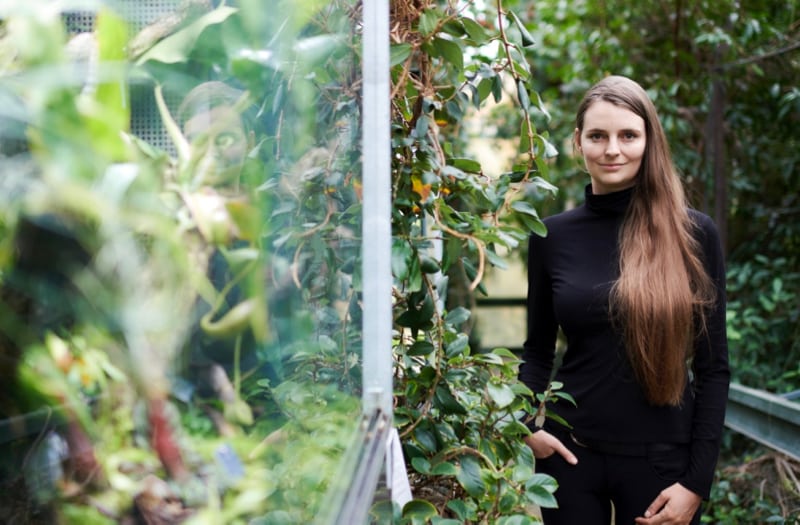
Sandra Brugger (Klimaforscherin), Institute of Plant Sciences, PhD student – Palaeoecology. © Manu Friederich
DRI: What are you hoping to accomplish? What would be the best outcome for this event?
Brugger: We hope to provide an inspiring meeting where people can present their work, get new input, and maybe even provide additional research motivation during difficult home-office situations they are experiencing. And above all, we are excited to get to know our fellows and their fascinating research projects.
DRI: How can people get involved or watch the event?
Brugger: The event is free of registration and will be hosted on three platforms: Zoom, Youtube and Remo. The program and the links to join the virtual conference can be found on our Event website: https://www.swissnexboston.org/event/snsf-fellows-conference/ hosted by Swissnex Boston, our partner for the conference.
DRI: How has your work been impacted by the pandemic?
Brugger: My own research has been severely impacted. I started the project only 8 months ago and since March we have only very limited access to lab facilities. This is critical for sample preparation and analyzing data in this early stage of the project.
Also, our group had to cancel fieldwork and as mentioned above, most conferences got cancelled this summer and for the upcoming months hopefully can be replaced by virtual meetings. It was a tough time to arrive new to the USA from Switzerland and to face the pandemic in a foreign country.