
News & Announcements
Working to Solve our Most Challenging Environmental Problems
DRI’s research calls on the expertise and methods of scientists from multiple scientific disciplines. More than 600 highly-skilled scientists, engineers, technicians, students, and staff work collaboratively within and across three research divisions, focused on understanding and answering critical science questions about global climate change, water quality and availability, air quality, the sustainability of desert lands, life in extreme environments, education, and more.

Remembering the Legacy of Sue Wagner, Long-Time DRI Supporter and Pioneering Woman in Nevada Politics
Sue Wagner built the foundation for state support for DRI. She joined the staff of DRI in 1981 and served as Special Assistant for Government and Legislative Affairs for nine years, and ending when she was elected Lieutenant Governor. One of her major achievements at DRI was shepherding of special legislation through the U.S. Congress to establish the DRI Dandini Research Park. Sue remained active in local and state politics and continued to play a role in supporting promising scientists from DRI and beyond.

Andrey Khlystov and Nathan Chellman Receive 2026 Board of Regents Awards
The Nevada System of Higher Education (NSHE) Board of Regents awards Andrey Khlystov, Ph.D., the 2026 Regents’ Distinguished Career Award in recognition of his significant accomplishments and contributions to the field of atmospheric science, and Nathan Chellman, Ph.D., the Jason Geddes Rising Researcher Award in recognition of his outstanding early-career accomplishments and potential to advance scientific knowledge in the field of hydrologic sciences.
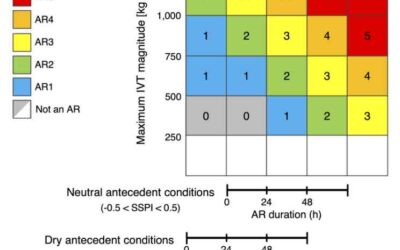
Accounting for Soil Saturation Enhances Atmospheric River Flood Warnings
Atmospheric rivers carry unfathomable amounts of water across the sky, bringing moisture to drought-stricken regions like the Western U.S. But whether a particular incoming atmospheric river storm will result in disastrous flooding has long been difficult for researchers to determine with confidence. Now, a new DRI-led study demonstrates that accounting for soil saturation levels can substantially improve our early warning of potentially destructive flooding events. The research, published February 12th in Nature Communications, was led by DRI hydrologist Mariana Webb. She and her team examined more than 71,000 atmospheric river storms in the Western U.S. and central Chile to improve flood hazard early warning.
Southwest Stormwater Center to Provide Regional Best-Practices Solutions for Stormwater Management, Financing
Stormwater management professionals and stakeholders across the U.S. Southwest region will be able to learn about the latest, best-practices solutions for stormwater management and financing through the newly established Southwest Stormwater Center (SWSC), a regional knowledge center for new and emerging stormwater control technologies.

DRI Awarded Grant to Advance AI and Computer Science Education for K-12 Preservice and Inservice Educators
The $2.7 million Department of Education award is a Fund for the Improvement of Postsecondary Education grant. The four-year project will address the need to advance artificial intelligence (AI) and computer science classroom education in grades K-12. To accomplish this, training and resources will be provided to undergraduate preservice educators and those already in the classroom, with a focus on Nevada’s rural communities.
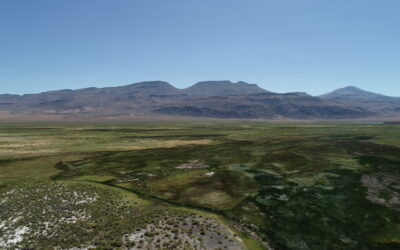
New Tool Will Help Manage One of Nevada’s Most Critical Freshwater Sources
The Nature Conservancy in Nevada (TNC in Nevada), DRI, and the University of Wisconsin – Madison (UW-Madison) have developed the Nevada GDE Water Needs Explorer Tool. This new online resource helps land and water managers understand how groundwater supports groundwater-dependent ecosystems (GDEs) and how changes in water levels can affect them.
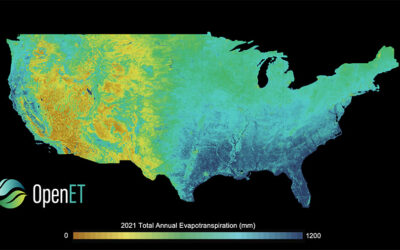
NASA and Partners Expand Crucial Water Tracking Program
DRI’s Charles Morton, Associate Research Scientist of Geography, who had a key role in the expansion of OpenET said, “Delivering wall-to-wall evapotranspiration data across the contiguous United States at the field scale is a major milestone for OpenET, and it’s exciting for us to imagine the future research and practical applications this expanded coverage will unlock.”
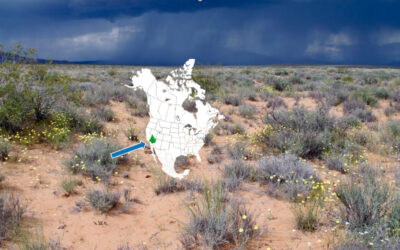
A Rare Desert Plant Shows Benefits of Sustainability Efforts at a Large Solar Array in the Mojave Desert
Although sunlight is one of the cleanest forms of renewable energy available, clearing large swathes of desert habitat to build solar arrays has consequences for the plants and animals it displaces. Researchers are trying to find better ways to preserve desert landscapes without impeding solar energy development. Now, a new study demonstrates that with careful planning and consideration for the ecosystem around it, at least one desert plant is surviving — and thriving — amidst the solar panels helping to power Las Vegas.

The DRI Foundation Welcomes New Chair and Trustees for 2026
The DRI Foundation, the non-profit arm of DRI, is pleased to announce new members to its Board of Trustees. The DRI Foundation Board of Trustees work in close collaboration with DRI President Kumud Acharya and the Office of Advancement to engage and build relationships with new and existing supporters to further DRI’s work across Nevada and around the world.

New Study Offers a Glimpse Into 230,000 Years of Climate and Landscape Shifts in the Southwest
Atmospheric dust plays an important role in the way Earth absorbs and reflects sunlight, impacting the global climate, cloud formation, and precipitation. Much of this dust comes from the continuous reshaping of Earth’s surface through the erosion of rocks and sediments, and understanding how this process has shaped landscapes can help us decipher our planet’s history – and its future. Although an ephemeral phenomenon by nature, dust emissions through time can be depicted through natural archives like lake sediment cores. In a new study, scientists examine one such record to peer 230,000 years into the past of the American Southwest.
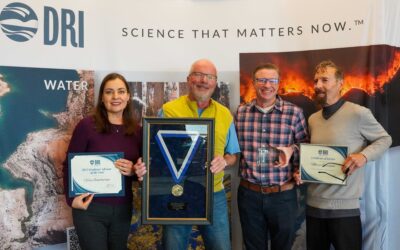
Annual Awards Presented to DRI Faculty and Staff at 2025 Celebration of Science
DRI’s annual awards and recognition ceremonies were held at our Reno and Las Vegas campuses in October to honor scientists and staff members for their achievements. Along with the below awardees, several faculty and staff were recognized for their long-term service to the institute. DRI prides itself on fostering a fulfilling workplace that builds internal community and inspires scientific discovery.
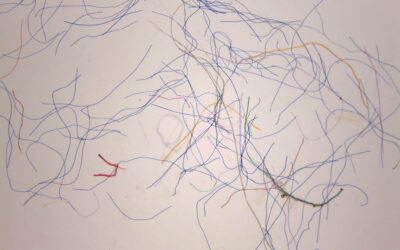
Household Dryers Are Significant Sources of Microfiber Pollution, Study Finds
The fabrics that fill our homes, from natural cotton towels and bedsheets, to clothes produced with synthetic materials, produce microscopic fibers as they break down over time. Previous research has shown that household washers collect and release these microfibers into the environment, and now a new study uses citizen science to demonstrate how dryer vents also produce microfibers under normal household use.