EXTREME WEATHER & HYDROPOWER
SCIENCE THAT MATTERS NOW
At DRI, our scientists study the forces shaping our water, air, and ecosystems—from droughts and floods to wildfire impacts and changing climates. For hydroelectric operators, this research offers critical insights into how shifting weather patterns, reservoir conditions, and watershed health affect both reliability and resilience. Our goal is to turn cutting-edge science into practical knowledge that helps you manage resources, reduce risks, and prepare for the future.
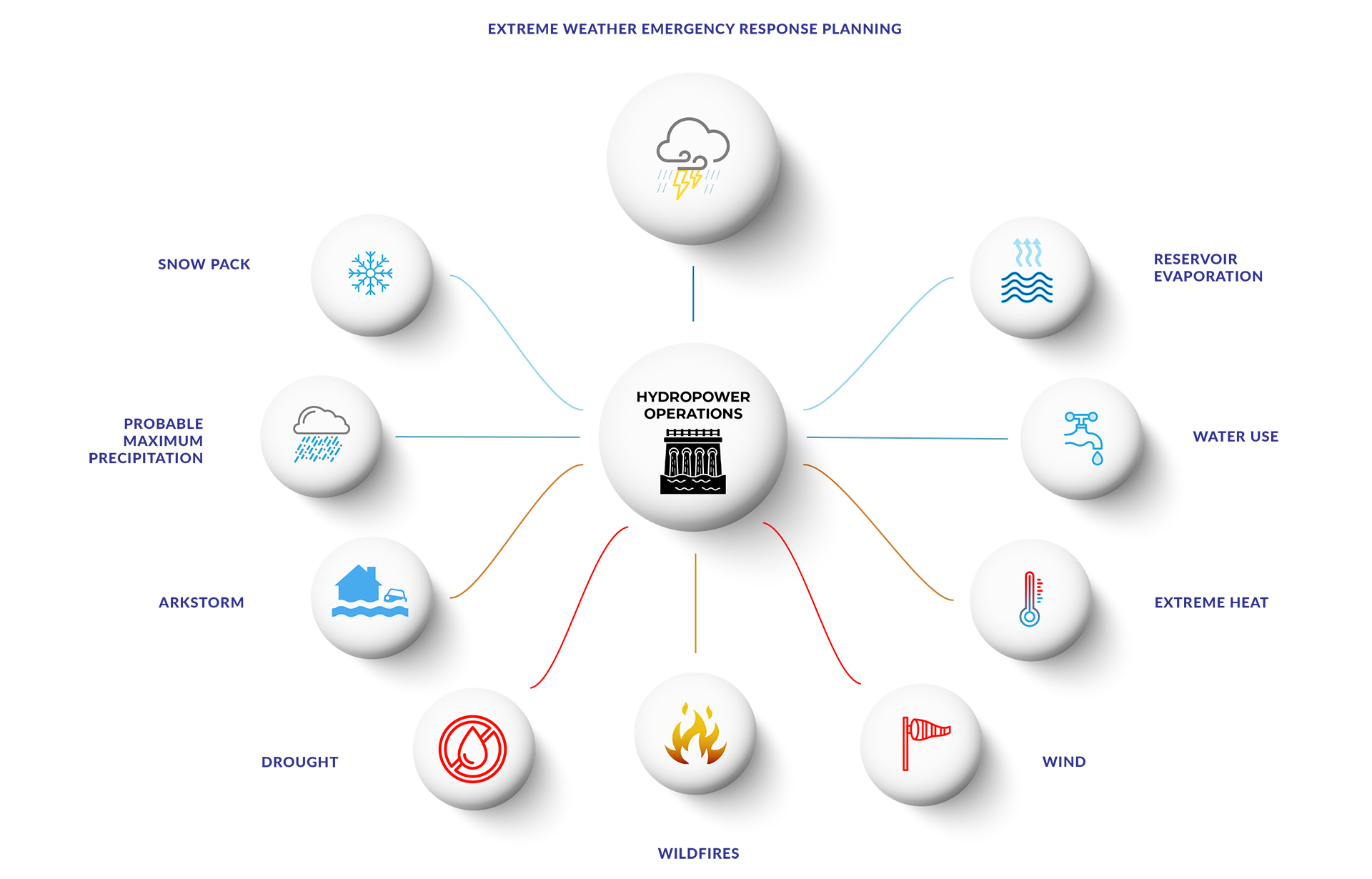
EXTREME WEATHER EMERGENCY PLANNING
SNOW PACK
DRI Science on the Colorado River
Climate Engine
Access and analyze historic and forecast climate and hydrology data and remote sensing archives
Information and Tool (requires setting up simple login)
Climate Toolbox
(visualizing past and projected climate and hydrology for CONUS):
climatetoolbox.org
PROBABLE MAXIMUM PRECIPITATION (PMP)
Modernizing Probable Maximum Precipitation (PMP) Estimation
Information: National Academies Study, “Modernizing Probable Maximum Precipitation Estimation”
ARkStorm
CLIMATE/WEATHER PREPAREDNESS (DROUGHT, WIND, TEMP, PRECIPITATION, WILDFIRE)
Climate Engine
Access and analyze historic and forecast climate and hydrology data and remote sensing archives
Information and Tool (requires setting up simple login)
Climate Toolbox
(visualizing past and projected climate and hydrology for CONUS):
climatetoolbox.org
Western Region Climate Center Tools (WRCC)
wrcc.dri.edu/my/climate (you need to register to access this site)
Montana Climate Office (U. Montana) – Drought Resources
Upper Missouri River Basin Drought Indicators Dashboard
History of the US Drought Monitor (from 2000-present)
Wildfire Risks:
NICC National Interagency Coordination Center
WATER USE
OpenET
For water management and evapotranspiration in the Western US
RESERVOIR EVAPORATION
Open Water Evaporation Network
Texas Reservoir Evaporation Tool
Texas Gridded Evaporation Tool
Forecasting: 28-day forecasts using downscaled CFS
CONUS-wide Modeling Coming Soon: 44,000+ water bodies throughout the CONUS with low latency estimates using NOAA Unrestricted Mesoscale Analysis (URMA)
In-situ Monitoring
Targeted initiatives including weather and eddy covariance data collection to inform and validate model performance.
Lake Powell
Klamath Lake
Remote Sensing
Testing and validating new technologies for widescale monitoring of reservoir evaporation, storage, and change.
Surface Area Estimation with HLS
New Technologies