
Lake Vida Project
2010 - 2012Geochemistry and Microbiology of the Extreme Aquatic Environment in Lake Vida, East Antarctica
Lake Vida, in the McMurdo Dry Valleys of East Antarctica, is one of the largest lakes in the region. It was originally thought to be an ice block lake – frozen solid. However, in 1995, ground penetrating radar surveys revealed a very salty liquid layer (a brine) underlying a 20 m (66 foot) ice cover. This started a series of investigations on the history and physics behind the formation of this unusual lake, as well as on the potential for life in the brine, and how it survives.
Lake Vida is not a lake like those of Wisconsin or Michigan. Unlike those lakes, Vida has an ice cover year round. In fact, the ice cover is so thick that water trapped under the ice is completely isolated from other environments. In the summer, new water coming in from glacial streams cannot get under the ice and so it flows on top and freezes. This leads to a unique situation where a thick ice cover on Lake Vida requires occurrence of warm summers (and therefore more stream flow).
We’ve created these pages for you to learn about our research and adventures. Enjoy.
Members of the Lake Vida expedition team.
- Why Lake Vida?
- Technical Science Summary
- Project Participants
- History of Research at Lake Vida
- 2010 Lake Vida Expedition
- Publications
- Presentations
- Press
Why Lake Vida?
We are interested in Lake Vida because it is an extreme environment. Several features make it a place where it is difficult to live:
- The water is about 6 times more saline than seawater;
- The lake has been isolated from the surface environment (and the resources there) for a long time;
- It is cold, -14 ºC (7 ºF) year round;
- It’s dark. The ice cover is thick enough and there is enough sediment that all light is blocked.
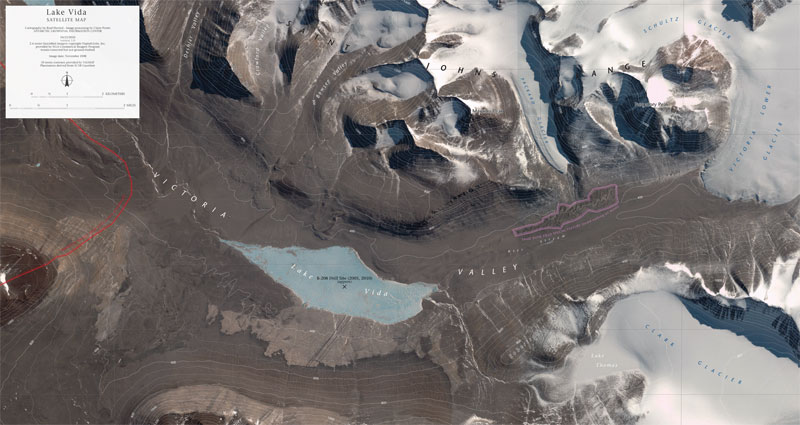
Map of Lake Vida, Antarctica.
Where There is Water, There is Life
On Earth there is a scientific mantra “where there is water, there is life”. There are only a few documented exceptions to this rule, and they are often controversial. Is Lake Vida one of these exceptions, or is there a viable microbial community there? Answers to this question are very important to the question of origins, evolution, and survival of life on Earth and on frozen extraterrestrial planets and satellites (i.e. moons and asteroids). We are also interested in the history of this lake and the record of climate change locked up in the ice cover and sediments.
Technical Science Summary
Lake Vida is the largest lake of the McMurdo Dry Valleys, and yet remains one of the least studied. However, it is known that this lake has a ~20 m ice cover overlaying a brine of unknown depth with at least 6 times seawater salinity and temperatures below -10 ºC year-round. It is also known that this brine has been isolated for 2,800 years. Thick sediment layers high in the ice cover fully block light penetration, insuring that any ecosystem in the brine is not currently photosynthetic. Samples of brine collected in November 2005 from 16.5 m down in the ice cover contain 1) the highest nitrous oxide levels of any natural water body on Earth (Dr. Samarkin, personal communication), 2) unusual geochemistry including anomalously high ammonia (nearly 4 mM), and iron concentrations (0.3 mM), 3) high microbial counts (106 to 107 cells per milliliter), 4) active bacteria (evidence of protein production), 5) a population of microbes including an unusual proportion (99%) of ultramicrobacteria, and 6) a microbial community that is unique even compared to other Dry Valley Lakes.
In this study, it is proposed to enter for the first time the main brine body below the thick ice of Lake Vida and perform in situ measurements, collect samples of the brine column, and collect sediment cores from the lake bottom for detailed geochemical, sedimentological, and microbiological analyzes The results will allow the characterization of present and past life in the lake, assessment of modern and past sedimentary processes, and determination of the lake’s history.
This study will have as a guiding premise:
- An ecosystem exists in the main brine body of Lake Vida.
- This ecosystem derives its resources from ancient pools resulting from its prior coupling with the surface (e.g. during times of thinner ice covers through stream input, aeolian deposition and subsequent fallout through the ice, and in situ photoautotrophy).
- Alternatively, if this encapsulated ecosystem did not exploit its resources, it must be receiving energy from an unknown process that geochemical and microbiological analyses will help constrain.
This study gathers a synergistic, multidisciplinary team of scientists, biologists, organic and inorganic geochemists, hydrologist, limnologist and sedimentologist. This team will be able to provide a new understanding of the biogeochemical processes allowing survival of a non-photosynthetic microbial community isolated for a prolonged period of time. This research will address diversity, adaptive mechanisms and evolutionary processes in the context of the physical evolution of the environment of Lake Vida. Sampling and cleanliness procedures, derived from the teams experience in brine sampling, are already being touted as an example of how future field exploration of subglacial lakes may be done.
Society at large will benefit from expanded knowledge of the limits of life on this planet. A thorough understanding of these limits expands our perception of the origin and evolution of life as we know it. Lake Vida may also be a model of what other dry valley lakes were like during climatic deteriorations in the past.
Principal Investigators
Peter Doran
Alison Murray
Fabien Kenig
Chris Fritsen
Giles Marion
Graduate Students
Ema Kuhn
Hilary Dugan
Gareth Trubl
Collaborators
Nathanial Ostrom
Lisa Pratt
Seth Young
Ross Edwards
Bernd Wagner
Diane McNight
Clara Castro
Reed Sherer
Chris McKay
Adrian Ponce
Frank Loeffler
Brian Glazer
Chris Hall
Mike SanClements
Jon Wornock
Technical Team
Vivian Peng
Peter Glenday
Jay Kyne
History of Research at Lake Vida
Lake Vida was first discovered by Victoria University’s (New Zealand) Antarctic Expeditions (VUWAE; 1958-59). The lake was then named after Vida, a sled dog on Robert Falcon Scott’s second (and fatal) expedition to reach the South Pole. Lake Vida is the largest lake of the McMurdo Dry Valleys, and yet remains one of the least studied. For years it was presumed frozen solid. Scientists from New Zealand drilled into Lake Vida in the 1960’s and could not find liquid water.
During the 1990’s, Peter Doran, while doing Ph.D. research in the area as part of the McMurdo Dry Valleys Long term Ecological Research site, became curious about this result and decided to use ground-pentrating radar (GPR) across the lake to help confirm or deny the presence of liquid water beneath. Those results clearly showed a body of very salty water under about 60 feet of ice in the center of the lake. The New Zealand scientists had drilled near the edge of the lake where indeed the lake is frozen to the bottom. A year after the GPR survey, Peter Doran led a small research effort at Lake Vida in collaboration with Chris Fritsen and John Priscu, who were working under a grant from the National Science Foundation (NSF) to study life in extreme environments. Ice cores were collected down to a depth of 14 m. the cores showed a beautiful and diverse array of frozen microbial mats, sediment and gas bubbles. Some of the organic matter in the ice core was dated and suggests that the ice cover has a history spanning about 3000 years. At 14 m depth, the ice was wet and salty and a bit of the water pooled in the very bottom of the hole. Problems with our hole melting equipment prevented us from drilling deeper without risking contamination of the lake.
In 2005, a project supported by the NASA program Astrobiology Science and Technology for Exploring Planets and led by Peter Doran had two objectives (i) develop a new ice drilling technology suitable for unmanned spaceflight and (ii) sample the saline waters of Lake Vida with the goal of assessing the chemical qualities of the waters and potential for life. Though the body of liquid water was not penetrated, we sampled brine entrained in the lower layers of the ice (16.5 m) that filled our borehole. From the information obtained from initial brine characterization, we have now a much clearer picture of how interesting this system is. [link to technical science summary
Historical Recap from Peter Webb, Geologist on the First Expedition to Victoria Valley
VICTORIA UNIVERSITY ANTARCTIC EXPEDITION (VUWAE-1 (1957-58)
The VUWAE-01 party was a subset of the New Zealand Trans-Antarctic Expedition led by Sir Edmund Hillary. The Victoria Valley party comprised Dr Ronald Balham (Biologist), Richard Barwick (Biologist), Andrew Packard (Biologist), and Peter Webb (Geologist). The first two were faculty members from the Department of Zoology at VUW, Packard was a guest scientist from the United Kingdom, Webb was an undergraduate student in geology from the Department of Geology at VUW. This was the first party to operate in the area.
During the summer season of 1956-57 the New Zealand Royal Air Force flight wing flew their Beaver an Auster aircraft over what later became known as Wright and Victoria Valleys and took low level reconnaissance photos. The large lake in the mid section of Victoria Valley was designated as the location for the four man party camp the following season. In the 1957-58 season the camp site was established at the western end of what was later named Lake Vida (Vida was a Scott Expedition 1910-13 husky).
The party flew into Lake Vanda in the US Navy Sikorsky helicopter “King Pin” as one very heavy load, also taking in a small rowing boat. The helicopter was so heavily laden that it couldn’t make enough elevation to get through Bull Pass and went back down Wright Valley and entered Victoria Valley over Clark Glacier. Open water existed only at the eastern end of the lake close to the camp site. The boat proved useful in this location. The remainder of the lake was ice covered as it is today.
The weather was mostly excellent for fieldwork. There was no snowfall but we did experience very high valley floor winds at times. Streams entering the eastern end of the lake were in flood for several hours a day. On his traverse to Lower Victoria Valley Peter Webb encountered a severe sand storm (in the region of the dunes on the northern side of Lake Vanda) and for a while enjoyed zero visibility and a good sandblasting. The party ranged all over the valley system on foot. This included visits to Lake Vashka, Upper Victoria Glacier, Sponsors Peak, Insel, and the peaks to the north and south (St Johns Range, eastern Olympus Range,etc). Panorama photos (360 degrees)) were taken from all peaks climbed; and the full length of Lake Vida was measured by step counts. Triangulation based on the panorama photos and length of the lake, which appeared in many pans, were later used to create a basic field map. These data and those from the TAE northern party were used when the first 250,000 scale topo maps were prepared by the NZ Lands and Survey and US Geological Survey.
The biologists concentrated on sampling lake water for micro-organisms, taking soil samples, algae and lichen samples. All members contributed to discovery, mapping and later carbon dating of numerous mummified seals and penguins. Much of this was later published in NZ. Peter Webb conducted the geological sampling and mapping program, used the data in his M.S, thesis, and published it in the NZ Journal of Geology and Geophysics in 1959.
Work in the Victoria and Wright Valleys area was continued by the VUWAE-2 (1958-59) and VUWAE-3 (1959-60) parties. Results from these three seasons of work was published in Nature, Journal of Glaciology, and the NZ Journal of Geology and Geophysics. Further information on these early days can be found in Colin Bull’s (2009) recent book “Innocents in the Dry Valleys” (Victoria University Press).
The 2010 Lake Vida Expedition
We have spent more than 12 months planning for the 2010 field season. The expedition requires complex logistical planning, ordering and shipping of supplies to Antarctica, in order to achieve a multi-disciplinary effort to sample the Lake Vida comprehensively. We benefited from the help of Raytheon Polar Services Company, which is managing Antarctic activities for the National Science Foundation.
All of the PIs and collaborators prepared for state of the art sampling of ice, brine, and sediments to obtain and preserve pristine samples and to prevent forward contamination during sampling. The treatment of samples for each type of analysis must follow strict protocols, requiring a high level of preparation and organization.
At the same time members of the field team must be considered ‘physically qualified’ for Antarctic deployment. This includes passing a number of medical tests warranting the good health of the deployee.
2010 Lake Vida Field Team
The 2010 Lake Vida Field Team included Peter Dora, Alison Murray, Fabien Kenig, Chris Fritsen, Hilary Dugan, Emanuele Kuhn, Bernd Wagner, Seth Young, Brian Glazer, Peter J. Glenday, and Jay Kyne.
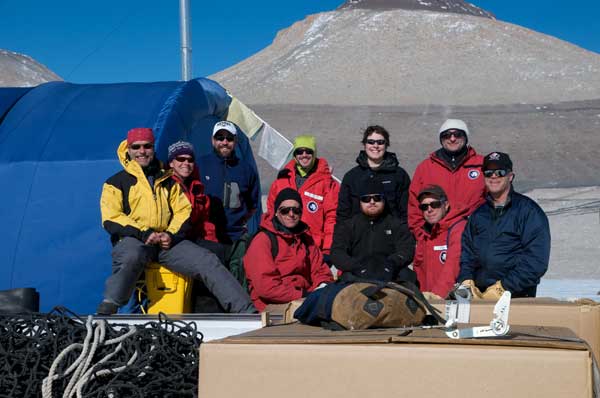
Lake Vida Field Team Group Photo. Front row: Jay Kyne, Bernd Wagner, Seth Young, Peter Doran, Peter Glenday; rear row: Alison Murray, Chris Fritsen, Brian Glazer, Emanuele (Emma) Kuhn, Fabien Kenig (Hillary Dugan missing from photo).
Field Plan
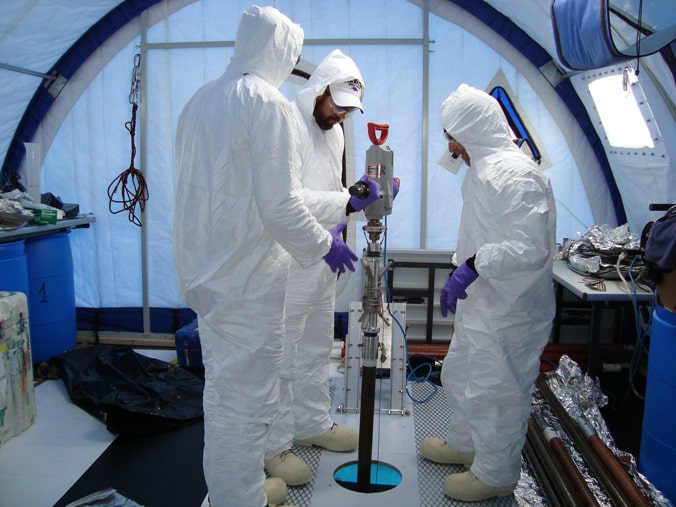
The second step is drilling a hole in the 20 m ice cover as well as collecting and describing an ice core.
The third step corresponds to the implementation of an environmental protocol developed and tested in 2005 to avoid forward contamination to the lake. This protocol implies the detailed cleaning and sterilization of any hardware penetrating the lake water as well as the making of a distilled water ice sheathing of the top 14 meters of the borehole with less than 103 cells/mL. The latter is justified by the differences between the algae-rich organic matter of the ice cover and the sole presence of bacteria in the brine.
The fourth step is penetration of the lake body by drilling the last 6 meters of the ice cover and adjustment of the borehole head so the water column of the lake is not disturbed.
The fifth step is the characterization of the water column by CTD (conductivity, temperature, density) which also measures oxygen concentration and pH, electrochemistry, visual (camera). This step will provide the information necessary to constrain our sampling strategy [e.g. depth of sampling].
The sixth step is sampling of the brine (at a maximum of 10 depths).
The seventh step is an enlargement of the lower section of the borehole so that sediment coring can take place in a protective sleeve to avoid any mixing of the water column and limit disruption of the sediment/water interface to the specific area of coring.
The eighth step is sediment coring. We have three types or sediment coring devices with us as we do not know yet which one will be the best to use. The first one is a gravity corer, the second one is a push corer and the third one a piston corer.
The Science
Environmental Stewardship
Field Planning
Geochemistry
- Sulfur biogeochemistry (Seth A Young)
- I will be investigating the past and present biogeochemical cycles of sulfur at Lake Vida. Microbial communities, that are not photosynthetic, have been documented from hypersaline brine previously collected from Lake Vida in 2005. Other prime candidates for microbial metabolic pathways in Lake Vida are sulfate reduction, sulfur disproportionation, and sulfide oxidation. Sensitive indicators of sulfur utilization by microbes are sulfur isotopic compositions of ions in the water column, minerals, and organic matter in the sediment column.For each sampling depth brine will be drawn into two 60 ml polycarbonate syringes each containing 10 ml of 1.5 M cadmium chloride solution that will fix any aqueous sulfide as cadmium sulfide. The soluble sulfate in the brine sample syringes will be recovered by addition of ~ 100 ml of saturated (0.2 M) BaCl2 solution, and precipitated as BaSO4. Additionally, at each sampling depth brine will be drawn up into a 15 ml gas-tight glass syringe for transitional sulfur species (SO32-, S2O32-, S0) characterization, and once filled they will be immediately flash frozen with dry ice to ensure preservation and minimize oxidation of transitional ions.Sediments from Lake Vida, taken at regular intervals, will be sequentially extracted for sulfur species yielding: water-soluble sulfate, elemental sulfur, acid-soluble sulfate, acid-volatile sulfides, chrome-reducible sulfides. Once all sulfur species have been chemically extracted, dried and homogenized, they will then be weighed into tin capsules with excess V2O5 and analyzed for their sulfur isotopic compositions using an elemental analyzer coupled to a Finnigan MAT 252 isotope ratio mass spectrometer in the Stable Isotope Research Facility (SIRF) at Indiana University.Biogeochemical processes operating within this perennially ice-covered lake may potentially be analogous to unexplored subglacial aquatic environments and periods of Earth’s history where oceanic photosynthesis dramatically declined (e.g. Neoproterozoic Snowball episodes). Lake Vida could also be a crucial analogue for extraterrestrial systems such as Europa or Mars.
- Organic geochemistry (Fabien Kenig)
- Organic geochemical analysis will be carried out on two sample types: i) lake brine and ii) core sediment samples.In the field, the brine will be filtered sequentially, under anoxic conditions, on precombusted 0.7 µm glass fiber filters and on 0.22 µm teflon filters to separate size fractions of microbial cells. A group of larger cells (105 cells/ml >) will be separated from abundant suspected ultramicrobacteria (107 particles/ml) observed in the ice brine we collected 5 years ago. Both filter type and sediment samples will be extracted in organic solvent and the extract will be analyzed for lipid constituents, including intact polar lipids and other biomarkers, by high pressure-liquid chromatography-mass spectrometry and gas chromatography-mass spectrometry (GC-MS). The stable carbon isotopic composition of single compounds will be analyzed to help constrain the processes of carbon assimilation and/or the source of carbon used by the source organisms of these biomarkers. Volatiles in the brine will also be analyzed by solid phase micro-extraction (SPME)-GC-MS.If the study of biomarkers and their isotopic composition in the brine will help constrain the nature of the current biological community of Lake Vida, the study of biomarkers in sediment core samples will provide information on the lake’s past biological communities. Biomarkers provide a tool to follow the evolution of the lake biological community as Lake Vida changed from an open lake with a thin ice cover to the encapsulated brine system we observe now.
- Inorganic chemical characteristics: nutrients, ions, dissolved metals
- Gases
- Radiochemistry
- Stable isotopes
- In situ electrochemistry (Brian Glazer)
- Aquatic environmental field techniques capable of making unobtrusive in situ measurements are very desirable for acquiring high-quality biogeochemical data. Continued refinement and development of such techniques for application to astrobiological priorities including exploration of ice-covered satellites is of great interest.At Vida, once the lake brine is penetrated, Glazer’s primary objective is to perform in situ voltammetric profiles, minimally disturbing the brine structure, and quantifying gradients of key redox-reactive chemical species present. Voltammetry is proving to be one of the more promising analytical techniques for quantifying redox couples in aquatic systems because it allows for simultaneous measurement of several analytes in real time (O2, H2S, Mn(II), Fe(II), S2O32-, S4O62-, Sx2-, S(0) and aqueous species of Fe(III) and FeS).Using a three-electrode potentiostat, a voltage ramp is applied to the custom solid-state working electrode (i.e., Au/Hg electrode) versus a reference electrode (i.e., Ag/AgCl electrode). Current at the working electrode surface is simultaneously measured through a counter electrode (i.e., Pt electrode). Current is proportional to concentration; analyte concentration can be calculated from current peak heights obtained in voltammograms using calibration coefficients established during laboratory standardizations (analogous to measuring absorption peaks at given wavelengths in spectroscopy).
Microbiology
- Microscopy
- Activity assays
- Molecular biology and genomics
Paleoclimate and Paleobiology
- Temperature record
- Sedimentary record
- Diatom record
Reports from the Field
15 November 2010 – Making Progress on our Field Plan
Alison Murray writing:
Hot off the presses…. Helicopter coming in an hour so thought I’d try and get a brief update out on USB stick to relay to Bernd Wagner who’s the only team member still in McMurdo.
We are progressing through the plan to access the lake… on the board checked off are: camp set up, drill to 13.1 m, widen the hole to 42 cm (which got a little wider), clean the hole – and achieve our goal of cell counts in the ice melt of 5 x 10⁴ cells per milliliter. That happened on Nov. 10 at 1:30 am, then we let the hole freeze for 4 days to create the clean ice pipe to sample through. This morning we started drilling to access the lake. That started at 9:00 am. As I write now – 7:45 pm we keep thinking that each time the drill goes down the hole it will be the last time, and that we’ll punch through and be “there”! We’ve been saying that however, since 2:30 pm. Since then it’s been a mix of emotions including excitement, frustration, followed by thrill, then perhaps back to frustration. We’ve hit some significant sediment layers that are challenging both to drill through, and to pick up with the core barrel. We started drilling at 13.8 m down the hole, and now are around 22 m down – retrieving the core along the way (see photo gallery).
Stay tuned for more… not sure how this is going to turn out at this point! Will there be a brine lake at the bottom of this hole??
What else…? Time spend during the week while the hole was freezing included some local hikes in the Victoria Valley (see some pictures in the photo gallery), finishing up on the cell counts for the hole cleaning process, catching up on sleep, reading and preparing for the next step which includes a quite complicated plan for sampling the brine.
– Lake Vida Team
8 November 2010 – Lake Bonney, Taylor Valley
Peter Doran writing:
I am at Lake Bonney in Taylor Valley for a few days getting caught up with my other project here with the McMurdo LTER. Myself and Peter Glenday left Lake Vida yesterday. That left 5 people in the camp still filtering the water in the hole. This morning Bernd Wagner, Fabien Kenig and Brian Glazier arrived at Vida to help out and get acclimated. Chris Fritsen flew back to McMurdo. Switching people in and out of Vida is necessary to meet our environmental requirements (there can never be more than 8 in the camp), and to keep people fresh. The long hours are grueling. I was pleasantly surprised to look at our initial schedule today and see that we are only a few days behind. Past experience told me to put a lot of buffer in the schedule to account for the unknowns. It usually doesn’t hurt to double the time estimates when you are doing planning back in the office. I often tell my students that working in Antarctica is like trying to go up the down escalator. You’ll move backwards if you don’t put in the extra effort to move forwards. One of the things we’ve been fighting in the field is taming nature. Melting a geometrically perfect hole in the ice has not been easy nor has keeping the hole from freezing while we are cleaning at the same time we do not want to make it bigger. All the challenges come with the territory, but we are moving up the escalator a bit at a time.
6 November 2010 – 4 Days in Vida
Ema Kuhn writing:
This place is amazing! You can spend hours looking around at the mountains and looking at the differences in the ice colors, bubbles and shapes that cover Lake Vida. Since we got here, we are working to put the pieces of the project together. Activities are related to maintain the camp working, like refilling gas for generators and hotsy, monitor the water gallons to do not freeze; dealing with the waste, communication; and activities related to the sampling including organizing lab and material, clean, clean and clean all the equipment that are going to be used using in sampling the ice and preparing the hole for sampling the water of the lake, installation of the microscope, plumbing tubing and pumps, cleaning everything that goes inside the Clean Drilling room, tables, chairs, and boxes and shoes – we set aside an extra pair of shoes that live in the clean room.
Today, we still heating and expanding the diameter of the hole with the hot finger. Chris will begin the fluorescence microscopy control. Hilary left the camp to Taylor Valley and Seth joined the group. Progress, progress and progress.
6 November 2010 – A Hole in the Ice
Chris Fritsen writing:
Simple Geometry tells us how big we have made our hole in the ice.
A 13 meter cylindrical hole in the ice with a diameter of 42 centimeters has a volume of 1.8 cubic meters or 1800 liters. When the ice that was in that hole is melted the volume of meltwater is only 1620 liters- because water expands when it freezes and turns to ice (or contracts when it melts). Therefore, we have had to add 180 liters of water to the hole in the ice to keep the liquid water level near the surface of the ice. However, we have added much more than 180 liters of pure fresh water to the hole (over 150 liters more than the original 180 liters) such that we know that the hole we have created in the ice has a much larger volume than we anticipated (originally estimated at 42 cm diameter). Turns out the hole volume was much more on the order of 3000 liters and the hole average diameter was about 50 centimeters on. This makes for a lot more water to clean during the next stage.
5 November 2010 – Morning at Lake Vida Camp
Alison Murray writing:
When the helicopter to pick up ice core boxes this evening, we’ve arranged that the pilot also picks up the USB stick with this report and movie files, they’ll then deliver it to someone in our group in McMurdo. The two polarhaven tents that are now our home for most of the month was set up by a team of McMurdo carpenters Friday October 29. They stayed through till Monday Nov 1st when the first group of our team deployed to the field (Peter Doran, Peter Glenday, Jay Kyne and Hilary Dugan). The first word we received from the carps (as they’re referred to here) was that they’d experienced 60 knot winds on Sunday and lost two mountain tents. Windy conditions here are not unusual – when we were here in 2005; winds were sustained most days through till ~ 4:00 am. The first team worked to set up the camp kitchen, fuel, and start unpacking the ~ 30K lbs of gear shipped out in the last 10 days or so.
Team 2 arrived on Wednesday Nov 3rd (Chris Fritsen, Ema Kuhn and Alison Murray) to participate in the ice coring (which started Wednesday evening), set up the lab and got ready for the hole melting and cleaning procedures.
Lake Vida Facts
Lake Vida lies at an elevation of 350 m, 125 km (79 miles) Northwest of McMurdo Station in the Victoria Valley, which is one of the northern most of the McMurdo Dry Valleys.
Science Facts (as far as we know…)
The 20 meter (65.6 ft.) thick ice cover over Lake Vida is the thickest of any lake on Earth.
Lake Vida brine is the coldest, most stable cryo-environment on Earth.
The Lake Vida brine sampled in the lower ice layers in 2005 has the highest levels of nitrous oxide (N2O) ever measured in a natural environment (Samarkin, personal communication).
The waters of the lake have been in permanent darkness for an estimated 3000 years.
The current view on the history of the lake is that some time in the past Lake Vida was like other lakes of the McMurdo Dry Valleys, though cold weather conditions that have persisted for millenia, have facilitated growth of the thick ice cover. In the Victoria Valley an annual wintertime temperature inversion precludes warmer catabatic winds from pushing through the valley, such that winter time temperature averages -40°C and frequent temperatures as low as -60°C.
Logistics Facts
The time to fill 12 x 55 gallon barrels of water with MilliQ water is 27 hours.
We anticipate moving 30,000 lbs of gear, fuel, research supplies, and food to the field camp on Lake Vida by helicopter (how many flights is that??).
We plan to use over 150 meters of several kinds of tubing for a Lake which has a depth of est. 25m!
We will collect samples for 48 different types of analyses, in which we intend to fill ~ 865 individual sample bottles for chemical and microbiological analysis.
Lake Vida Publications
Marion, GM, AE Murray, B Wagner, CH Fritsen, F Kenig PT Doran. 2013. Carbon sequestration and release from Antarctic Lakes: LakeVida and West Lake Bonney. Aquatic Geochem. 19:135-145. doi:10.1007/s10498-012-9184-1.
Murray, A.E., F. Kenig, C.H. Fritsen, C.P. McKay, K.M. Cawley, R. Edwards, E. Kuhn, D.M. McKnight, N.E. Ostrom, V. Peng, A. Ponce, J.C. Priscu, V. Samarkin, A.T. Townsend, P. Wagh, S.A. Young, P.T. Yung, P.T. Doran. 2012. Microbial life at -13°C in the brine of an ice-sealed Antarctic Lake. Proc. Natl. Acad. Sci. USA. 2012; 109:20626-20631. doi:10.1073/pnas.1208607109
Malone J.L., Castro C.M., Hall C.M., Doran P.T., Kenig F., McKay C.P. 2010. New insights into the origin and evolution of Lake Vida, McMurdo Dry Valleys, Antarctica – A noble gas study in ice and brines. Earth and Planetary Science Letters 289, 112–122. doi:10.1016/j.epsl.2009.10.034
Doran, P.T., Fritsen, C.H., Murray, A.E., Kenig, F., McKay, C.P., & Kyne, J.D. 2008. Entry approach into pristine ice-sealed lakes – Lake Vida, East Antarctica, a model ecosystem. Limnol. Oceanogr. Methods, 6, 542-547.
Marion, G. 2007. Adapting molar data (without density) for molal models. Computers & Geosciences, 33, 829-834.
Mosier, A., Murray, A., & Fritsen, C. 2007. Microbiota within the perennial ice cover of Lake Vida, Antarctica. FEMS Microbiol. Ecol., 59(2), 274-288.
Doran, P.T., Fritsen, C.H., McKay, C.P., Priscu, J.C., & Adams, E.E. 2003. Formation and character of an ancient 19-m ice cover and underlying trapped brine in an “ice-sealed” east Antarctic lake. Proc. Natl. Acad. Sci., 100(1), 26-31.
Lake Vida Presentations
Murray, AE. The Microbiology of Antarctica’s Lake Vida. National Academy Committee on Astrobiology and Planetary Sciences, Washington DC. March 2013.
Trubl, G, E Kuhn, A Ichimura, C Fritsen, M Madigan, AE Murray. Biogeochemistry and genetic potential related to denitfrification of heterotrophic Bacteriaisolated from Lake Vida brine. AGU Fall Meeting, San Francisco, CA, Dec 2012.
Kuhn, E., AE Murray, H Dugan, AS Ichimura, R Edwards, V Peng, CH Fritsen, F Kenig, S Young, PT Doran. Microbial life in the iron-rich, anoxic cryobrine of Lake Vida, Antarctica. SCAR Open Science Conference, Portland OR, July, 2012.
Ostrom, NE, AE Murray, G Trubl, E Kuhn. The enigmatic nitrogen biogeochemistry of Lake Vida, an isolated brine cryoecosystem. International Symposium on Isotopmers, Washington DC, June, 2012.
Trubl, G, E Kuhn, N Ostrom, AE Murray. Denitrification in microorganisms isolated from ice-sealed Lake Vida brine. 56th Annual Meeting of the Arizona-Nevada Academy of Science, Glendale AZ, April, 2012.
Kuhn, E, AE Murray, CH Fritsen, FE Lofffler, P Doran. Addressing the Lake Vida cryobrine microbial community lifestyle: “Omics’ approaches to survey biogeochemical processes of a salty, freezing, ice-sealed ecosystem. AbSciCon, Atlanta, GA, Apr 2012.
Murray, AE, NE Ostrom, BT Glazer, CP McKay, F Kenig, F Löffler, CH Frisen, PT Doran. Stable isotopic signatures in the isolated brine cryoecosystem of Lake Vida reveal evidence of both abiotic and biotic processes. AGU Fall meeting San Francisco,CA, Dec 2011.
Kuhn, E, A Ichimura, V Peng, C Fritsen, AE Murray. Characterization of theabundant < 0.2 mm cell-like particles inhabiting Lake Vida brine, McMurdo Dry Valleys, Antarctica. AGU Fall Meeting, San Francisco, CA, Dec 2011.
Dugan, H, PT Doran, CH Fritsen, F Kenig, AE Murray, S Arcone. A 26 m ice cover on Lake Vida, Antarctica. AGU Fall meeting, San Francisco, CA, Dec 2011
Murray, AE. Exploring the Lake Vida brine microbial community – a window into diversity , adaptation and processes in extreme cold. DOE Joint Genome Institute, November, 2011.
Murray, AE. Cryobrines of Lake Vida – detecting life on the edge. Applied and Environmental Microbiology Gordon Research Conference, Mt. Holyoke, MA,July 2011.
Murray, AE. Microbe Planet: Life on Earth, Extreme Environments, and Astrobiology. Tahoe Center for Environmental Sciences/Squaw Valley Institute, September, 2010.
Murray, AE and K Hand. Astrobiology of Icy Worlds. NASA Space grant meeting, Reno, NV, Sept 2009
0 0 1 21 120 DRI 1 1 140 14.0 Normal 0 false false false EN-US JA X-NONE Murray, AE. Life in the ice cover and underlying cold brine of Lake Vida, Antarctica. Goldschmidt Meeting, Davos, Switzerland, June, 2009.
Lake Vida in the News
- Is scientists’ Antarctic find key to extraterrestrial life? BBC World News America. Nov 28, 2012.
- Unlocking a Lake’s Bacterial Secrets, Beneath 20 Meters of Ice. Science Friday. Dec 7, 2012.
- Viable Microbes in Lake Vida but Not Lake Vostok So Far. Microbe Magazine. Jan 2013.
- Life abounds in Antarctic lake sealed under ice. Nature News. Nov 26, 2012.
- Antarctic lake find pushes known boundaries of what life can endure. The Guardian. Nov 26, 2012.
- Antarctic lake’s clue to alien life. BBC News. Nov 27, 2012.
- Lake life survives in total isolation for 3000 years. New Scientist. Nov 26, 2012.
- Beneath 50-foot ice layer, an Antarctic lake full of life. LA Times. Nov 27, 2012.
- Scientists Find Ancient Microbes in Antarctic Lake. NASA Jet Propulsion Laboratory. Dec 2, 2012
Press Releases
CONTACT
Alison Murray, Ph.D.
Alison.Murray@dri.edu
LAB LOCATION
Desert Research Institute
2215 Raggio Parkway
Reno, NV 89512
DIVISION
Earth & Ecosystem Sciences